الوضع الليلي


 8:3:55
  2018-11-08
  2859
2859
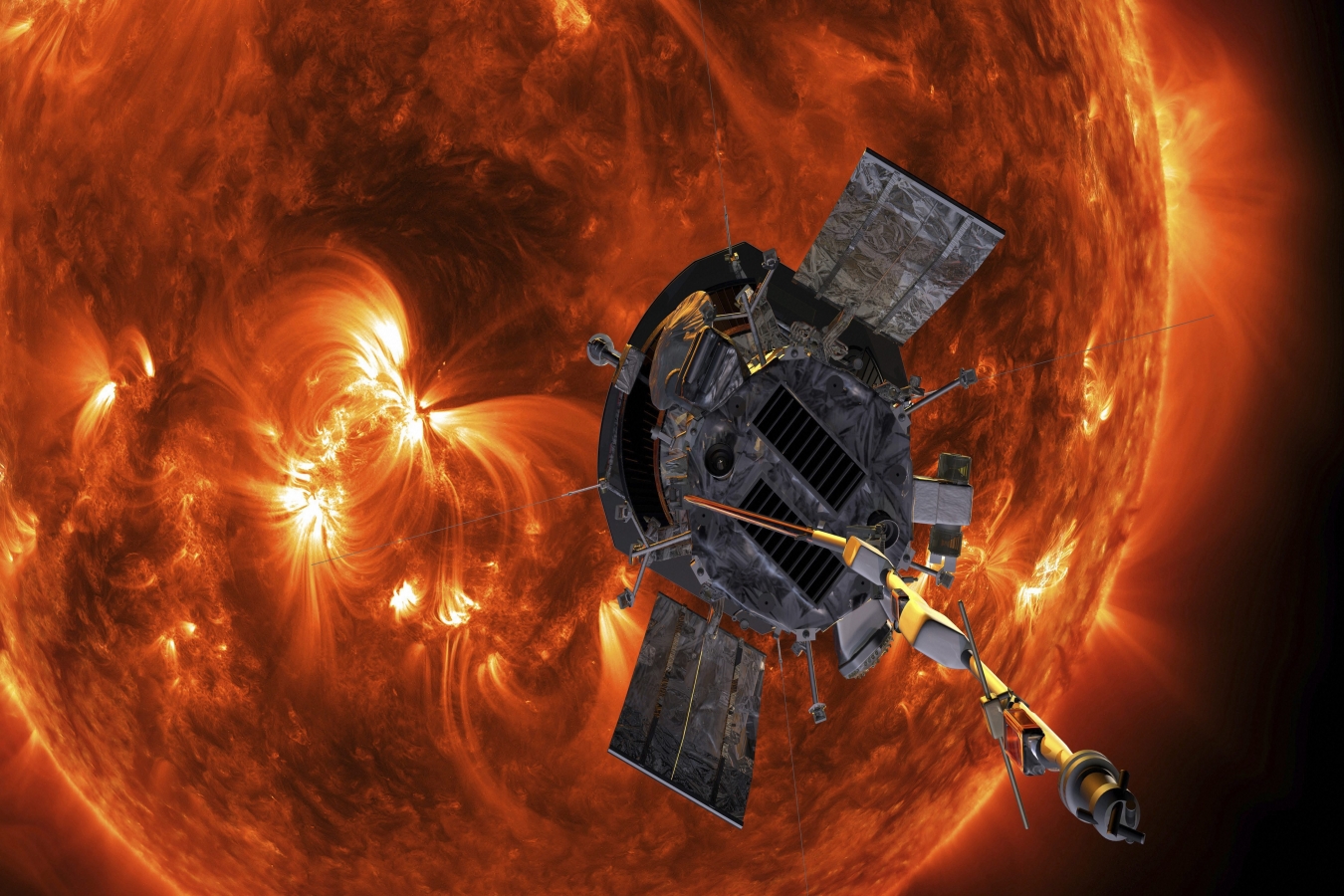
Parker Solar Probe, NASA's historic mission to solve the mysteries of the Sun, is alive and well after skimming by the Sun at just 15 million miles from its surface.
This is far closer than any spacecraft has ever gone - the previous record was set by Helios B in 1976 and broken by Parker on October 29 - and this manoeuvre has exposed the spacecraft to intense heat and solar radiation in a complex solar wind environment, NASA said in a statement on Thursday.
On November 5, the spacecraft made the closest approach, called perihelion. Parker Solar Probe reached a top speed of 213,200 miles per hour, setting a new record for spacecraft speed.
At this distance, the intense sunlight heated the Sun-facing side of Probe's heat shield, called the Thermal Protection System, to about 820 degrees Fahrenheit.
This temperature will climb up to 2,500 Fahrenheit as the spacecraft makes closer approaches to the Sun, NASA said.
"Parker Solar Probe was designed to take care of itself and its precious payload during this close approach, with no control from us on Earth - and now we know it succeeded," said Thomas Zurbuchen, Associate Administrator of NASA's Science Mission Directorate in Washington.
On November 7, mission controllers at the Johns Hopkins University Applied Physics Lab received the status beacon from the spacecraft at 4:46 pm (EST).
The beacon indicated status "A" - the best of all four possible status signals, meaning that Parker Solar Probe is operating well with all instruments running and collecting science data and, if there were any minor issues, they were resolved autonomously by the spacecraft.
"Parker is the culmination of six decades of scientific progress. Now, we have realised humanity's first close visit to our star, which will have implications not just here on Earth, but for a deeper understanding of our universe," Zurbuchen added.
Parker Solar Probe's first solar encounter phase began on October 31, and the spacecraft will continue collecting science data through the end of the solar encounter phase on November 11. It will be several weeks after the end of the solar encounter phase before the science data begins downlinking to Earth.
The spacecraft will repeatedly break its own speed record as its orbit draws closer to the star and the spacecraft travels faster and faster at perihelion, NASA said.
Reality Of Islam |
|

Keeping sil
Two experim
Changing a

Plants are
 9:3:43
2018-11-05
9:3:43
2018-11-05
10 benefits of Marriage in Islam
7:5:22
2019-04-08
benefits of reciting surat yunus, hud &
9:45:7
2018-12-24
advantages & disadvantages of divorce
11:35:12
2018-06-10
6:0:51
2018-10-16
5:58:12
2021-12-18
4:25:57
2023-02-11
10:43:56
2022-06-22
9:42:16
2022-10-19
2:33:4
2023-02-15
9:30:2
2021-11-12
2:11:12
2022-10-15
5:41:46
2023-03-18
| LATEST |
 HOME
HOME