تاريخ الرياضيات

الاعداد و نظريتها
تاريخ التحليل
تار يخ الجبر
الهندسة و التبلوجي
الرياضيات في الحضارات المختلفة
العربية
اليونانية
البابلية
الصينية
المايا
المصرية
الهندية
الرياضيات المتقطعة
المنطق
اسس الرياضيات
فلسفة الرياضيات
مواضيع عامة في المنطق
الجبر
الجبر الخطي
الجبر المجرد
الجبر البولياني
مواضيع عامة في الجبر
الضبابية
نظرية المجموعات
نظرية الزمر
نظرية الحلقات والحقول
نظرية الاعداد
نظرية الفئات
حساب المتجهات
المتتاليات-المتسلسلات
المصفوفات و نظريتها
المثلثات
الهندسة
الهندسة المستوية
الهندسة غير المستوية
مواضيع عامة في الهندسة
التفاضل و التكامل
المعادلات التفاضلية و التكاملية
معادلات تفاضلية
معادلات تكاملية
مواضيع عامة في المعادلات
التحليل
التحليل العددي
التحليل العقدي
التحليل الدالي
مواضيع عامة في التحليل
التحليل الحقيقي
التبلوجيا
نظرية الالعاب
الاحتمالات و الاحصاء
نظرية التحكم
بحوث العمليات
نظرية الكم
الشفرات
الرياضيات التطبيقية
نظريات ومبرهنات
علماء الرياضيات
500AD
500-1499
1000to1499
1500to1599
1600to1649
1650to1699
1700to1749
1750to1779
1780to1799
1800to1819
1820to1829
1830to1839
1840to1849
1850to1859
1860to1864
1865to1869
1870to1874
1875to1879
1880to1884
1885to1889
1890to1894
1895to1899
1900to1904
1905to1909
1910to1914
1915to1919
1920to1924
1925to1929
1930to1939
1940to the present
علماء الرياضيات
الرياضيات في العلوم الاخرى
بحوث و اطاريح جامعية
هل تعلم
طرائق التدريس
الرياضيات العامة
نظرية البيان

Watson,s Triple Integrals
 المؤلف:
Bailey, D. H.; Borwein, J. M.; Kapoor, V.; and Weisstein, E. W
المؤلف:
Bailey, D. H.; Borwein, J. M.; Kapoor, V.; and Weisstein, E. W
 المصدر:
"Ten Problems in Experimental Mathematics." Amer. Math. Monthly 113
المصدر:
"Ten Problems in Experimental Mathematics." Amer. Math. Monthly 113
 الجزء والصفحة:
...
الجزء والصفحة:
...
 17-9-2018
 2364
2364




+
-
20
Watson's Triple Integrals
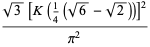
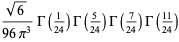
Watson (1939) considered the following three triple integrals,
 |
 |
 |
(1) |
 |
 |
 |
(2) |
 |
 |
 |
(3) |
 |
 |
 |
(4) |
 |
 |
 |
(5) |
 |
 |
 |
(6) |
 |
 |
 |
(7) |
 |
 |
 |
(8) |
 |
 |
 |
(9) |
 |
 |
 |
(10) |
 |
 |
 |
(11) |
 |
 |
 |
(12) |
 |
 |
 |
(13) |
 |
 |
 |
(14) |
(OEIS A091670, A091671, and A091672), where  is a complete elliptic integral of the first kind,
  is a Jacobi theta function, and
  is the gamma function. Analytic computation of these integrals is rather challenging, especially
  and
and  .
.
Watson (1939) treats all three integrals by making the transformations
 |
 |
 |
(15) |
 |
 |
 |
(16) |
 |
 |
 |
(17) |
regarding  ,
,  , and
, and  as Cartesian coordinates, and changing to polar coordinates,
 |
 |
 |
(18) |
 |
 |
 |
(19) |
 |
 |
 |
(20) |
after writing  .
.
Performing this transformation on  gives
gives
 |
 |
 |
(21) |
 |
 |
 |
(22) |
 |
 |
 |
(23) |
 |
 |
 |
(24) |
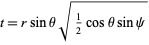
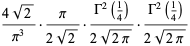
 can then be directly integrated using computer algebra, although Watson (1939) used the additional transformation
 |
(25) |
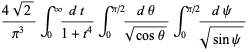
to separate the integral into
 |
 |
 |
(26) |
 |
 |
 |
(27) |
 |
 |
 |
(28) |
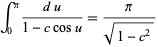
The integral  can also be done by performing one of the integrations
 |
(29) |
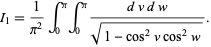
with  to obtain
 |
(30) |
Expanding using a binomial series
 |
 |
 |
(31) |
 |
 |
 |
(32) |
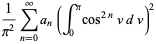
where  is a Pochhammer symbol and
 |
(33) |
Integrating gives
 |
 |
 |
(34) |
 |
 |
 |
(35) |
 |
 |
 |
(36) |
 |
 |
 |
(37) |
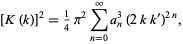
Now, as a result of the amazing identity for the complete elliptic integral of the first kind 
 |
(38) |
where  is the complementary modulus and
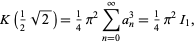
  (Watson 1908, Watson 1939), it follows immediately that with
  (i.e.,
  , the first singular value),
 |
(39) |
so
 |
 |
 |
(40) |
 |
 |
 |
(41) |
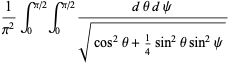
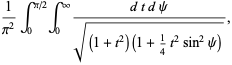
 can be transformed using the same prescription to give
 |
 |
 |
(42) |
 |
 |
 |
(43) |
 |
 |
 |
(44) |
 |
 |
 |
(45) |
 |
 |
 |
(46) |
 |
 |
 |
(47) |
where the substitution  has been made in the last step. Computer algebra can return this integral in the form of a Meijer G-function
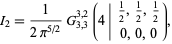 |
(48) |
but more clever treatment is needed to obtain it in a nicer form. For example, Watson (1939) notes that
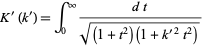 |
(49) |
immediately gives
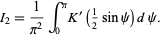 |
(50) |
However, quadrature of this integral requires very clever use of a complicated series identity for  to obtain term by term integration that can then be recombined as recognized as
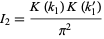 |
(51) |
(Watson 1939).
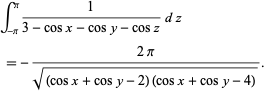
For  , only a single integration can be done analytically, namely
 |
(52) |
It can be reduced to a single infinite sum by defining  and using a binomial series expansion to write
 |
(53) |
But this can then be written as a multinomial series and plugged back in to obtain
 |
(54) |
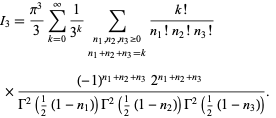
Exchanging the order of integration and summation allows the integrals to be done, leading to
 |
(55) |
Rather surprisingly, the sums over  can be done in closed form, yielding
 |
(56) |
where  is a generalized hypergeometric function. However, this sum cannot be done in closed form.
Watson (1939) transformed the integral to
 |
(57) |
However, to obtain an entirely closed form, it is necessary to do perform some analytic wizardry (see Watson 1939 for details). The fact that a closed form exists at all for this integral is therefore rather amazing.
REFERENCES:
Bailey, D. H.; Borwein, J. M.; Kapoor, V.; and Weisstein, E. W. "Ten Problems in Experimental Mathematics." Amer. Math. Monthly 113, 481-509, 2006b.
Borwein, J. and Bailey, D. Mathematics by Experiment: Plausible Reasoning in the 21st Century. Wellesley, MA: A K Peters, 2003.
Domb, C. "On Multiple Returns in the Random-Walk Problem." Proc. Cambridge Philos. Soc. 50, 586-591, 1954.
Glasser, M. L. and Zucker, I. J. "Extended Watson Integrals for the Cubic Lattices." Proc. Nat. Acad. Sci. U.S.A. 74, 1800-1801, 1977.
Joyce, G. and Zucker, I. J. "On the Evaluation of Generalized Watson Integrals." Proc. Amer. Math. Soc. 133, 71-81, 2005.
McCrea, W. H. and Whipple, F. J. W. "Random Paths in Two and Three Dimensions." Proc. Roy. Soc. Edinburgh 60, 281-298, 1940.
Sloane, N. J. A. Sequences A091670, A091671, and A091672 in "The On-Line Encyclopedia of Integer Sequences."
Watson G. N. "The Expansion of Products of Hypergeometric Functions." Quart. J. Pure Appl. Math. 39, 27-51, 1907.
Watson G. N. "A Series for the Square of the Hypergeometric Function." Quart. J. Pure Appl. Math. 40, 46-57, 1908.
Watson, G. N. "Three Triple Integrals." Quart. J. Math., Oxford Ser. 2 10, 266-276, 1939.
 الاكثر قراءة في التفاضل و التكامل
 اخر الاخبار
اخبار العتبة العباسية المقدسة

الآخبار الصحية


مواضيع ذات صلة
 قسم الشؤون الفكرية يصدر كتاباً يوثق تاريخ السدانة في العتبة العباسية المقدسة
 "المهمة".. إصدار قصصي يوثّق القصص الفائزة في مسابقة فتوى الدفاع المقدسة للقصة القصيرة
 (نوافذ).. إصدار أدبي يوثق القصص الفائزة في مسابقة الإمام العسكري (عليه السلام)