0
EN
1
المرجع الالكتروني للمعلوماتية

Grammar

Tenses

Present

Present Simple

Present Continuous

Present Perfect

Present Perfect Continuous

Past

Past Simple

Past Continuous

Past Perfect

Past Perfect Continuous

Future

Future Simple

Future Continuous

Future Perfect

Future Perfect Continuous

Parts Of Speech

Nouns

Countable and uncountable nouns

Verbal nouns

Singular and Plural nouns

Proper nouns

Nouns gender

Nouns definition

Concrete nouns

Abstract nouns

Common nouns

Collective nouns

Definition Of Nouns

Animate and Inanimate nouns

Nouns

Verbs

Stative and dynamic verbs

Finite and nonfinite verbs

To be verbs

Transitive and intransitive verbs

Auxiliary verbs

Modal verbs

Regular and irregular verbs

Action verbs

Verbs

Adverbs

Relative adverbs

Interrogative adverbs

Adverbs of time

Adverbs of place

Adverbs of reason

Adverbs of quantity

Adverbs of manner

Adverbs of frequency

Adverbs of affirmation

Adverbs

Adjectives

Quantitative adjective

Proper adjective

Possessive adjective

Numeral adjective

Interrogative adjective

Distributive adjective

Descriptive adjective

Demonstrative adjective

Pronouns

Subject pronoun

Relative pronoun

Reflexive pronoun

Reciprocal pronoun

Possessive pronoun

Personal pronoun

Interrogative pronoun

Indefinite pronoun

Emphatic pronoun

Distributive pronoun

Demonstrative pronoun

Pronouns

Pre Position

Preposition by function

Time preposition

Reason preposition

Possession preposition

Place preposition

Phrases preposition

Origin preposition

Measure preposition

Direction preposition

Contrast preposition

Agent preposition

Preposition by construction

Simple preposition

Phrase preposition

Double preposition

Compound preposition

prepositions

Conjunctions

Subordinating conjunction

Correlative conjunction

Coordinating conjunction

Conjunctive adverbs

conjunctions

Interjections

Express calling interjection

Phrases

Sentences

Clauses

Part of Speech

Grammar Rules

Passive and Active

Preference

Requests and offers

wishes

Be used to

Some and any

Could have done

Describing people

Giving advices

Possession

Comparative and superlative

Giving Reason

Making Suggestions

Apologizing

Forming questions

Since and for

Directions

Obligation

Adverbials

invitation

Articles

Imaginary condition

Zero conditional

First conditional

Second conditional

Third conditional

Reported speech

Demonstratives

Determiners

Direct and Indirect speech

Linguistics

Phonetics

Phonology

Linguistics fields

Syntax

Morphology

Semantics

pragmatics

History

Writing

Grammar

Phonetics and Phonology

Semiotics

Reading Comprehension

Elementary

Intermediate

Advanced

Teaching Methods

Teaching Strategies

Assessment

قم بتسجيل الدخول اولاً لكي يتسنى لك الاعجاب والتعليق.

Antonyms

المؤلف:  Patrick Griffiths

المصدر:  An Introduction to English Semantics And Pragmatics

الجزء والصفحة:  30-2

10-2-2022

1275

+

-

20

Antonyms

The term antonymy is sometimes employed to mean any kind of oppositeness. I follow the practice of most semanticists in applying it to one particular sort of opposition, exemplified by noisy and silent in (2.8).
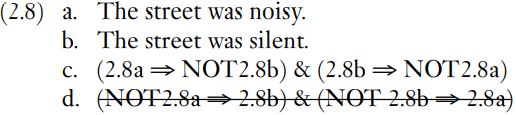
(The scoring through of 2.8d is deliberate and will be explained below.)

Antonymy is defined by a pattern of entailments such as the one in (2.8c): if we know that (2.8a) is true, then we can be sure that, with regard to the same (part of) the same street at the same time, (2.8b) is false, or equivalently that the negation of (2.8b) is true (2.8a ⇒ NOT2.8b). And if we know that (2.8b) is true, it follows – again provided that we keep the place and time constant – that the street was not noisy (NOT2.8a).

Both of the entailments shown in (2.8c) go from an affirmative sentence to a negative one. With antonym pairs, we do not get the entailments in (2.8d). They are have been scored through to indicate that they do not hold. The reason that they do not hold is because there is middle ground between what noisy denotes and what silent denotes, as I try to suggest in Figure 2.2.
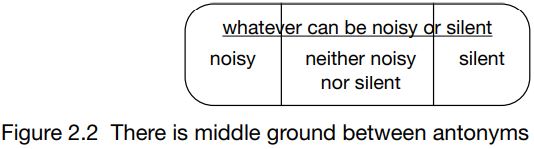
  

Imagine a complaint to the mayor that a particular street is noisy. The mayor denies this and the complainant then says “Well, it’s not silent”. The mayor can reasonably respond by saying “Agreed, but it is not noisy either”. There is a middling range of sound levels that are not loud enough to count as noisy, but that also cannot be said to be silent/noiseless.

Some other antonym pairs are listed in (2.9).
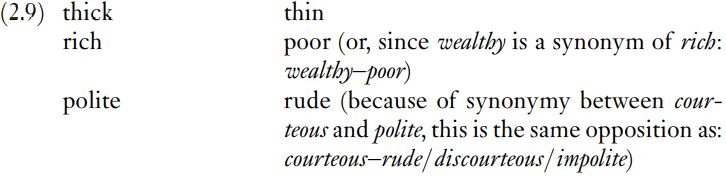
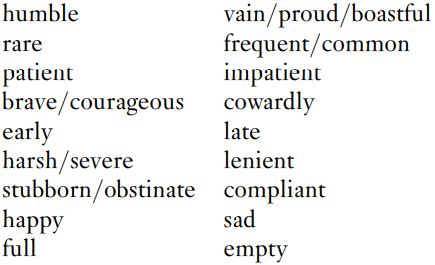
The list in (2.9) is longer than the ones given in (2.4) and (2.6). All three lists could easily be extended, but a list of antonym pairs can easily be made longer than lists of either synonyms or complementaries. The explanation for there not being all that many synonyms is that they are something of a luxury. Courteous offers the same entailments, no more and no fewer, that we get from using the word polite. Thus we could do without one of them if the transmission of information was our only concern.

Synonyms are perhaps tolerated because they allow us to speak and write expressively: varying the way we convey the same information and manipulating assonances, rhymes, alliterations and rhythms. Similar considerations make it something of a luxury to have both members of a complementary pair. Whatever information we can convey with, for instance, the word false can be can be put across by saying not true, or vice versa. However, there are considerations of perspective that make either a negative or an affirmative more appropriate in some circumstances, so we might not all that willingly give up one member of each complementary pair.


اخر الاخبار

اشترك بقناتنا على التلجرام ليصلك كل ما هو جديد