Causatives
The sentences in the left-hand column of Table 4.1 are causatives and each one entails the sentence to its right.
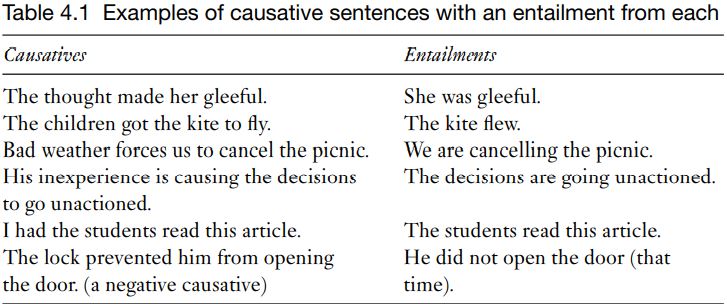
The sentences on the right in Table 4.1 have either one or two arguments (in the special sense of argument introduced above) and they describe states or events. The causatives on the left differ from the corresponding sentences on the right in several ways:
•They include a causative verb (make, get, force, cause, have, prevent in these examples).
• The subject (the thought, the children, bad weather and so on) is an extra argument – in addition to the arguments of the corresponding sentence on the right.
• The subject of the causative sentence is used to refer to whatever – human, abstract or concrete – brings about the situation described by the sentence on the right.
• The causative has an embedded clause carrying the same proposition as the sentence to its right in the table. This is most clearly seen in I had (the students read this article), where the embedded clause is in parentheses. (Even here there has been a change. Think of how read is pronounced: in the causative as /ri:d/, the untensed base form of the verb, but as a past tense verb /rεd/ in the entailed free-standing clause.)
So the meaning expressed by a causative sentence is: a situation is brought about – caused – by whatever the subject noun phrase refers to, and the caused situation is described by the embedded clause.2 For example, the person referred to as I caused the situation ‘the students read this article’ to come about.
The verb in the main clause of a causative sentence is a causative verb. Cause is arguably a superordinate for the other causative verbs in Table 4.1, for example the causative verb force can be taken to mean ‘cause an unwanted consequence’, where the hyponym’s meaning given in single quotes is the meaning of the superordinate with a modifier. It would take more space than is available here to present the case properly. But, accepting cause as the superordinate, we have the entailment pattern shown in (4.3), where X is the referent of the subject of the causative sentence and the single quotes enclose propositions – clause meanings.

Of course, the relevant details of the entailed clause need to stay the same on either side of the arrow: ‘clause’ is the same proposition both times, even if the wording changes from, for example, the kite to fly (left-hand column in Table 4.1) to The kite flew (right-hand column). (You might wonder how the two propositions can be the same, given that The kite flew is past tense, unlike the kite to fly. Past tense, matching flew, is on the verb got in The children got the kite to fly – and the embedded clause the kite to fly, falling within the scope of got, receives past tense from the main clause verb.)
The embedded clause – the one in brackets in (4.3) – is an argument of the causative verb. Semantically, causative verbs have a minimum3 of two arguments: one denoting the causer and one denoting the caused state or event. I’ll call the latter argument the embedded situation. The embedded situation itself contains arguments; for two of the examples discussed in the previous paragraphs they are the students, this article and the kite.








