

Grammar


Tenses


Present

Present Simple

Present Continuous

Present Perfect

Present Perfect Continuous


Past

Past Simple

Past Continuous

Past Perfect

Past Perfect Continuous


Future

Future Simple

Future Continuous

Future Perfect

Future Perfect Continuous


Parts Of Speech


Nouns

Countable and uncountable nouns

Verbal nouns

Singular and Plural nouns

Proper nouns

Nouns gender

Nouns definition

Concrete nouns

Abstract nouns

Common nouns

Collective nouns

Definition Of Nouns

Animate and Inanimate nouns

Nouns


Verbs

Stative and dynamic verbs

Finite and nonfinite verbs

To be verbs

Transitive and intransitive verbs

Auxiliary verbs

Modal verbs

Regular and irregular verbs

Action verbs

Verbs


Adverbs

Relative adverbs

Interrogative adverbs

Adverbs of time

Adverbs of place

Adverbs of reason

Adverbs of quantity

Adverbs of manner

Adverbs of frequency

Adverbs of affirmation

Adverbs


Adjectives

Quantitative adjective

Proper adjective

Possessive adjective

Numeral adjective

Interrogative adjective

Distributive adjective

Descriptive adjective

Demonstrative adjective


Pronouns

Subject pronoun

Relative pronoun

Reflexive pronoun

Reciprocal pronoun

Possessive pronoun

Personal pronoun

Interrogative pronoun

Indefinite pronoun

Emphatic pronoun

Distributive pronoun

Demonstrative pronoun

Pronouns


Pre Position


Preposition by function

Time preposition

Reason preposition

Possession preposition

Place preposition

Phrases preposition

Origin preposition

Measure preposition

Direction preposition

Contrast preposition

Agent preposition


Preposition by construction

Simple preposition

Phrase preposition

Double preposition

Compound preposition

prepositions


Conjunctions

Subordinating conjunction

Correlative conjunction

Coordinating conjunction

Conjunctive adverbs

conjunctions


Interjections

Express calling interjection

Phrases

Sentences


Grammar Rules

Passive and Active

Preference

Requests and offers

wishes

Be used to

Some and any

Could have done

Describing people

Giving advices

Possession

Comparative and superlative

Giving Reason

Making Suggestions

Apologizing

Forming questions

Since and for

Directions

Obligation

Adverbials

invitation

Articles

Imaginary condition

Zero conditional

First conditional

Second conditional

Third conditional

Reported speech

Demonstratives

Determiners


Linguistics

Phonetics

Phonology

Linguistics fields

Syntax

Morphology

Semantics

pragmatics

History

Writing

Grammar

Phonetics and Phonology

Semiotics


Reading Comprehension

Elementary

Intermediate

Advanced


Teaching Methods

Teaching Strategies

Assessment
Reconstructing Proto-Indo-European words
المؤلف:
P. John McWhorter
المصدر:
The Story of Human Language
الجزء والصفحة:
42-9
2024-01-11
1191
Reconstructing Proto-Indo-European words
A. Here is sister-in-law in seven Indo-European languages:
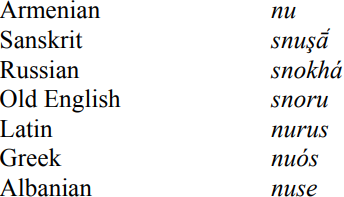
Actually, in Albanian and Armenian, the meaning of the root is now bride—semantic change is eternal.
To discover what the Proto-Indo-European word for sister-in-law was, we trace backwards. This method is called comparative reconstruction.
B. Some of the words begin with sn-, while others begin with n-. To decide whether the Proto-Indo-European word began with sn- or n-, we seek an account that squares with typical sound-change processes. Along those lines, it is more likely that several separate languages lost an s—by ordinary sound erosion—than that several separate languages somehow developed s for some reason (and always s). Thus, we know that the word began with sn-.
C. To decide whether the first vowel was an o or a u, we choose u, because more of the words have u than o. Again, it is more likely that a few words changed a u to an o than that many changed an o to a u. Thus, the first word would have begun with snu-.
D. The second consonant is a little harder to decide on. Three words—half of our set—have an s, but this is not a majority. Here, some additional information nudges us in the right direction. In many Latin words, r between vowels had begun as s. In Russian, many kh sounds trace back to s in earlier Slavic languages. This gives us a majority for s, and we can assume that the first word began with snus-.
E. The ending gives us a surprise.
1. Because sister-in-law is a feminine concept, if we are familiar with such languages as Spanish and Italian, in which -o is the masculine ending and -a the feminine one, we expect the original ending to have been -a. But Greek and Latin have -ós and -us, masculine endings, and in Armenian, when the word is given case endings, an o appears on the stem: nuo.
2. This is just three, not a majority. But then logic beckons: given that sisters-in-law are women, why would Sanskrit and Russian speakers have changed a feminine ending to a masculine one? In bizarre cases like this, we suppose that the ending must have originally been masculine and that some languages naturally “fixed” this over time and changed it to the more logical feminine ending. Thus, we have our original Proto-Indo-European word, the mysteriously cross-gender word snusos.
F. Through comparative reconstruction, then, we can know that a word that is merely nu in Albanian today began as the longer, chunkier snusos. Indo-Europeanists mark these hypothetical forms with an asterisk: *snusos.
الاكثر قراءة في Linguistics fields
اخر الاخبار
اخبار العتبة العباسية المقدسة
الآخبار الصحية

قسم الشؤون الفكرية يصدر كتاباً يوثق تاريخ السدانة في العتبة العباسية المقدسة
"المهمة".. إصدار قصصي يوثّق القصص الفائزة في مسابقة فتوى الدفاع المقدسة للقصة القصيرة
(نوافذ).. إصدار أدبي يوثق القصص الفائزة في مسابقة الإمام العسكري (عليه السلام)


