SUBJECTIVE TIME-ZERO AND VERB TENSE
It seems a reasonable proposal that events comprehended as occurring during, prior to, and after the period of perceptual observation will tend to be encoded in the present, past, and future tenses respectively. Events #21 (THE ORANGE BALL HITS THE TUBE), #22 (THE BALL HIT THE TUBE) and #23 (THE BALL WILL HIT THE TUBE) were intended to test it. Although the resulting sentences revealed some rather interesting phenomena, the main effect predicted was not as strong as anticipated. This was in part due to difficulties in engineering these time relations - eyes ‘ open ’ during actual time of contact between ball and tube, ‘open’ just after time of contact, and ‘open’ prior to, but closed just before, time of contact - and also due to the fact that, from the observers’ point of view, two verbs were involved in these demonstrations, interminal rolling and terminal hitting.
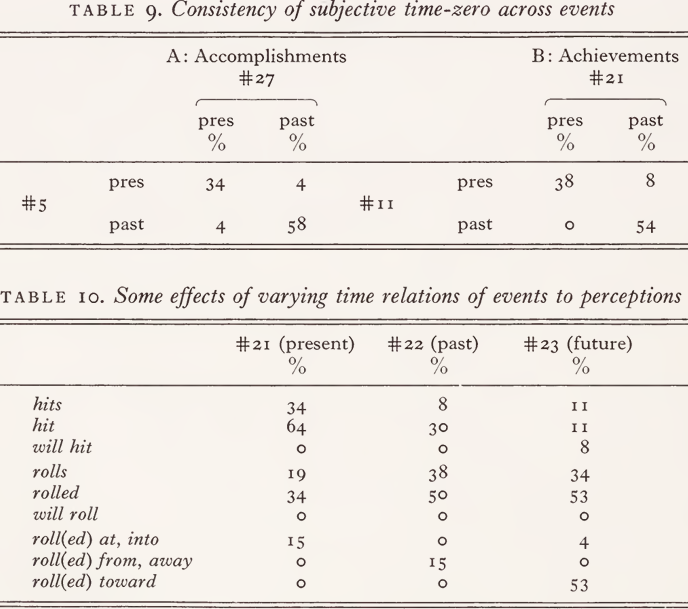
It also became evident in scanning all 32 demonstrations that there was a division between perceiving events as contemporaneous (present tense) and completed (past tense). What was not expected was that individual observer-speakers would display rather constant and characteristic ‘time-zero’ reference points. In describing terminal actions (Vendler’s ‘accomplishments’) and terminal states (Vendler’s ‘ achievements ’), some individual speakers display a characteristic ‘ set ’ for the present (subjective time-zero equals termination of the perceived event) and other speakers a ‘set’ for the past tense (subjective time-zero equals their own time of reporting the event). To test the degree of within-individual consistency in time orientation two widely separated ‘accomplishment’ events (#5, THE MAN PUTS THE BALL ON A PLATE; # 27, THE MAN TAKES SOME CHIPS) and ‘achievement’ events (# 11, A BIG ORANGE BALL IS HIT BY A BLACK BALL; #21, THE ORANGE BALL HITS THE TUBE) were examined. Table 9 gives the percentage of speakers who are consistent (present-present or past-past) or inconsistent (present-past or past-present) for the two ‘accomplishment’ events (A) and two ‘achievement’ events (B). It can be seen that the vast majority of speakers are internally consistent (92% for both types of events). Not shown here is the fact that, with very few exceptions, the same speakers who use a given tense for ‘accomplishments’ also use the same tense for ‘achievements’ i.e., time ‘sets’ are not conditioned differentially by types of events.
Using the ratio of present-to-past ‘sets’ for our speakers (approximately 40% present to 60% past), we can now ask to what extent the attempted manipulations of time orientation in events #21-23 were successful in producing deviations from this base-line. As shown in Table 10, the terminal achievement verb hit does show the predicted trends: #21 (present) has a present/past split at about the base-line; #22 (past) is biased more toward past tense (although the over-all frequency of hit goes down); and # 23 (future) shows much reduced past tense and 8% future. The interminal action verb roll shows much higher frequencies of occurrences for #22 (past) and #23 (future) - events for which contact between BALL and TUBE was not observed but much ‘ rolling ’ was - yet the ratio of present to past stays quite constant near the base-line level. Also shown in Table 10 are relative frequencies of certain prepositional phrases accompanying the verb rolled (in either present or past tense); rolling at or into occur when the event is seen, rolling from or away when it has already happened, and rolling toward when the event is anticipated. That the preposition toward carries a future orientation is evident from the 53% occurrences when the event is anticipated but not seen, and of these most were accompaniments of past-tense rolled. There appears to be semantic equivalence between will hit and rolled toward in expressing a future-orientation feature.