Combining Dem–Num–Adj with Art–Pl–N
How do these orders relate to the order of Art and Pl and N, and to the order of classifiers? I suggest that Dem, Num, and Adj are generally to be thought of as phrasal modifiers of functional projections in the DP. Demonstratives may lexicalize to D heads, and the numeral “one” in particular often seems to lexicalize as a head. Adjectival elements may also sometimes directly represent heads in the extended projection of N. But in the general case, a demonstrative can be thought of as modifying a DP, while a numeral can be thought of as modifying a PlP, and a typical adjective can be thought of as modifying an NP.
This would give an order something like Dem > Art > Num > Pl > Adj > N. The surface word order, however, is complicated by the facts of cluster formation; specifically, the tendency of heads like Pl to form a morphological cluster with N changes the linear order with respect to phrasal modifiers like adjectives. Despite such complications, a pattern like the expected one can be discerned. For example, in Rijkhoff’s (2002) balanced survey of eighty-five languages, six allow Demonstrative to cooccur with an article; in three of those, the order is as given in (1a), and in three others it is as in (1b).
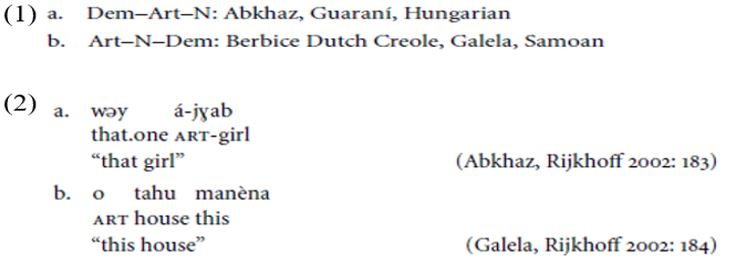
Most typically, definite articles are in complementary distribution with demonstratives. According to Rijkhoff, four of the six languages which allow cooccurrence have a “stage II” article, in the sense of Greenberg (1978), that is not associated with definiteness, but with specificity.1
However, Hungarian and Berbice Dutch Creole have definite articles which cooccur with the demonstrative.
(3)

On the basis of these observations, I conclude that demonstratives are basically higher than articles (cf. also Julien 2005), but in languages like Galela (illustrated in (2b)) the [Art–N] sequence moves to the left of the demonstrative. It remains to be investigated what drives this movement, but it might be triggered by a requirement for N–Dem adjacency.2
Similarly, the order Num > Pl can be discerned in the typological data, in that a numeral is normally further from the noun stem than is plural marking, and in those cases where it is not, as in Gungbe, there are reasons to think that movement has occurred.
The relative position of Adjectives with respect to the Art–Pl–N hierarchy is the most difficult question. Clearly, most adjectives are lower than Art; rare cases of gradable descriptive adjectives higher than articles clearly involve movement (as in how big a house, with the wh-operator how). I will return to the question of the relative order of adjectives and plural markers, but for now will assume that adjectives are ordinarily below the plural. This gives a preliminary hierarchy as follows:

The categories which I have assumed are phrasal are interleaved with the categories which I have assumed are heads.3
1 Greenberg’s four stages of the development of a demonstrative into a gender or noun marker are as follows:
(i) a. Stage 0: Demonstrative
b. Stage I: Definiteness
c. Stage II: Specificity
d. Stage III: Gender/Class or Noun Marker
2 Bruge (2002) argues that demonstratives originate low and move to SpecDP. However, this is hard to reconcile with Greenberg’s Universal 20. Most of Bruge’s arguments are equally consistent with movement of a phrasal projection of N to the left of the demonstrative. Thanks to Klaus Abels and David Adger for discussion.
3 There are interesting issues regarding head versus phrasal status of these elements; see, for example Bernstein (1993) for arguments that some attributive adjectives are heads, Svenonius (1994) for arguments that most attributive adjectives must be phrases, Sadler and Arnold (1994) for the suggestion that they must have a status in between phrase and head, and Starke (2004) for the claim that the distinction does not exist. I will continue to assume that there is a distinction and that attributive adjectives, in general, are phrasal, along with numerals (see Ionin andMatushansky 2005) and possibly demonstratives, though it seems likely that at least the latter are often recategorized as heads.








