Postnominal adjectives in English
English shows one environment where adjectives that normally occur only pronominally can occur after N. This is the so-called indefinite pronoun construction (IPC).1
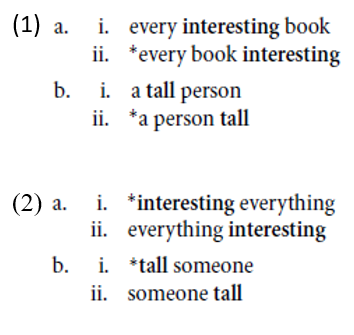
Thus adjectives like interesting and tall normally must occur prenominally (1); however, when they occur with indefinite pronouns like everything/ something/anything/nothing, everyone/someone/anyone/no one, etc., they must occur in postnominal position, as seen in (2).
Many have tried to analyze the postnominal adjectives with indefinite pronouns as prenominal adjectives that have been stranded by N-raising (3):
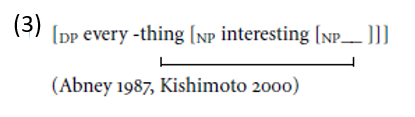
However, as Larson and Marušiˇc (2004) show, this analysis cannot be correct: adjectives in indefinite pronoun constructions do not behave like underlying prenominal adjectives, but as underlying postnominal adjectives.
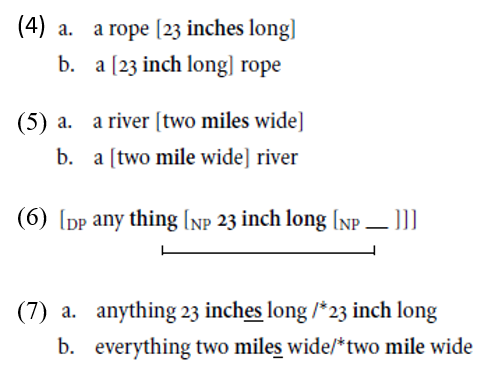
To give an illustration of the arguments, English measure adjectives show a difference in inflection when they occur pre- vs. postnominally, as noted by Sadler and Arnold (1994). In postnominal position, the unit phrase shows plural inflection (4a, 5a), whereas in prenominal position, it is uninflected (4b, 5b). If adjectives with indefinite pronouns were stranded prenominal modifiers, we would expect the inflectionless form (6). But this is not what we see. The form we get is the inflected one, characteristic of postnominal adjectives (7). This argues against the N-Raising analysis.
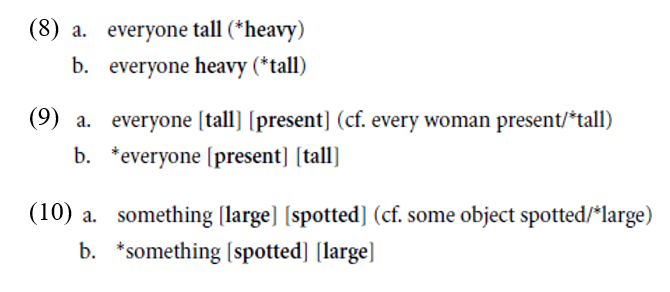
Another problem for the raising analysis concerns modifier recursion. Although indefinite pronoun constructions allow adjectives to occur postnominally that ordinarily could not occur there, only a single such form is permitted. As (8a, b) show, more than one such adjective yields ungrammaticality. Two postnominal adjectives are permitted when one of them would independently be allowed in the postnominal slot, as in (9a) and (10a), but here again there is a restriction. The adjective that is ordinarily disallowed in postnominal position must occur adjacent to the indefinite pronoun (9b, 10b).
None of this is predicted by the stranding analysis. Since adjectives stack in the prenominal position it is a mystery why two prenominal adjectives would be forbidden postnominally: the noun should just be able to raise around them (11).
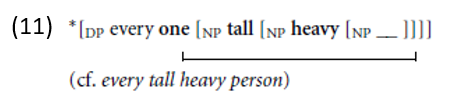
Likewise, it’s unclear why there should be any ordering restriction.
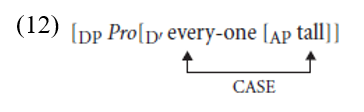
Our Case-analysis permits a surprisingly simple account, however. Suppose that a determiner’s NP restriction – its internal argument – could incorporate into it, just as verbs are known to be able to incorporate their objects. Following Baker’s (1988) analysis of object incorporation in Southern Tiwa, we might expect the determiner’s single Case feature to be “freed up” for checking on a single additional argument.
We propose that this is what is happening with APs in English IPCs. The indefinite N (-one, -thing, -place, -where) incorporates into D, freeing its single Case feature for alternative checking. Exactly one AP is then licensed in the postnominal position by the free Case feature, as displayed in (12):
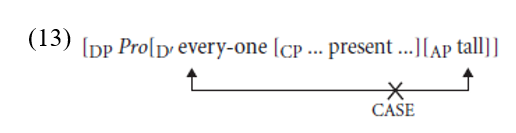
The ordering restriction we observe on the postnominal adjectives can then be understood as a version of the usual adjacency/minimality requirement on Case-checked items vis-a-vis their Case-checkers (13):2
1 The terminology “indefinite pronoun” is adopted here from the literature (see, for example, Haspelmath 1997), despite our reservations about expressions like everything and nothing being referred to as “pronouns.”
2 By contrast, postnominal modifiers that do not require case are predicted to stack freely and show no ordering restrictions.








