

Grammar


Tenses


Present

Present Simple

Present Continuous

Present Perfect

Present Perfect Continuous


Past

Past Simple

Past Continuous

Past Perfect

Past Perfect Continuous


Future

Future Simple

Future Continuous

Future Perfect

Future Perfect Continuous


Parts Of Speech


Nouns

Countable and uncountable nouns

Verbal nouns

Singular and Plural nouns

Proper nouns

Nouns gender

Nouns definition

Concrete nouns

Abstract nouns

Common nouns

Collective nouns

Definition Of Nouns

Animate and Inanimate nouns

Nouns


Verbs

Stative and dynamic verbs

Finite and nonfinite verbs

To be verbs

Transitive and intransitive verbs

Auxiliary verbs

Modal verbs

Regular and irregular verbs

Action verbs

Verbs


Adverbs

Relative adverbs

Interrogative adverbs

Adverbs of time

Adverbs of place

Adverbs of reason

Adverbs of quantity

Adverbs of manner

Adverbs of frequency

Adverbs of affirmation

Adverbs


Adjectives

Quantitative adjective

Proper adjective

Possessive adjective

Numeral adjective

Interrogative adjective

Distributive adjective

Descriptive adjective

Demonstrative adjective


Pronouns

Subject pronoun

Relative pronoun

Reflexive pronoun

Reciprocal pronoun

Possessive pronoun

Personal pronoun

Interrogative pronoun

Indefinite pronoun

Emphatic pronoun

Distributive pronoun

Demonstrative pronoun

Pronouns


Pre Position


Preposition by function

Time preposition

Reason preposition

Possession preposition

Place preposition

Phrases preposition

Origin preposition

Measure preposition

Direction preposition

Contrast preposition

Agent preposition


Preposition by construction

Simple preposition

Phrase preposition

Double preposition

Compound preposition

prepositions


Conjunctions

Subordinating conjunction

Correlative conjunction

Coordinating conjunction

Conjunctive adverbs

conjunctions


Interjections

Express calling interjection

Phrases

Sentences


Grammar Rules

Passive and Active

Preference

Requests and offers

wishes

Be used to

Some and any

Could have done

Describing people

Giving advices

Possession

Comparative and superlative

Giving Reason

Making Suggestions

Apologizing

Forming questions

Since and for

Directions

Obligation

Adverbials

invitation

Articles

Imaginary condition

Zero conditional

First conditional

Second conditional

Third conditional

Reported speech

Demonstratives

Determiners


Linguistics

Phonetics

Phonology

Linguistics fields

Syntax

Morphology

Semantics

pragmatics

History

Writing

Grammar

Phonetics and Phonology

Semiotics


Reading Comprehension

Elementary

Intermediate

Advanced


Teaching Methods

Teaching Strategies

Assessment
Polydefiniteness/D-spreading in Modern Greek
المؤلف:
RICHARD LARSON AND HIROKO YAMAKIDO
المصدر:
Adjectives and Adverbs: Syntax, Semantics, and Discourse
الجزء والصفحة:
P64-C3
2025-04-07
564
Polydefiniteness/D-spreading in Modern Greek
Like English, Modern Greek shows prenominal restrictive adjectives that cannot typically appear postnominally. This is illustrated in the contrast between (1a) and (1b).1
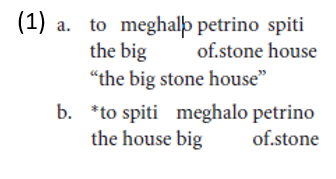
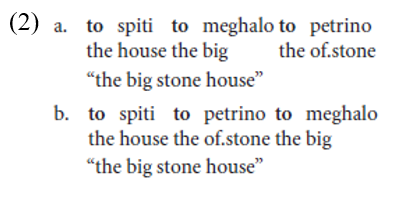
But postnominal APs can be licensed in Modern Greek definite DPs via the phenomenon of “determiner spreading,” in which the definite determiner is essentially duplicated between each of the modifiers. Thus either (2a) or (2b) is possible (Androutsopoulou 1994, 1995; Alexiadou and Wilder 1998; Kolliakou 1998; Marinis and Panagiotidis 2004).
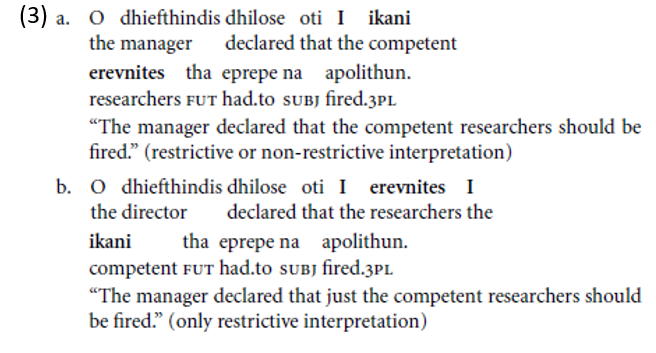
Interestingly, the possibility of D-spreading imposes at least two constraints. First, the adjective must be interpreted restrictively. Second, only intersective/ predicating as are permitted. These facts are illustrated in (3–5). In (3a) (from Marinis and Panagiotidis 2004) the prenominal A ikani ‘competent’ appearing in the boldfaced DP is interpreted either restrictively or unrestrictively. Thus DP can be understood as referring only to the competent researchers, or to all the researchers (who are understood to be competent). By contrast in (3b), with D-spreading, only the former, restrictive interpretation is available for the postnominal A.
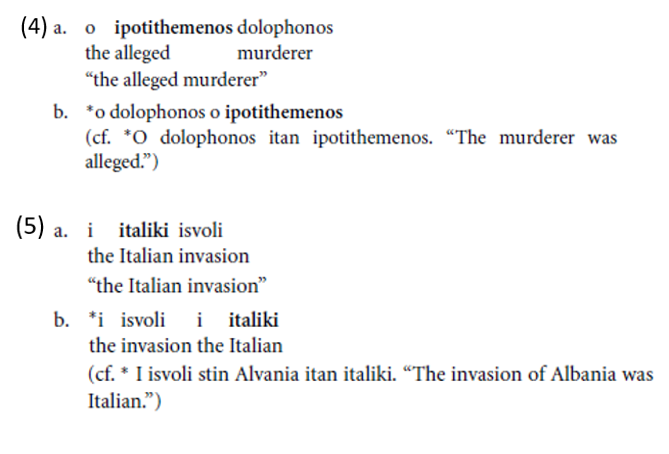
The second constraint – that only intersective/predicating as can appear – is demonstrated in (4) and (5) (from Alexiadou and Wilder 1998). (4a, b) show that the non-intersective adjective ipotithemenos ‘alleged’ can appear in prenominal position, but not in the D-spreading construction. Similarly, for (5a, b), which involve the non-predicating nationality adjective italiki ‘Italian.
The facts of Modern Greek raise simple and immediate questions: How does D-spreading license a postnominal A that would have otherwise been disallowed? And why must A be read restrictively/predicatively? Again the D-shell analysis offers an attractive answer.
On our proposal, multiple modifiers involve multiple DP-shells through which D raises recursively. Suppose that as D raised through the DP-shells, it were permitted to leave behind a copy whose formal but not semantic features were active. Assuming, as we have, that D checks the Case features on its complements, we would expect a single additional D Case to become available for each copy of D, allowing an AP to remain in situ for each copy.
We suggest that this is exactly what is happening in the Greek polyde finiteness construction. When definite D raises, it has the option of leaving copies behind (6a); this licenses exactly one AP/NP in each shell by each copied head (6b).
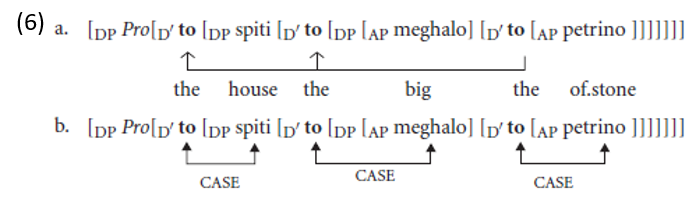
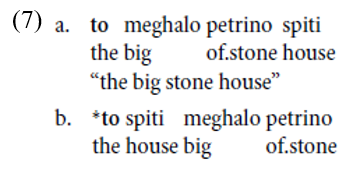
In the case where no copies are left, no Case is assigned to the APs/NPs, and they must raise (7a, b).
1 Chris Kennedy (p.c.) raises the interesting question of whether verb-copying is available for case marking in the verbal domain as well. The phenomenon of verb serialization in West African languages suggests a possible general analogy.
الاكثر قراءة في Linguistics fields
اخر الاخبار
اخبار العتبة العباسية المقدسة
الآخبار الصحية

قسم الشؤون الفكرية يصدر كتاباً يوثق تاريخ السدانة في العتبة العباسية المقدسة
"المهمة".. إصدار قصصي يوثّق القصص الفائزة في مسابقة فتوى الدفاع المقدسة للقصة القصيرة
(نوافذ).. إصدار أدبي يوثق القصص الفائزة في مسابقة الإمام العسكري (عليه السلام)


