Meaning–form correlations and adjective position in Spanish Introduction
This chapter addresses the empirical generalization in (1), which raises puzzling questions about the putative correlation between meaning and syntax.
(1) In Spanish, a language in which adjectives appear pre- and postnominally, there are systematic (although sometimes not easily describable) interpretive differences associated with the position of adjectives in the nominal domain.
These differences in meaning can be provisionally described, as is usual in descriptive grammars, as an opposition between the restrictive (R) and nonrestrictive (NR) readings of adjectives.1

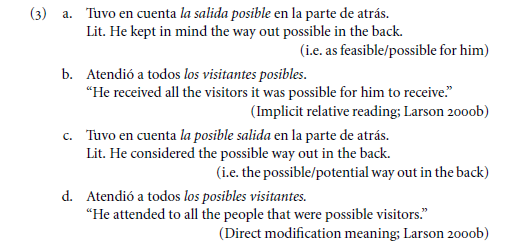
There are other oppositions cross-cutting the opposition R vs. NR, which I will consider – for the sake of argument and with the provisions below – as falling under the same general principle. Namely, I will assume, first, that modal adjectives have an “implicit relative” reading in postnominal position yet a “direct modification” reading when prenominal. In the implicit relative reading, as opposed to the direct modification reading – the distinction is Larson’s (2000a, 2000b) –, the adjective does not modify the noun directly but rather does so indirectly through an implicit relative clause. See (3):
I will also assume that non-intersective and intersective adjectives have preferred positions within DP, namely prenominal and postnominal position, respectively:

Nonetheless, this view might be controversial. While it is generally accepted that intersective adjectives occur postnominally in Romance, since they are a subclass of predicative adjectives (Knittel 2005), it is less obvious what the situation is regarding non-intersective adjectives. At first sight it appears that adjectives like bueno ‘good,’ malo ‘bad,’ or grande ‘big,’ clearly non-intersective when preceding an N (5a), can also have this reading in postnominal position: (5b) is ambiguous between the intersective and the non-intersective reading. However, if we look at a larger set of data we find that the non-intersective reading is standard in prenominal position and it survives in postnominal position mainly when the alternative reading is not possible for independent reasons.
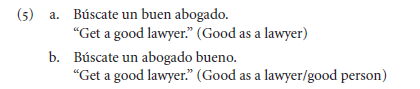
A way to dispense with these apparent problems is, first, to claim that the ambiguity in derives from the nominal and propose, following Larson 1998, that the source of the “as a” reading is a result of the modification of an event argument in NP/DP. Second, the presence of a non-intersective reading in (5b) can be considered as a singular fact, perhaps a result of displacement of the adjective for prosodic reasons (see below).
It appears, then, that to correctly depict the whole paradigm some qualifications are in order. To do this let us return to the R–NR distinction. Observe that there are examples like those in (6) in which, similarly to (5), it seems to be the case that both interpretations are allowed in postnominal position.

The conclusion that can be drawn from this set of data is that syntactic position does in fact determine semantic interpretation (Bolinger 1967; Bouchard 1998, 2002; Larson 1998, among others). Strictly speaking, in the case of the relation between nouns and modifying adjectives, there appear to be three canonical interpretations associated with three syntactic environments: R in postnominal position, NR in prenominal position and (restrictive) F in prenominal focus positions.2
In this chapter I give theoretical support to this preliminary conclusion. In the following sections, I provide evidence for the hypothesis that there is a systematic correlation (with the caveats just made) between syntactic position and logical types of adjectives. Pretheoretically speaking, the supposition I will take as a point of departure is that adjectives have a lexical meaning which contributes to their logical type, but the latter is ultimately determined configurationally.
Finally, another crucial working hypothesis is that when R or NR interpretations appear in non-canonical positions this is due to interferences from other factors, either semantic or pragmatic, external to the syntax of the noun– adjective relation.
1 I consider mainly object-denoting nouns.
2 There is also a second, right-focus position which I will consider later on.








