Adjectives and degree modification Introduction
Adjectives are often considered to be the prototypical example of a “gradable” category.1 Degree expressions such as too are restricted to adjectives and morphological comparatives, and superlatives are found for adjectives and not for other categories. This has led several linguists to assume that gradability is a distinctive property of adjectives (see, among others, Jackendoff 1977), while others rather insist on the fact that gradability is found across categories (see Bolinger 1972; Bresnan 1973; Doetjes 1997; Neeleman et al. 2004). This chapter investigates the relation between gradability and the category “adjective,” as opposed to other categories, on the basis of the distribution of degree expressions.
Even though it is clear that certain degree expressions are adjectival modifiers only, it is also clear that other degree expressions have a much broader use. Consider the paradigm in (1), which compares French trop and English too.
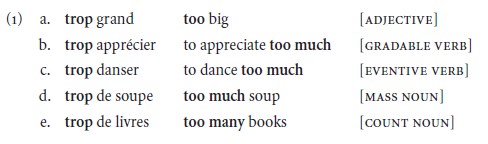
Whereas the distribution of too suggests that adjectives (1a) differ from other categories and are the only gradable ones, trop combines also with nouns and verbs, and rather suggests that adjectives are not special at all.
The tension between the distributions of trop-like expressions, on the one hand, and of those that behave like too, on the other, will be the point of departure for this chapter. I will argue that degree expressions form a continuum based on their distributions, roughly corresponding to compatibility with the categories in (1a–e). If a degree expression is compatible with category (a) it may be compatible with category (b), which is adjacent to (a) on this continuum. It cannot be compatible with an expression of the category (e), which is not adjacent to (a), unless it is compatible with all of the categories in between. For instance, there exist degree expressions that are limited to adjectives and abstract verbs (e.g. terribly), but no degree expressions that have the distribution of both too and many, as nouns and adjectives are not adjacent categories on the degree expression continuum. The continuum allows us to formulate the special relation between adjectives and gradability in a more precise way: adjectives are at one end of the continuum, and not somewhere in the middle.
It has been claimed in the literature that expressions such as English too make use of a degree variable that is part of the lexical meaning of adjectives, while other categories lack such a degree variable. The second way to look at the relation between adjectives and gradability is based on scale structure (see Kennedy and McNally 2005). Instead of claiming that adjectives are associated with scales while other categories are not, it is hypothesized that certain types of scales are typically adjectival in the sense that they are incompatible with other categories. On this view, degree expressions that typically combine with adjectives are sensitive to adjectival scales, rather than to the category adjective itself.
1 In this chapter I will not make a distinction between adjectives and those adverbs that have adjective-like behavior in the sense that they can be modified by, for instance, very (that is, for English, most of the adverbs ending in -ly, and a few other ones such as well).








