

Grammar


Tenses


Present

Present Simple

Present Continuous

Present Perfect

Present Perfect Continuous


Past

Past Simple

Past Continuous

Past Perfect

Past Perfect Continuous


Future

Future Simple

Future Continuous

Future Perfect

Future Perfect Continuous


Parts Of Speech


Nouns

Countable and uncountable nouns

Verbal nouns

Singular and Plural nouns

Proper nouns

Nouns gender

Nouns definition

Concrete nouns

Abstract nouns

Common nouns

Collective nouns

Definition Of Nouns

Animate and Inanimate nouns

Nouns


Verbs

Stative and dynamic verbs

Finite and nonfinite verbs

To be verbs

Transitive and intransitive verbs

Auxiliary verbs

Modal verbs

Regular and irregular verbs

Action verbs

Verbs


Adverbs

Relative adverbs

Interrogative adverbs

Adverbs of time

Adverbs of place

Adverbs of reason

Adverbs of quantity

Adverbs of manner

Adverbs of frequency

Adverbs of affirmation

Adverbs


Adjectives

Quantitative adjective

Proper adjective

Possessive adjective

Numeral adjective

Interrogative adjective

Distributive adjective

Descriptive adjective

Demonstrative adjective


Pronouns

Subject pronoun

Relative pronoun

Reflexive pronoun

Reciprocal pronoun

Possessive pronoun

Personal pronoun

Interrogative pronoun

Indefinite pronoun

Emphatic pronoun

Distributive pronoun

Demonstrative pronoun

Pronouns


Pre Position


Preposition by function

Time preposition

Reason preposition

Possession preposition

Place preposition

Phrases preposition

Origin preposition

Measure preposition

Direction preposition

Contrast preposition

Agent preposition


Preposition by construction

Simple preposition

Phrase preposition

Double preposition

Compound preposition

prepositions


Conjunctions

Subordinating conjunction

Correlative conjunction

Coordinating conjunction

Conjunctive adverbs

conjunctions


Interjections

Express calling interjection

Phrases

Sentences


Grammar Rules

Passive and Active

Preference

Requests and offers

wishes

Be used to

Some and any

Could have done

Describing people

Giving advices

Possession

Comparative and superlative

Giving Reason

Making Suggestions

Apologizing

Forming questions

Since and for

Directions

Obligation

Adverbials

invitation

Articles

Imaginary condition

Zero conditional

First conditional

Second conditional

Third conditional

Reported speech

Demonstratives

Determiners


Linguistics

Phonetics

Phonology

Linguistics fields

Syntax

Morphology

Semantics

pragmatics

History

Writing

Grammar

Phonetics and Phonology

Semiotics


Reading Comprehension

Elementary

Intermediate

Advanced


Teaching Methods

Teaching Strategies

Assessment
Discourse adjectives Introduction
المؤلف:
GINA TARANTO
المصدر:
Adjectives and Adverbs: Syntax, Semantics, and Discourse
الجزء والصفحة:
P305-C10
2025-04-30
1019
Discourse adjectives Introduction
This chapter introduces and provides a semantic analysis of discourse adjectives, a natural class of predicates whose members include apparent, evident, clear, and obvious in their use as propositional modifiers in sentences such as those in (1).
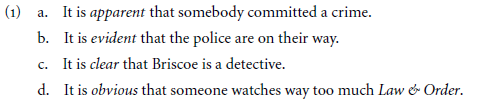
Discourse adjectives are a predicate type whose meaning is not typical of expressions in natural language. The main claim made is that discourse adjectives provide interlocutors with a way to talk about their conversation rather than their world. To illustrate, compare the sentences in (2).

Sentence (2a) is an informative sentence – it provides information about the world. Specifically, (2a) specifies that Briscoe has the property of being a detective. In contrast, sentence (2b) does not provide new information about whether or not Briscoe is a detective. Instead, the new information provided is information about the discourse itself. An utterance of (2b) makes a claim about the interlocutors’ beliefs about the proposition expressed by Briscoe is a detective – specifically, that in the current discourse situation there is sufficient evidence to conclude that Briscoe is a detective, at least to a minimum, vague standard of clarity.
The idea presented is that discourse adjectives do not add new information to the common ground in the conventional manner (Stalnaker 1978: 325; van der Sandt 1992: 367, etc.); they are an example of a predicate whose semantics carries no new descriptive content. Their function is to allow speakers to synchronize their common ground. The key elements of this analysis are an understanding of vagueness, factivity, and the interpretation of the sometimes implicit experiencer of a discourse adjective. Additionally, to represent the synchronizing effect of utterances with discourse adjectives, the analysis makes crucial use of a framework that leverages a representation of the speaker’s and Addressee’s distinct information states.
This chapter will provide a complete analysis of the semantics of sentence (2b). It is structured as follows. First, support for the claim that discourse adjectives are a natural class is provided by showing that they share a unique syntactic distribution. The syntactic distribution of discourse adjectives is contrasted with that of two other types of proposition-modifying predicates, raising adjectives and what I call attitude adjectives, which correspond in large part to emotive factive predicates (Kiparsky and Kiparsky 1971). The observation is made that discourse adjectives often give the appearance of being factive predicates, even though they ultimately fail standard diagnostics for factivity. The heart of the chapter is a case study of the semantics of clear which includes a discussion of experiencers, beliefs, and vagueness. As this case study modifies the framework proposed by Gunlogson (2001), the final section is a brief discussion of the consequences for this model.
الاكثر قراءة في Linguistics fields
اخر الاخبار
اخبار العتبة العباسية المقدسة
الآخبار الصحية

قسم الشؤون الفكرية يصدر كتاباً يوثق تاريخ السدانة في العتبة العباسية المقدسة
"المهمة".. إصدار قصصي يوثّق القصص الفائزة في مسابقة فتوى الدفاع المقدسة للقصة القصيرة
(نوافذ).. إصدار أدبي يوثق القصص الفائزة في مسابقة الإمام العسكري (عليه السلام)


