

Grammar


Tenses


Present

Present Simple

Present Continuous

Present Perfect

Present Perfect Continuous


Past

Past Simple

Past Continuous

Past Perfect

Past Perfect Continuous


Future

Future Simple

Future Continuous

Future Perfect

Future Perfect Continuous


Parts Of Speech


Nouns

Countable and uncountable nouns

Verbal nouns

Singular and Plural nouns

Proper nouns

Nouns gender

Nouns definition

Concrete nouns

Abstract nouns

Common nouns

Collective nouns

Definition Of Nouns

Animate and Inanimate nouns

Nouns


Verbs

Stative and dynamic verbs

Finite and nonfinite verbs

To be verbs

Transitive and intransitive verbs

Auxiliary verbs

Modal verbs

Regular and irregular verbs

Action verbs

Verbs


Adverbs

Relative adverbs

Interrogative adverbs

Adverbs of time

Adverbs of place

Adverbs of reason

Adverbs of quantity

Adverbs of manner

Adverbs of frequency

Adverbs of affirmation

Adverbs


Adjectives

Quantitative adjective

Proper adjective

Possessive adjective

Numeral adjective

Interrogative adjective

Distributive adjective

Descriptive adjective

Demonstrative adjective


Pronouns

Subject pronoun

Relative pronoun

Reflexive pronoun

Reciprocal pronoun

Possessive pronoun

Personal pronoun

Interrogative pronoun

Indefinite pronoun

Emphatic pronoun

Distributive pronoun

Demonstrative pronoun

Pronouns


Pre Position


Preposition by function

Time preposition

Reason preposition

Possession preposition

Place preposition

Phrases preposition

Origin preposition

Measure preposition

Direction preposition

Contrast preposition

Agent preposition


Preposition by construction

Simple preposition

Phrase preposition

Double preposition

Compound preposition

prepositions


Conjunctions

Subordinating conjunction

Correlative conjunction

Coordinating conjunction

Conjunctive adverbs

conjunctions


Interjections

Express calling interjection

Phrases

Sentences


Grammar Rules

Passive and Active

Preference

Requests and offers

wishes

Be used to

Some and any

Could have done

Describing people

Giving advices

Possession

Comparative and superlative

Giving Reason

Making Suggestions

Apologizing

Forming questions

Since and for

Directions

Obligation

Adverbials

invitation

Articles

Imaginary condition

Zero conditional

First conditional

Second conditional

Third conditional

Reported speech

Demonstratives

Determiners


Linguistics

Phonetics

Phonology

Linguistics fields

Syntax

Morphology

Semantics

pragmatics

History

Writing

Grammar

Phonetics and Phonology

Semiotics


Reading Comprehension

Elementary

Intermediate

Advanced


Teaching Methods

Teaching Strategies

Assessment
Discourse adjectives are not factive
المؤلف:
GINA TARANTO
المصدر:
Adjectives and Adverbs: Syntax, Semantics, and Discourse
الجزء والصفحة:
P308-C10
2025-05-01
1224
Discourse adjectives are not factive
Kiparsky and Kiparsky’s list of factive predicates is presented in (1), and their list of non-factive predicates is provided in (2).
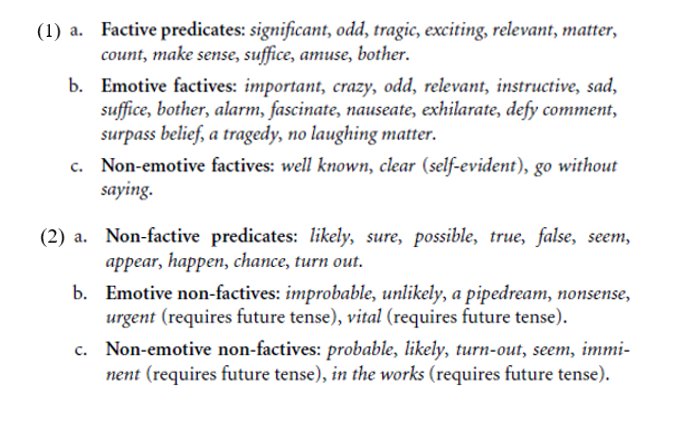
Kiparsky and Kiparsky characterize the class of factive predicates as based on presuppositions in the sense of “propositions that the speaker presupposes to be true” (1971: 147). For them, factivity depends on presupposition rather than assertion. Factive predicates presuppose the truth of their complement. That is, a sentence A presupposes a sentence B if and only if B is true whether or not A is true or false.
It is noteworthy that Kiparsky and Kiparsky categorize clear as a factive predicate. In what follows I show that clear is in fact not factive, though I admit that it has a strong flavor of factivity. Consider the pair of sentences in (3).
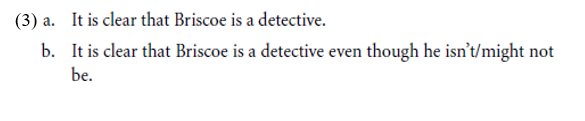
Sentence (3) seems to entail that Briscoe is a detective. That is, an initial assumption an addressee may make after hearing an utterance of (3) is that Briscoe is a detective. A standard cancellation test as applied in (3b) shows that the entailment can be canceled, indicating that clear doesn’t entail the truth of its complement proposition.
What have now become standard diagnostics for presupposition as it relates to factivity are that the presuppositions remain constant under negation and questioning. The interaction of negation with factive verbs is illustrated in (4).
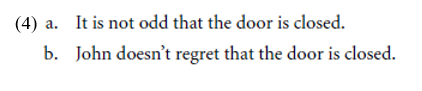
In (4), only the emotive reaction to the embedded proposition is negated. The sentences still presuppose that the embedded proposition (here, the proposition expressed by the sentence the door is closed) is true. As a result, overtly denying that the door is closed leads to a contradiction unless the utterance is meant to challenge the appropriateness of the choice of the word odd or regret in a metalinguistic use of negation (Horn 1985, 1989). As a result, overt cancellation of this proposition results in a contradiction, as shown in (5).

The presuppositions of discourse adjectives, unlike the presuppositions of true factives, do not remain constant under negation. Thus, in contrast to the sentences in (5), the sentences in (6) are not contradictory.

With respect to the constancy of presuppositions under questioning, Kiparsky and Kiparsky discuss the example in (7).

When a speaker utters (7) the conveyed meaning is not an inquiry as to whether or not the money is gone. Rather, it takes for granted that the money is gone, and questions the addresseeطs reaction to that fact. Discourse adjectives fail to pattern like true factives with respect to this diagnostic as well. Consider (8).
(8) Is it clear that our money is gone?
While it is possible to interpret a speaker’s utterance of (8) as an indication that she believes the money is gone and is inquiring about the addressee’s reaction to this fact, this is not the only reading possible. That is, (8) is indeterminate between a reading in which the speaker is questioning whether or not the money is gone, and questioning whether or not this is clear to the addressee.
الاكثر قراءة في Linguistics fields
اخر الاخبار
اخبار العتبة العباسية المقدسة
الآخبار الصحية

قسم الشؤون الفكرية يصدر كتاباً يوثق تاريخ السدانة في العتبة العباسية المقدسة
"المهمة".. إصدار قصصي يوثّق القصص الفائزة في مسابقة فتوى الدفاع المقدسة للقصة القصيرة
(نوافذ).. إصدار أدبي يوثق القصص الفائزة في مسابقة الإمام العسكري (عليه السلام)


