The interactive function of language
In our everyday social encounters, language serves an interactive function. It is not sufficient that language merely pairs forms and meanings. These form meaning pairings must be recognised by, and be accessible to, others in our community. After all, we use language in order to ‘get our ideas across’, in other words to communicate. This involves a process of transmission by the speaker, and decoding and interpretation by the hearer, processes that involve the construction of rich conceptualisations (see Figure 1.4).

The messages we choose to communicate can perform various interactive and social functions. For example, we can use language to change the way the world is, or to make things happen:

The utterance in (2a), spoken by a suitably qualified person (such as a member of the clergy licensed to perform marriages), in an appropriate setting (like a church), in the presence of two unmarried adults who consent to be joined in matrimony, has the effect of irrevocably altering the social, legal and even spiritual relationship between the two people. That is, language itself can serve as a speech act that forever alters an aspect of our reality.
Similarly, in the example in (2b), the utterance represents a command, which is also a type of speech act. Language provides a means of communication, allowing us to share our wishes and desires. Moreover, the way in which these wishes and desires are expressed signals who we are, and what kind of relationship we have with our addressee. We would be unlikely to issue a command like (2b) to the Queen of England, for example.
Another way in which language fulfils the interactive function relates to the notion of expressivity. Language is ‘loaded’, allowing us to express our thoughts and feelings about the world; consider the different mental images evoked by the following expressions, which might be used by different speakers to refer to the same individual:

While the example in (3a) focuses on the profession of the individual and her relative standing in that profession, the example in (3b) focuses on her physical appearance. Moreover, although both these sentences relate to a female linguist, the person’s gender cannot be inferred from the sentence in (3a) while it can from the second sentence due to normative patterns of linguistic behaviour and social stereoptypes. That is, we typically use the expression blonde bomb shell to describe the physical attributes of women rather than men.
Language also plays a role in how we affect other people in the world, and how we make others feel by our choice of words. That is, language can provide information about affect (emotional response):

These examples also illustrate the way in which we present our public selves through language. The language we choose to use conveys information about our attitudes concerning others, ourselves and the situations in which we find ourselves.
Language can be used to create scenes or frames of experience, indexing and even constructing a particular context (Fillmore 1982). In other words, language use can invoke frames that summon rich knowledge structures, which serve to call up and fill in background knowledge.
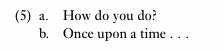
The example in (5a) creates a greeting frame, signalling an acknowledgement of another person and a recognition that this is the first time they have met. It also signals a degree of formality, which expressions like hey, what’s up? or hi would not. Analogously, the utterance in (5b) signals the beginning of a fairy tale. In other words, just by hearing or reading the expression in (5b) an entire frame is invoked, which guides how we should respond to what follows, what our expectations should be and so forth.
In summary, we’ve seen that not only does language encode particular meanings, but also that, by virtue of these meanings and the forms employed to symbolise these meanings which constitute part of shared knowledge in a particular speech community, language can serve an interactive function, facilitating and enriching communication in a number of ways.








