A typology of word structure
Position class charts work best for languages which have the following properties:
a each morpheme has a simple linear ordering relationship with all other morphemes in the same word;
b each affix expresses only one grammatical feature or category;
c all affixes which express the same grammatical category have the same ordering relationships with all other classes of morphemes.
In other words, these charts are most useful for languages in which affixes are strung together like beads on a string, and there is a one-to-one correspondence between grammatical categories and position classes. A traditional term used to refer to languages which have this type of word structure is AGGLUTINATING, suggesting that the word consists of a number of morphemes stuck together.
Obviously, this is not the situation in all languages. We will discuss several kinds of “non-linear” morphemes in Non-linear morphology. In the remainder of this topic, we will give a brief overview of the range of morphological structure found in the world’s languages.
Some languages (especially in southeast Asia) have almost no affixes. Most words consist of a single morpheme (a bare root). Such languages have traditionally been called ANALYTIC (or ISOLATING) languages.
Another type of language is the SYNTHETIC type (also referred to as FUSIONAL or INFLECTIONAL languages). In languages of this type, a single affix frequently marks several grammatical categories at once. Such affixes are sometimes called PORTMANTEAU MORPHEMES.3 A well-known example involves the Latin verbal suffixes, a small number of which are illustrated in (24).
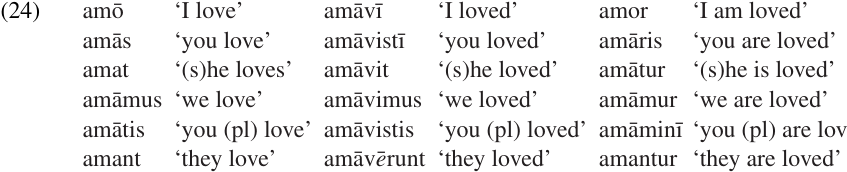
While the verbal endings contain some recurring elements, in many forms it is not possible to divide the ending into smaller morphemes which are consistently identifiable. For example, the suffix–ō in ‘I love’ expresses all of the following categories at once: tense and aspect (simple present), subject agreement (first singular), voice (active), and mood (indicative). Similarly, the suffix–(ā)minī expresses second person plural present passive indicative, all in one morpheme.
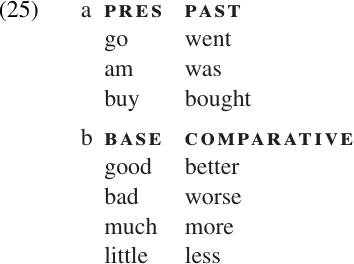
Another common pattern in synthetic (or fusional) languages is that a certain category may be expressed by SUPPLETION, i.e. a change in the form of the root, rather than by adding an affix.4 This pattern is found in the past tense forms of some English verbs (25a), and in the comparative forms of some English adjectives (25b).In a sense, the suppletive form (e.g. went) is a portmanteau morpheme expressing both the basic meaning of the root (‘go’) and one or more additional grammatical categories (‘past tense’).
A fourth type of language is the POLYSYNTHETIC type. This term is generally used to designate languages which allow the INCORPORATION of one word into another. In examples (26–27), the noun roots that express the direct object (tobacco and sweat, respectively) are morphologically part of the verb. As these examples illustrate, one word in a polysynthetic language often corresponds to a whole sentence in English.
(26) Onandaga (North America; Woodbury 1975, cited in Baker 1988:76) Waʔ-ha-yvʔkw-ahni:nu-ʔ
PAST-he/it-tobacco-buy-ASPECT
‘He bought tobacco.’
(27) Rembarrnga (Australia; Dixon 1980:223–224)
yarran-məəʔ-kuʔpi-popna-ni-yuwa
1pl. ɪo/3sg.SUBJ-might-sweat-smell-INF-along.PRES
‘It (the kangaroo) might smell our sweat along (i.e. as we try to sneak up on it).’
To summarize, we have identified four broad types of languages based on their characteristic word structures:
ANALYTIC (or ISOLATING): one morpheme per word;
AGGLUTINATING: strings of affixes, each marking a single grammatical feature;
SYNTHETIC (FUSIONAL or INFLECTIONAL): single affixes marking several grammatical categories at once (portmanteau morphemes); or suppletive forms;
POLYSYNTHETIC: long strings of affixes or incorporated roots in a single word.
These terms are of only limited value as a system for classifying languages since many languages do not fit perfectly into any one category. However, the terms do help us to recognize and describe some of the differences in word structure found between languages, or even between different types of words in the same language.
3. Portemanteau is a French word meaning ‘coat rack,’ while the English form port-manteau is used in to refer to a kind of suitcase. In linguistics, this label is intended to indicate that a single morpheme expresses several concepts at once, just as a coat rack (or a suitcase) can hold several coats at the same time.
4. See Allomorphy for a fuller discussion.








