Literal and figurative language as complex concepts
The basic assumption made by the traditional view is there are two kinds of meaning that can be straightforwardly distinguished: literal and figurative meaning. However, as Gibbs shows, there are many different kinds of literal and figurative meaning.
Definitions of literal language
Gibbs identifies a number of different definitions of literal meaning assumed within the cognitive science literature, four of which are presented in the following excerpt (Gibbs 1994: 75):
Conventional literality, in which literal usage is contrasted with poetic usage, exaggeration, embellishment, indirectness, and so on.
Nonmetaphorical literality, or directly meaningful language, in which one word (concept) is never understood in terms of a second word (or concept).
Truth conditional literality, or language that is capable of ‘fitting the world’ (that is, referring to objectively existing objects or of being objectively true or false).
Context-free literality, in which the literal meaning of an expression is its meaning [independent of any communicative situation].
We return below to examine each of these in turn, observing for the time being that there is more than one idea about what defines literality in language.
Definitions of non-literal language
Not only have different scholars assumed different definitions of literal language, there are many definitions of non-literal language. Here, we consider just a few categories of ‘non-literal’ language use: irony, zeugma and metonymy.
An expression is ironic when what is meant is the opposite of what is said. This is illustrated by the response of ‘Teenage son’ to his mother in example (1).

Zeugma is a kind of ellipsis, in which a lexical item is understood, but ‘left out’ in subsequent clauses within a sentence, and where this lexical item has a different semantic or grammatical status in each case. One consequence is that when a lexical item has more than one meaning, a different meaning can be invoked in each clause. This can result in a humorous effect, as in example (2), where two different meanings of expire are invoked:
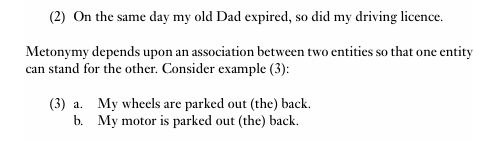
In this example, a salient component of a car, namely the wheels or the motor, can be used to refer to the car as a whole. This brief survey reveals that both ‘literal language’ and ‘non-literal (or figurative) language’ are complex concepts. We must therefore question the assumption that there are two distinct and discrete kinds of language use that can be unambiguously identified. In the next section, we focus in more detail on the question of whether literal and non-literal language are fully discrete.








