Morphological aspect
Many linguists, following Comrie (1976a), make a fundamental distinction between PERFECTIVE vs. IMPERFECTIVE aspect. Perfective aspect presents the event as a single, unanalyzable whole, ignoring the stages which make up that event. Imperfective aspect focuses in some way on the “internal structure” of the event, the process involved. Comrie notes two primary types of imperfective aspect: the PROGRESSIVE, e.g. John was working (when I entered); and the HABITUAL, e.g. John used to work here.
English does not have a specific marker for perfective aspect, but it does have a progressive form. The contrast between the simple past tense and the past progressive form can, in certain contexts, be used to illustrate the contrast between perfective vs. Imperfective aspect. The simple past in (14a) has a perfective interpretation; the event is viewed as a whole, including beginning and end, so it seems contradictory to say that it was not completed. The past progressive in (14b) has an imperfective (specifically progressive) interpretation; it refers to the “middle” of the event, whether or not the intended outcome was in fact achieved.
(14) a When I got home from the hospital, my wife wrote a letter to my doctor
(?? but she never finished it). (PERFECTIVE)
b When I got home from the hospital, my wife was writing a letter to my doctor
(but she never finished it). (IMPERFECTIVE)
Comrie (1976a) notes that Spanish has a morphological contrast between two past tense forms: the perfective (15a), traditionally referred to as the PRETERIT, and imperfective (15b). Notice that the imperfective form is ambiguous between progressive and habitual senses, as reflected in the English translation.

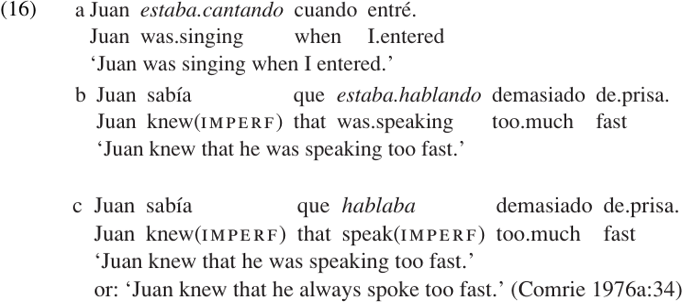
Spanish also has a specific progressive form involving the auxiliary estar; this is illustrated in (16).Again, the imperfective form in (16c) is ambiguous in a way that the progressive form (16b) is not.
When a telic predicate is expressed in the perfective aspect, it implies that the “end point” of the event was actually achieved; but with the imperfective aspect there is no such implication. In Russian, for example, where the contrast between perfective and imperfective aspect is very prominent, examples like (17) are perfectly normal (Comrie 1976a:48).

However, perfective aspect is not the same as “boundedness” or “telicity. Comrie points out that in a number of languages, phrases like for ten minutes can be used with both perfective and imperfective verbs. Both of the Spanish sentences in (18) are fully grammatical, yet there is a subtle difference between them. The perfective form (18a) is like a snapshot of the whole thirty-year period, and might be used in a summary statement. The imperfective form (18b) describes the reign as a process that went on for thirty years; at any point within that period, Don Carlos was ruling. This form might be used to introduce a more detailed, year-by-year account of the reign.

Inherently stative predicates may be more naturally expressed in the imperfective. The normal way to express the past tense of the Spanish verb meaning ‘to know’ is in the imperfective, as in (16b, c) and (19a). The perfective aspect (19b) would give the predicate an eventive meaning, in this case ‘came to know.’ As noted above, states cannot normally be expressed in the progressive (19c).

English, unlike Spanish, has two distinct imperfective forms in the past tense, progressive vs. habitual; and the progressive form does not allow a habitual interpretation (20).
(20) When we were in high-school, John used to swallow /*was swallowing goldfish.
Comrie (1976a:27–28) states that HABITUAL aspect describes a recur ring event or ongoing state which is a characteristic property of a certain period of time. Clearly there is no hard and fast rule as to how often an event must occur in order for it to be considered “characteristic” of the time period being discussed. But some sense of what this means can be seen in the contrast between (21) and (22). If Mary uses the habitual form in (21), John seems justified in objecting on the grounds that the action being described only happened a few times. On the other hand, if Mary uses the simple past as in (22), the same objection seems illogical.
(21) Mary: “When we were in high-school, John used to swallow goldfish to frighten the teachers.”
John: “Don’t exaggerate, I only did it a few times.”
(22) Mary: “When we were in high-school, John swallowed goldfish to frighten the teachers.”
John: #?“Don’t exaggerate, I only did it a few times.”
Another type of imperfective aspect is the ITERATIVE (or REPETITIVE), which is used in some languages to refer to events which occur repeatedly (keep on X-ing). Such forms are often translated into English using phrases like over and over, more and more, here and there, etc.
Some languages have a special aspectual category, the INCEPTIVE, for referring to the beginning of a situation (e.g. about to X, on the point of X ing). The term INCHOATIVE is sometimes used in the same way, but more often this term refers to a change of state or entering a state (to become X; e.g. get fat, get old, get rich). A number of languages have inchoative affixes which derive change of state verbs from stative verbs or adjectives. Finally, the COMPLETIVE aspect is used to describe an event which has been completed. Such forms are often translated into English using phrases like he finished X-ing.
A number of other aspectual distinctions are marked in particular languages, but we will not list any more of them here. Instead, let us turn our attention to the PERFECT, which is often classified as an aspect but in some ways functions more like a tense.








