Stems, roots, and compounds
We discussed the difference between two different kinds of morphemes, namely roots and affixes. All of the words in example (1) in "Derivational morphology" share the same root, namely the morpheme believe. But we have suggested that some forms which contain this root (those in (1a)) belong to the same lexeme, while others (1b) do not. It is often helpful to be able to refer to the portion of a word which all forms of a given lexeme have in common. This unit is generally called the STEM.
A stem is the part of a word that contains no inflectional morphology; it consists of the root plus any derivational morphology. So, while a root is always a single morpheme (by definition, a morpheme which is not an affix), a stem may consist of one or more morphemes. If a given word contains both derivational and inflectional morphology, then the root, stem, and word are all different (2a). If a word contains no inflectional morphology, then the stem and word are the same (2b). If a word contains no affixation at all, then the root, stem and word are all the same (2c).
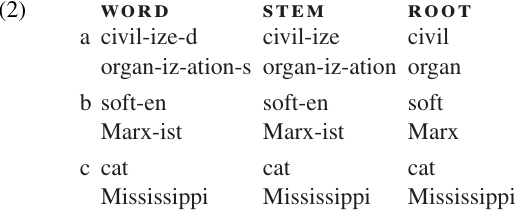
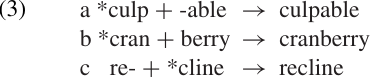
A root or stem is called BOUND if it cannot occur on its own without additional affixation; a FREE form is one that can occur as an independent word. In English, because there is relatively little inflectional morphology, most roots and stems are free, as illustrated in (2). Some examples which could be analyzed as bound roots are presented in (3).
A stem which contains more than one root is called a COMPOUND. Compounding can be considered a special type of derivational morphology.1 At times, it can be difficult to distinguish a compound word (a word containing a compound stem) from a phrase (i.e. a group of two or more independent words). Some of the criteria which can help us to identify compounds include the following:
(i) A compound word normally contains only one main stress. In a phrase, however, each word may contain its own stress. (Note that English spelling is not always a reliable guide.)
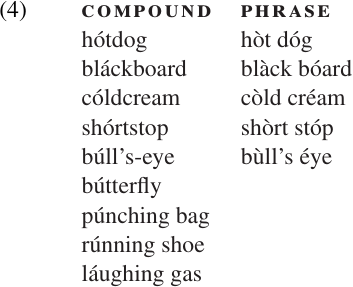
(ii) The original meanings of the roots may be lost in a compound. For example, a hotdog is not a dog, and it can be cold (or even frozen); a blackboard might be green; etc. But in a phrase, each word retains its original meaning; so, a hot dog must be both hot and a dog.
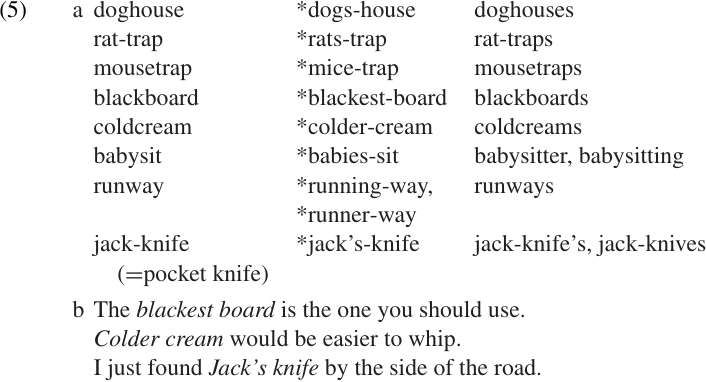
(iii) In a phrase, each individual word can take its normal range of affixes (5b). However, it is generally not possible to add extra suffixes to the first root of a compound in English, but only to the compound as a whole (5a).2
(iv) Words in a phrase can often be separated by inserting one or more other words between them. This is never possible with compounds. When any other word separates the two elements in the compound, the compound sense is lost, as illustrated in (6).
(6) a I watched a butterfly out the window.
I watched my butter suddenly fly out the window.
b I’ll have a skinless hotdog with mustard and onion.
I’ll have a hot, skinless dog with mustard and onion.
1. Some scholars prefer to treat compounding and derivational morphology as two different types of WORD FORMATION. We will not distinguish between word formation and derivation.
2. There are a few exceptional cases in English, such as brothers-in-law, passers-by, hangers-on, attorneys general, etc.








