Allomorphy
In most languages there are certain morphemes which appear in different forms depending on their environment. A familiar example of this is the indefinite article in English:
(1) a dog an apple
a man anorchid
a bus an elephant
a ticket an umbrella
In this case it is easy to predict which form of the article will occur in any given context: we always find an before vowels and a before consonants. In other words, the form of the article depends entirely on the phonological shape of the word which follows it. A similar example is the Korean nominative case marker:
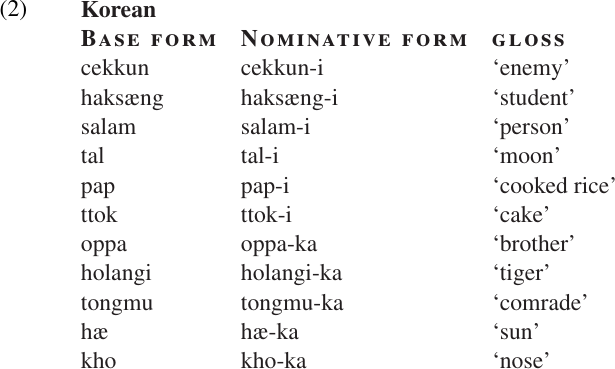
Once again, it is easy to predict which form of the case marker will be used simply by observing the phonological shape of the noun. The form-ka is found whenever the noun ends in a vowel, while-i is found whenever the noun ends in a consonant.
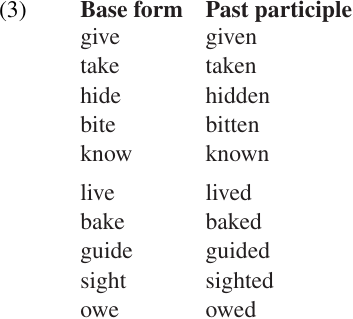
In other cases, however, it is not so easy to predict which form will occur. Consider the past participle suffixes of the following English verbs. Some verbs take-ed while others take–en; but as the list in (3) demonstrates, there is no phonological basis for predicting which suffix any particular verb will take:
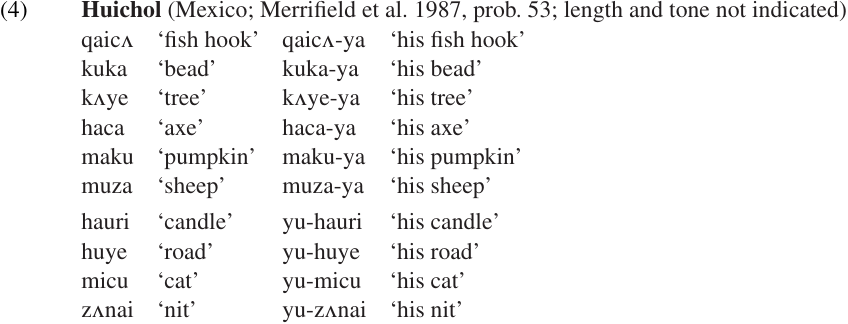
A similar pattern can be seen in the Huichol possessive markers in (4). Once again there appears to be no way to predict, based on either phonological patterns or semantic features, which form of the possessive marker will occur with which stem. Some nouns take the suffix-ya while others take the prefix yu-, but the choice seems to be quite arbitrary. A language learner would simply have to memorize which nouns take which form on a case-by-case basis.
All these examples have two important features in common. In every case, the variant forms (a) have the same meaning, and (b) are in complementary distribution, i.e. never occur in the same environments. It is these two factors which allow us to identify them as variant forms of the same morpheme, rather than two different morphemes.
Variant forms of the same morpheme are called ALLOMORPHS. If the choice of which allomorph occurs in which environment is predictable on the basis of phonological patterns, as in (1–2), the alternation is said to be PHONOLOGICALLY CONDITIONED. If the choice of allomorph is essentially arbitrary and must be learned on a word-by-word basis, as in examples (3–4), the alternation is said to be LEXICALLY CONDITIONED.
Phonologically conditioned allomorphy may be of two basic types. If the change in form is the result of a phonological process, that process is said to be MORPHOPHONEMIC.1 A process in which one allomorph simply replaces another– that is, a change in form that cannot be described as a phonological process– is referred to as SUPPLETION. We will consider each of these possibilities in turn, beginning with suppletion.
1. We are ignoring simple allophonic variation.








