Rules for suppletive allomorphy
Linguists have expended a great deal of effort trying to develop precise formal notations for writing phonological rules, and a certain amount of consensus has emerged; but there is less agreement as to how rules of suppletive allomorphy should be written. For our purposes the exact form of the rule is not so important, but it must be stated clearly and precisely. It is always good practice to state any rule twice, once in prose and once in some more precise type of notation. A possible format for writing suppletive rules is illustrated below.
We have identified the alternation in the form of the Korean nominative marker as a case of phonologically conditioned suppletion: one allomorph replaced by another in a specific phonological environment. In addition to describing the alternation in prose, we need some kind of formal rule to make our description more precise. One possibility is shown in (13).

In this rule, one allomorph is chosen as the basic form or label for the morpheme. This form is shown in braces {xx} on the left side of the rule, with the phonemic form of each specific allomorph listed on the right side. The “+” in the environment on the right side indicates a morpheme boundary. The rule in (13) can be interpreted as follows: “the suffix {-ka} is realized as /-i/ when it attaches to a stem ending in a consonant, but as /-ka/ when it attaches to a stem ending in a vowel.”
A possible variation of this format would be to use a grammatical category, e.g. NOMINATIVE, as the label for the morpheme, rather than a phonological form. This is illustrated in (14).

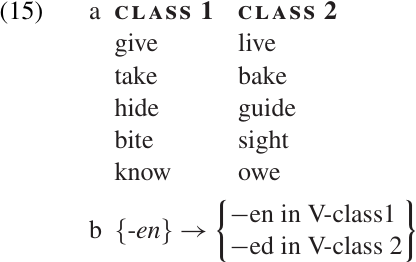
As an example of lexically conditioned affix suppletion, let us return to the English past participle suffixes illustrated in (3). We will refer to the set of verbs that take the–en allomorph as “class 1” and the set of verbs that take the–ed allomorph as “class 2.” (For simplicity, let us assume that these two classes are all that we need to deal with.) The lexical entry for each verb in English will have to contain a feature showing which class it belongs to. The rule of allomorphy specifies which allomorph will be chosen based on which of these features is found in the lexical entry. A simple way of writing such a rule is shown in (15b).