Inflectional classes
Our analysis of the English past participle forms in (15) in "Rules for suppletive allomorphy" illustrates how a lexical category, e.g. Verb, can be divided into subclasses on the basis of suppletive allomorphy. When an affix has a limited number of allomorphs (in this case–en vs. –ed), and the choice of allomorph is lexically conditioned, we can classify words according to the allomorph they select. The lexical entry for each word in that category must include a feature that shows which subclass the word belongs to. A similar example was presented in (4), where we discovered that there are (at least) two distinct classes of nouns in Huichol: those that take-ya vs. those that take yu-.
Now consider the data in (16). It is clear that the markers for singular and plural number in Wali have several different allomorphs, and there seems to be no phonological pattern that would allow us to predict which allomorph will occur with which stem. The lexical entry for each common noun must include a feature that shows which form of the number markers that noun requires. These features will divide the set of common nouns into several different sub-classes: [N-class 1], [N-class 2], etc. Since sub-classes of this kind are based on shared patterns of allomorphy involving inflectional affixes, they are often referred to as INFLECTIONAL CLASSEs.
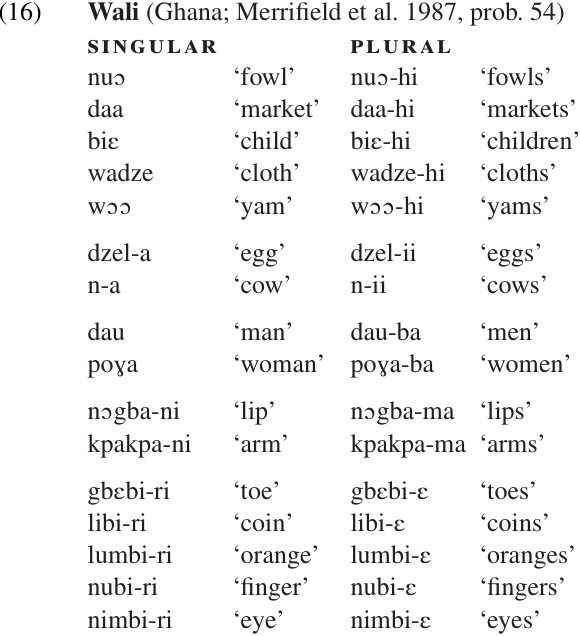
In traditional grammar, inflectional sub-classes of nouns are often referred to as DECLENSIONS; for verbs, inflectional sub-classes are called CONJUGATIONS. These labels are used especially when the sub classification determines not just the choice of allomorph for a single morpheme, but the allomorphs for an entire paradigm set.
Latin nouns are inflected for case and number, with both of these categories being marked by a single portmanteau suffix. The suffix which marks a particular combination of case and number, e.g. dative plural, can appear in several different forms (or allomorphs), and the distribution of these allomorphs is lexically conditioned. Each Latin noun can be assigned to one of five distinct sub-classes, or declensions, depending on the set of inflectional allomorphs which attach to that particular stem. Three of these declensions are illustrated in (17); for simplicity, only the singular paradigms are listed.
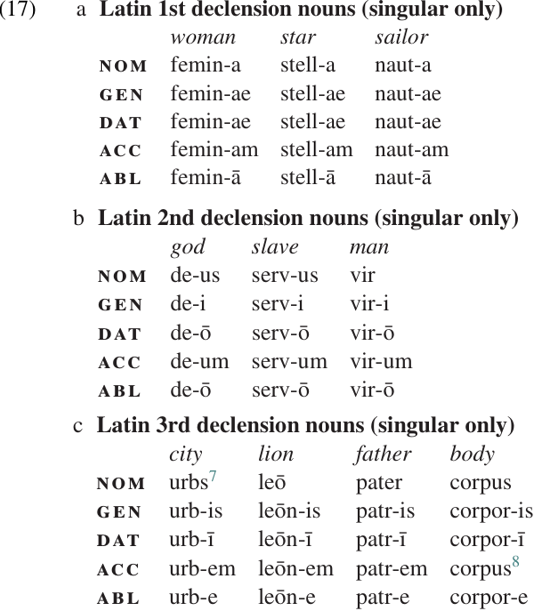
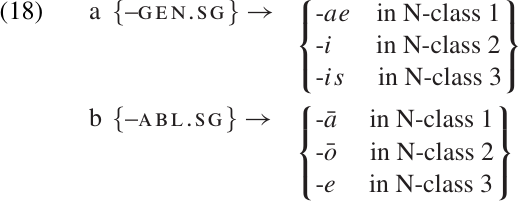
Each of the suffixes in this paradigm (i.e. each case-number marker) would have its own rule of allomorphy, conditioned by the declension class of the noun. Two sample rules are presented in (18).
It is important to distinguish inflectional classes like those illustrated in (15–17) from the gender classes. Inflectional classes are determined by patterns of allomorphy appearing on the noun itself. Gender classes are determined by patterns of agreement observed in words which co-occur with the noun: modifiers, determiners, verbs, etc. So, we may find two nouns of the same gender appearing in different inflectional classes, and nouns belonging to the same inflectional class which have different genders. The Latin 3rd declension, for example, includes nouns of all three genders. In (17c), leō ‘lion’ and pater ‘father’ are masculine; urbs ‘city’ is feminine; and corpus ‘body’ is neuter. The gender of these nouns is reflected in the form of their modifiers, as seen in leō magnus ‘large lion,’ urbs magna ‘large city,’ corpus magnum ‘large body’ (all in the nominative singular).
7. Rene̒ van den Berg has pointed out to me that the-s in urbs preserves the old nominative case marker.
8. Neuter 3rd declension nouns do not take the–em suffix.








