Allomorphy Conclusion
We have identified two basic types of allomorphy: morphophonemic change, in which the shape of a morpheme is altered by some phonological process; and suppletion, in which there is no regular phono logical relationship between the two allomorphs. Suppletion may occur in roots or affixes, and is generally used to mark inflectional categories (tense, person, number, etc.), rather than derivational processes.
In the case of root suppletion, all of the suppletive forms must simply be listed in the lexical entry of the root. Affix suppletion, in contrast, can be described by rules like those illustrated in (13–15) and (18). These rules may be conditioned by the phonological shape, morphological structure, or lexical sub-class of the stem. When the suppletion is lexically conditioned, the lexical entry for each stem of the relevant category must include a class feature (e.g. [N-class 1], [N-class 2], etc.). These class features divide the words within that category into sub-classes, based on the allomorphs which appear on each word. In the case of nouns, it is important to remember that these inflectional classes may be different from the gender classes in the same language, which are determined on the basis of agreement patterns.
These different types of allomorphy are summarized in (19), which is adapted from Bickford (1998:163). This tree shows a logical way of classifying the various patterns of allomorphy, but it does not necessarily match the procedural order we would follow in analyzing a particular pattern.
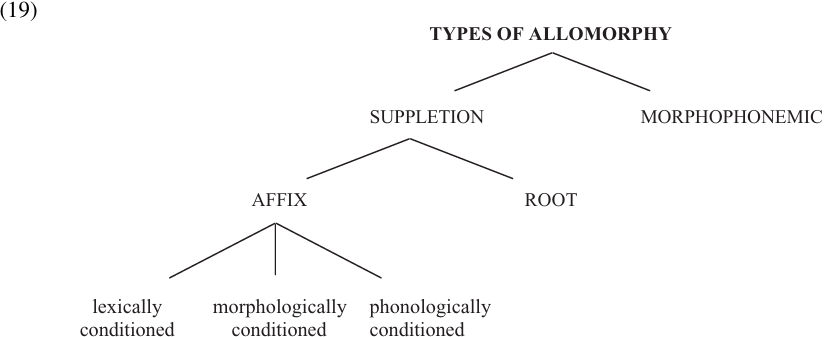
When we set out to analyze the patterns of allomorphy in a body of data, the first step is normally to observe which morphemes appear in more than one form. This will include noticing whether alternations occur in roots or affixes. The second step is (typically) to look for a phonological conditioning environment. If the choice of allomorph is predictable on phonological grounds, we need to decide whether it is best analyzed as a morphophonemic process, or as a case of phonologically conditioned suppletion. If the choice of allomorph is not phonologically predictable, there are two basic options. Suppletive forms of the same root will be listed in the lexical entry of that root; suppletive forms of an affix will be related by a rule which refers to lexical sub-classes of the words which bear that affix, as discussed above.








