Non-linear sequencing of affixes
Infixation
As mentioned above, an INFIX is an affix that is added inside another morpheme. Two well-known examples are found in Tagalog: the realis marker-in-, mentioned above; and the Active Voice marker-um-. Cognate forms occur in Kimaragang Dusun, with slightly different functions. (3a) shows the use of the past tense marker–in– with transitive roots in the passive voice, while (3b) shows the use of both infixes within transitive roots. Another example is the plural marker on Oaxaca Chontal nouns (4).
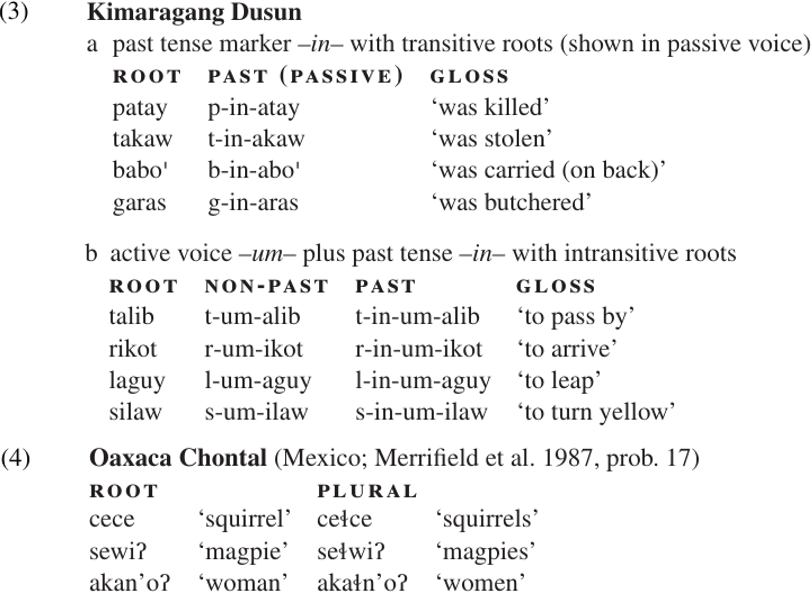
In analyzing and describing an infix, it is crucial to specify precisely where the infix occurs. Usually, the point of insertion will be one phonological unit (e.g. one phoneme or syllable) from an edge (beginning or end) of the stem. In the Tagalog and Kimaragang examples, the infixes are inserted immediately after the initial consonant. In the Chontal example (4), the infix is inserted immediately before the final syllable.
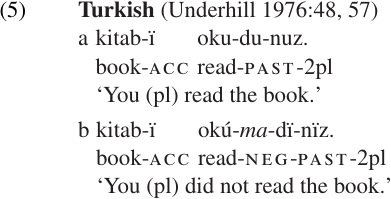
It is also important to remember that the term “infix” cannot be applied to every affix that occurs in the middle of a word. It refers specifically to an affix which is inserted inside another morpheme. Many languages allow long strings of affixes, but as long as they occur one after another, rather than one inside another, none of them would be called infixes. For example, consider the negative marker in (5b). If we compare the negative verb in (5b) with the corresponding positive form in (5a), we could say that the negative affix gets inserted in the middle of the word. However, it does not occur inside another morpheme, but between the root and its suffixes; so, it is not an infix, but just another suffix.
Typically, infixes are inserted into the root, but they may also occur inside other affixes as in the following Kimaragang examples: root omot‘ to harvest (rice),’ active transitive mong-omot, past tense m[in]ong-omot ‘harvested’; root talib ‘pass by’, causative pa-talib, past tense p[in]a-talib ‘allowed (someone) to pass.’








