0
EN
1
المرجع الالكتروني للمعلوماتية

Grammar

Tenses

Present

Present Simple

Present Continuous

Present Perfect

Present Perfect Continuous

Past

Past Simple

Past Continuous

Past Perfect

Past Perfect Continuous

Future

Future Simple

Future Continuous

Future Perfect

Future Perfect Continuous

Parts Of Speech

Nouns

Countable and uncountable nouns

Verbal nouns

Singular and Plural nouns

Proper nouns

Nouns gender

Nouns definition

Concrete nouns

Abstract nouns

Common nouns

Collective nouns

Definition Of Nouns

Animate and Inanimate nouns

Nouns

Verbs

Stative and dynamic verbs

Finite and nonfinite verbs

To be verbs

Transitive and intransitive verbs

Auxiliary verbs

Modal verbs

Regular and irregular verbs

Action verbs

Verbs

Adverbs

Relative adverbs

Interrogative adverbs

Adverbs of time

Adverbs of place

Adverbs of reason

Adverbs of quantity

Adverbs of manner

Adverbs of frequency

Adverbs of affirmation

Adverbs

Adjectives

Quantitative adjective

Proper adjective

Possessive adjective

Numeral adjective

Interrogative adjective

Distributive adjective

Descriptive adjective

Demonstrative adjective

Pronouns

Subject pronoun

Relative pronoun

Reflexive pronoun

Reciprocal pronoun

Possessive pronoun

Personal pronoun

Interrogative pronoun

Indefinite pronoun

Emphatic pronoun

Distributive pronoun

Demonstrative pronoun

Pronouns

Pre Position

Preposition by function

Time preposition

Reason preposition

Possession preposition

Place preposition

Phrases preposition

Origin preposition

Measure preposition

Direction preposition

Contrast preposition

Agent preposition

Preposition by construction

Simple preposition

Phrase preposition

Double preposition

Compound preposition

prepositions

Conjunctions

Subordinating conjunction

Correlative conjunction

Coordinating conjunction

Conjunctive adverbs

conjunctions

Interjections

Express calling interjection

Phrases

Sentences

Clauses

Part of Speech

Grammar Rules

Passive and Active

Preference

Requests and offers

wishes

Be used to

Some and any

Could have done

Describing people

Giving advices

Possession

Comparative and superlative

Giving Reason

Making Suggestions

Apologizing

Forming questions

Since and for

Directions

Obligation

Adverbials

invitation

Articles

Imaginary condition

Zero conditional

First conditional

Second conditional

Third conditional

Reported speech

Demonstratives

Determiners

Direct and Indirect speech

Linguistics

Phonetics

Phonology

Linguistics fields

Syntax

Morphology

Semantics

pragmatics

History

Writing

Grammar

Phonetics and Phonology

Semiotics

Reading Comprehension

Elementary

Intermediate

Advanced

Teaching Methods

Teaching Strategies

Assessment

قم بتسجيل الدخول اولاً لكي يتسنى لك الاعجاب والتعليق.

Circumfixes and other discontinuous morphemes

المؤلف:  PAUL R. KROEGER

المصدر:  Analyzing Grammar An Introduction

الجزء والصفحة:  P307-C16

2026-02-09

673

+

-

20

Circumfixes and other discontinuous morphemes

A CIRCUMFIX is a discontinuous affix, with elements added both before and after the stem, as illustrated from Malay in (2) and Basari in (6). Nouns in Basari carry markers that indicate their noun class and number (singular vs. plural). Some of these markers are circumfixes:
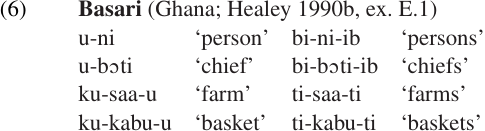
 

A circumfix is often described as a combination of a prefix plus a suffix. But if both the prefix and suffix elements exist in the language as independent affixes, and if the meaning of the combined form is predictable from the independent meanings of the prefix and suffix, then the combination would not be regarded as a circumfix. The two parts of a circumfix must function as a single unit, both semantically and morphologically.


For example, the Malay circumfix illustrated in (2) consists of two parts, ke-and-an. The second of these elements, -an, does occur on its own as a suffix; it is relatively productive and has a variety of uses. The prefix ke-, however, is not productive and occurs only in a small number of frozen forms. Moreover, the meaning of the nominalizer ke- . . .-an cannot be derived from the meanings of its two component parts on their own. That is why the combination is considered to be a single affix, i.e. a circumfix.


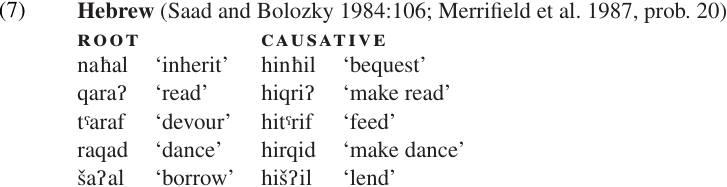
Circumfixes are a fairly common type of discontinuous morpheme, but there are other types as well. A frequently cited example is the complex pattern of morphology in Semitic languages, in which the root consists only of consonants, while the vowels and syllable patterns are determined by derivational and inflectional processes.
 

اخر الاخبار

اشترك بقناتنا على التلجرام ليصلك كل ما هو جديد


