Inflectional rules
The phenomena seem to raise problems for the Item and Arrangement (IA) model of morphology. It is not easy to see (at first glance) how infixes, circumfixes, suprafixes, mutation, reduplication, metathesis, and subtraction can be adequately represented using only linear sequences of morphemes. As we stated, recent developments in phonological theory do, in fact, provide ways of handling many of these processes as kinds of affixation, though whether this is the best analysis remains a hotly debated issue. In any case, such analyses require a more sophisticated knowledge of phonology than we can assume, so we will not attempt to discuss them here.
Our immediate goal is to provide a way of describing non-linear morphological processes as part of a basic grammatical description. For this purpose, we will adopt an approach closer to the Item and Process (IP) model. In a sense, such an approach is already built into our format for writing Word Formation Rules. The phonological change involved in the derivation need not be simple affixation. We could write a rule for the Malay circumfix in (2) as follows:

But WFRs are designed to represent only derivational processes. As we have seen, non-linear morphological processes may be used to mark either inflection or derivation, so we need a different kind of rule to handle the inflectional cases. Until now we have been assuming that inflectional morphology can be represented in a position class chart, but the processes we have discussed are precisely those for which such a chart is likely to be inadequate.
Inflectional morphology is used to mark grammatical features such as tense, person, case, etc. Some linguists assume that these features are added to the stem by a special type of syntactic rule, based on the word’s syntactic environment. Under this approach, the presence of the feature would trigger an inflectional rule to produce the correct word form, whether by adding an affix or by some other process.
We will adopt a slightly different approach here. Let us assume that the inflectional rules themselves introduce the grammatical features and at the same time modify the phonological shape of the base in some way. The inflected forms produced by these rules are then available for lexical insertion whenever their grammatical features are compatible with the syntactic context.
Let us consider some concrete examples, without trying to provide a completely rigorous system for writing such rules. The first-person possessive morpheme in Terena (10) could be represented roughly as in (17). This rule is intended to describe a process which: (i) nasalizes all the vowels in the word; and (ii) adds the grammatical feature [1st pers. poss].

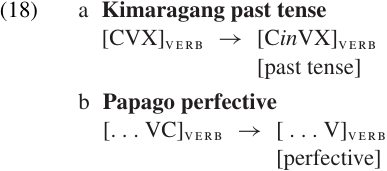
Similarly, the function of the Kimaragang past tense marker-in- (3) could be represented as in (18a). The perfective morpheme in Papago (13) could be represented as a process which deletes the final consonant in the word, as shown in (18b). And, of course, this same notation could be used to describe ordinary prefixes and suffixes, if desired. Remember to supplement each rule with a prose description of the pattern that it expresses.