0
EN
1
المرجع الالكتروني للمعلوماتية

Grammar

Tenses

Present

Present Simple

Present Continuous

Present Perfect

Present Perfect Continuous

Past

Past Simple

Past Continuous

Past Perfect

Past Perfect Continuous

Future

Future Simple

Future Continuous

Future Perfect

Future Perfect Continuous

Parts Of Speech

Nouns

Countable and uncountable nouns

Verbal nouns

Singular and Plural nouns

Proper nouns

Nouns gender

Nouns definition

Concrete nouns

Abstract nouns

Common nouns

Collective nouns

Definition Of Nouns

Animate and Inanimate nouns

Nouns

Verbs

Stative and dynamic verbs

Finite and nonfinite verbs

To be verbs

Transitive and intransitive verbs

Auxiliary verbs

Modal verbs

Regular and irregular verbs

Action verbs

Verbs

Adverbs

Relative adverbs

Interrogative adverbs

Adverbs of time

Adverbs of place

Adverbs of reason

Adverbs of quantity

Adverbs of manner

Adverbs of frequency

Adverbs of affirmation

Adverbs

Adjectives

Quantitative adjective

Proper adjective

Possessive adjective

Numeral adjective

Interrogative adjective

Distributive adjective

Descriptive adjective

Demonstrative adjective

Pronouns

Subject pronoun

Relative pronoun

Reflexive pronoun

Reciprocal pronoun

Possessive pronoun

Personal pronoun

Interrogative pronoun

Indefinite pronoun

Emphatic pronoun

Distributive pronoun

Demonstrative pronoun

Pronouns

Pre Position

Preposition by function

Time preposition

Reason preposition

Possession preposition

Place preposition

Phrases preposition

Origin preposition

Measure preposition

Direction preposition

Contrast preposition

Agent preposition

Preposition by construction

Simple preposition

Phrase preposition

Double preposition

Compound preposition

prepositions

Conjunctions

Subordinating conjunction

Correlative conjunction

Coordinating conjunction

Conjunctive adverbs

conjunctions

Interjections

Express calling interjection

Phrases

Sentences

Clauses

Part of Speech

Grammar Rules

Passive and Active

Preference

Requests and offers

wishes

Be used to

Some and any

Could have done

Describing people

Giving advices

Possession

Comparative and superlative

Giving Reason

Making Suggestions

Apologizing

Forming questions

Since and for

Directions

Obligation

Adverbials

invitation

Articles

Imaginary condition

Zero conditional

First conditional

Second conditional

Third conditional

Reported speech

Demonstratives

Determiners

Direct and Indirect speech

Linguistics

Phonetics

Phonology

Linguistics fields

Syntax

Morphology

Semantics

pragmatics

History

Writing

Grammar

Phonetics and Phonology

Semiotics

Reading Comprehension

Elementary

Intermediate

Advanced

Teaching Methods

Teaching Strategies

Assessment

قم بتسجيل الدخول اولاً لكي يتسنى لك الاعجاب والتعليق.

Clitics

المؤلف:  PAUL R. KROEGER

المصدر:  Analyzing Grammar An Introduction

الجزء والصفحة:  P316-C17

2026-02-11

670

+

-

20

Clitics

We identified two basic classes of morphemes, free vs. bound. We said that free morphemes are those which can occur as independent words, while bound morphemes are those which cannot occur by themselves as complete words. An important difference between affixes and roots is that affixes are always bound, while roots may be (and in English usually are) free.


We will discuss forms which are difficult to classify as either free or bound, forms that in some ways seem like independent words but in other ways seem more like affixes. Ambiguous elements of this type are called CLITICS.


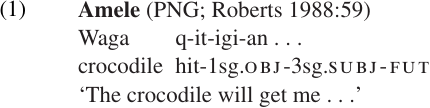
To begin with a specific example, let us look at verbal inflection in Amele, a Papuan language of New Guinea. Verbs in Amele are marked for subject agreement, object agreement (optional), tense, mood, and certain other categories. In most sentences, these markers appear as suffixes on the verb, as in (1).


However, in certain contexts these “suffixes” may be separated from the verb and occur as free forms; that is, they can be pronounced as independent words. Some examples are given in (2–4).
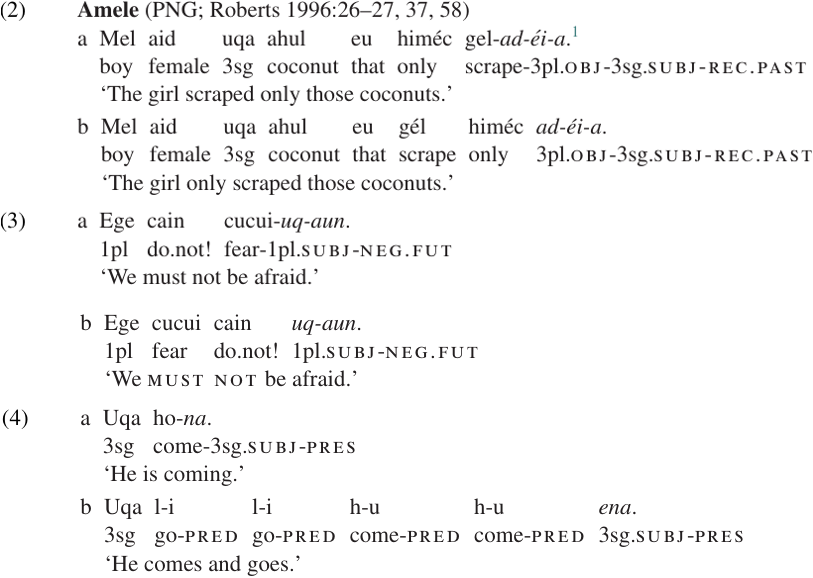


Roberts (1996) demonstrates that the tense and agreement markers are not affixes (in the usual sense) but auxiliaries which occur in clause-final position.2 When these auxiliaries occur next to the verb stem, as in (1), (2a), (3a), and (4a), they are “phonologically bound” to the verb, i.e. pronounced as part of the same PHONOLOGICAL WORD. This is the most common pattern. However, in a number of contexts they may also stand alone as separate phonological words, as illustrated in (2b), (3b), and (4b).


Notice that the syntactic position of the Amele auxiliaries is the same in both cases. The attachment of the auxiliaries to the verb stem in the (a) examples appears to be purely phonological. The rules of syntax which determine the order of elements in the clause must treat these auxiliaries as independent words, whether they are finally pronounced that way or not. Thus, the bound forms of the auxiliaries in (1), (2a), (3a), and (4a) match very well a standard definition of a CLITIC: an element which is “syntactically free but phonologically bound.”


The phrase “syntactically free” means that the rules of syntax treat the clitic as an independent word. The phrase “phonologically bound” means that the clitic is pronounced as if it were affixed to an adjacent word. (This word is called the clitic’s HOST.) So, we need to be able to make a distinction between phonological words and syntactic words; a clitic and its host constitute a single phonological word but two separate syntactic words.


1. As noted below, the acute accents in (2) represent primary stress.

2. These auxiliary elements are followed only by sentence-final elements such as question particles, sentence-level conjunctions, complementizers, etc.


اخر الاخبار

اشترك بقناتنا على التلجرام ليصلك كل ما هو جديد

