0
EN
1
المرجع الالكتروني للمعلوماتية

Grammar

Tenses

Present

Present Simple

Present Continuous

Present Perfect

Present Perfect Continuous

Past

Past Simple

Past Continuous

Past Perfect

Past Perfect Continuous

Future

Future Simple

Future Continuous

Future Perfect

Future Perfect Continuous

Parts Of Speech

Nouns

Countable and uncountable nouns

Verbal nouns

Singular and Plural nouns

Proper nouns

Nouns gender

Nouns definition

Concrete nouns

Abstract nouns

Common nouns

Collective nouns

Definition Of Nouns

Animate and Inanimate nouns

Nouns

Verbs

Stative and dynamic verbs

Finite and nonfinite verbs

To be verbs

Transitive and intransitive verbs

Auxiliary verbs

Modal verbs

Regular and irregular verbs

Action verbs

Verbs

Adverbs

Relative adverbs

Interrogative adverbs

Adverbs of time

Adverbs of place

Adverbs of reason

Adverbs of quantity

Adverbs of manner

Adverbs of frequency

Adverbs of affirmation

Adverbs

Adjectives

Quantitative adjective

Proper adjective

Possessive adjective

Numeral adjective

Interrogative adjective

Distributive adjective

Descriptive adjective

Demonstrative adjective

Pronouns

Subject pronoun

Relative pronoun

Reflexive pronoun

Reciprocal pronoun

Possessive pronoun

Personal pronoun

Interrogative pronoun

Indefinite pronoun

Emphatic pronoun

Distributive pronoun

Demonstrative pronoun

Pronouns

Pre Position

Preposition by function

Time preposition

Reason preposition

Possession preposition

Place preposition

Phrases preposition

Origin preposition

Measure preposition

Direction preposition

Contrast preposition

Agent preposition

Preposition by construction

Simple preposition

Phrase preposition

Double preposition

Compound preposition

prepositions

Conjunctions

Subordinating conjunction

Correlative conjunction

Coordinating conjunction

Conjunctive adverbs

conjunctions

Interjections

Express calling interjection

Phrases

Sentences

Clauses

Part of Speech

Grammar Rules

Passive and Active

Preference

Requests and offers

wishes

Be used to

Some and any

Could have done

Describing people

Giving advices

Possession

Comparative and superlative

Giving Reason

Making Suggestions

Apologizing

Forming questions

Since and for

Directions

Obligation

Adverbials

invitation

Articles

Imaginary condition

Zero conditional

First conditional

Second conditional

Third conditional

Reported speech

Demonstratives

Determiners

Direct and Indirect speech

Linguistics

Phonetics

Phonology

Linguistics fields

Syntax

Morphology

Semantics

pragmatics

History

Writing

Grammar

Phonetics and Phonology

Semiotics

Reading Comprehension

Elementary

Intermediate

Advanced

Teaching Methods

Teaching Strategies

Assessment

قم بتسجيل الدخول اولاً لكي يتسنى لك الاعجاب والتعليق.

Nominal predications: nouns

المؤلف:  Vyvyan Evans and Melanie Green

المصدر:  Cognitive Linguistics an Introduction

الجزء والصفحة:  C16-P556

2026-02-17

422

+

-

20

Nominal predications: nouns

Book: Cognitive Linguistics an Introduction

Author: Vyvyan Evans and Melanie Green

Page: C16-556

The challenge for a semantic account of the noun class is to provide a characterisation of a category that includes a very wide range of concept types. Consider the underlined nouns in the following examples.
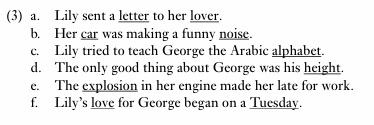
While some nouns (like letter and car) are objects, others (like lover) encode a relation between two people or things. The noun noise expresses a physical sensation, while a noun like alphabet refers to a group of interconnected yet discrete entities. The noun height expresses a scalar concept, while the noun explosion describes an event. The noun love encodes an emotion, while the noun Tuesday refers to a point in time. As this small set of examples illustrates, the content meanings of members of the noun class is extremely disparate, and it is unlikely that a semantic account of the noun class that rests upon content meaning is an achievable goal. However, Langacker argues that a semantic account is not impossible. Recall that Langacker views meaning in terms of a continuum ranging from the highly specific to the highly schematic. If we move along the scale towards schematicity, it appears that a schematic semantic characterisation of the noun class is possible. Langacker states his schematic characterisation of the noun class as follows (Langacker 2002: 63):

In our discussion in the previous chapter we very briefly exemplified this claim with respect to basic domains like TIME and SPACE. For example, count nouns that designate a region in the domain of TIME include moment and period, and count nouns that designate a region in the domain of SPACE include line, triangle and circle. However, some nouns evoke a combination of domains. For example, flash profiles a region in the domains TIME, COLOUR and VISION.As Langacker observes, flash is bounded in TIME but not in VISION. In other words, a flash must be very brief in terms of time, but can expand to take up our whole visual field, so bounding need only apply in one of the domains evoked by the expression. Langacker also points out that count nouns like second, hour, week, month and year do not evoke the basic domain of TIME directly, but evoke abstract domains that humans have constructed in order to ‘measure’ time. We might refer to these domains as CLOCK (in the case of seconds, minutes and hours), or CALENDAR (in the case of days, weeks, months and years), although the two are not necessarily distinct.


اشترك بقناتنا على التلجرام ليصلك كل ما هو جديد

