The final stages
The developments sketched in the previous section by no means constitute the endpoint of grammaticalization; rather, as has been demonstrated independently in many works, the process may continue until both the meaning and the phonetic substance of the item undergoing grammaticalization are lost. For example, when definite articles a rise out of demonstrative attributes in accordance with the Demonstrative > definite article pathway, they may further undergo extension, spreading from definite to all specific nouns (= ‘‘Stage-II articles’’), and finally their use can be generalized to occur with virtually all nouns, except, for example, for some generic uses, becoming an obligatory appendage of nouns, thereby acquiring the status of signaling nominality (= ‘‘Stage-III articles’’; Greenberg 1978, 1991). In a similar fashion, when a tense marker arises, this need not be the end of grammaticalization. Tense markers may develop further into markers of epistemic modality and/or they may assume subordinating functions (see, e.g., “Assumptions” (2d)).
The following example, being a special instance of the Verb > complementizer pathway, illustrates what may happen in the final stages of the process. The more a verb in combination with another verb loses in meaning content, the more it tends to merge with the other verb, and in the end the two may lexicalize into a new verb. In the Saharan languages of the Nilo-Saharan family, a verb for ‘say’ has been added productively to other verbs, adjectives, and nouns serving as its complements, one of its functions being to derive verbs from other word categories.1 In the course of this process, the ‘say’-verb has merged with its complement to the extent that it has lost its meaning entirely, the result being a new verb. The following example from the Nigerian Kanuri illustrates the various stages of development. Sentence (50a) shows the lexical use of the verb, (50b) that of ‘say’ as an element deriving (inchoative) verbs from adjectives (in this case, ku̒rà ‘big’), and (50c) illustrates the use of ‘say’ as a semantically empty inflectional appendage of a verb, that is, its erstwhile complement.
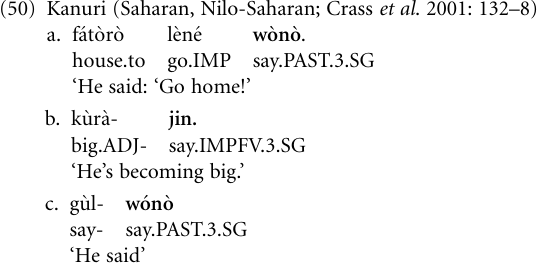
The erstwhile verb has undergone massive erosion, surviving in most cases solely as an alveolar nasal consonant, and in specific contexts even this consonant disappears, leaving no segmental trace of the erstwhile verb. The result of this process is that in Kanuri and other Chadic languages, a new class of verbs has evolved, where the verb ‘say’ has been reduced to a phonological relic of the verb stem. This class constitutes one of the three verb classes commonly distinguished in Saharan languages; it is actually the largest and most productive of the three classes, accounting for up to 90 percent of all verbs.
Thus, one possible final stage of grammaticalization is that the item undergoing the process loses its function and ends up as a phonological appendage of another form, serving no purpose, or no purpose other than identifying these forms as belonging to the same lexical or morphological paradigm.2 In this way, they may become markers identifying noun classes or nouns (Greenberg 1978), or verb classes or verbs. Alternatively, and perhaps more commonly, the item may be lost entirely without leaving any semantic or formal traces.
1 It is largely unclear what its function was when combined with other verbs.
2 It happens occasionally that such function-less items are re-grammaticalized, or ‘‘exapted’’ (Lass 1990, 1997).








