A scenario of evolution
The developments sketched later can be conflated in the form of an evolutionary network as presented in Figure 2.1 in “A scenario of evolution”, where six layers of evolution are proposed. As we observed in Section “Layers”, the term ‘‘layer’’ refers to clusters of categories that show the same relative degree of grammaticalization vis-à-vis both the categories from which they are derived and which they develop into.
As a rule, individual instances of grammaticalization processes extend over only two or three layers; there are however a few cases where a grammatical item in a given language may cover a larger range of layers. We mentioned in “The fifth layer” that there is a fairly widespread grammaticalization path leading from reflexive pronoun to passive marker. Now, one of the most common lexical sources for reflexive pronouns is nouns meaning ‘body’ or ‘head’, and there are some languages exhibiting the whole pathway from noun via reflexive to passive marker. The !Xun language of southwestern Africa is such a language: There is a noun / ˡe̒ ‘body’, cf. (67a), but it can also be interpreted as a reflexive marker.
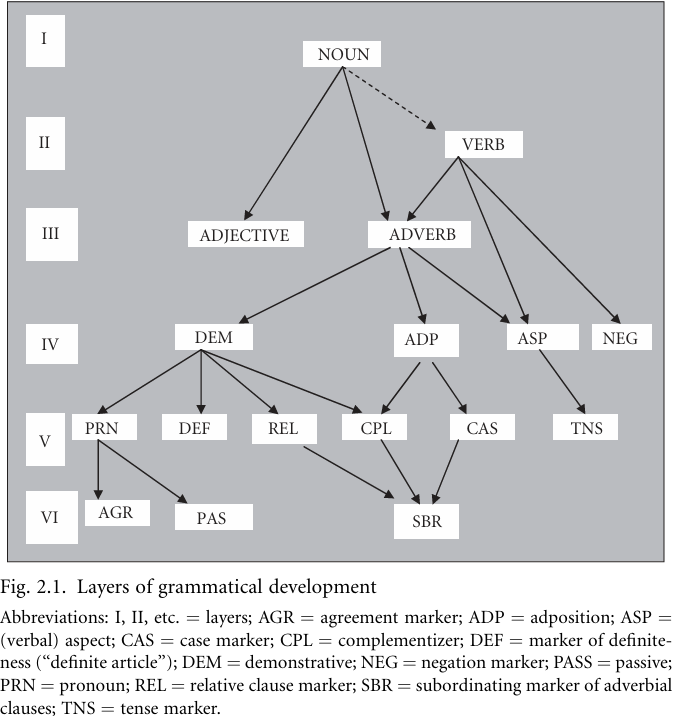
While the lexical meaning is still available in the eastern E2 dialect, the northern N1 dialect of !Xun has grammaticalized it into a reflexive and eventually also into a passive marker. Thus, example (67b)exhibits the reflexive construction, and (67c) the passive construction, where there is an inanimate subject; note that we are dealing with a fully-fledged passive that can take an agent introduced by the multi-purpose preposition kē having a transitivizing function (TR). However, the passive construction still bears witness to its nominal origin since the passive marker / ˡe̒ behaves morphosyntactically like a head noun obligatorily requiring a possessive modifier. Accordingly, cases like this one cover the whole spectrum from layer I (noun) via layer V (reflexive pronoun) to layer VI (passive marker).
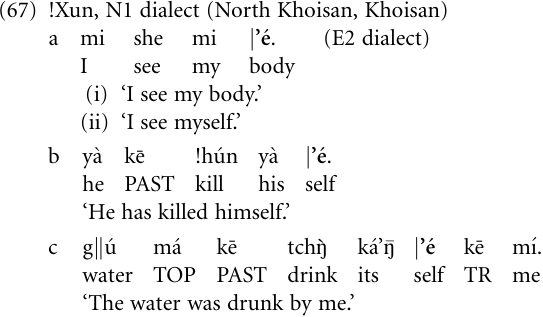
For a better understanding of this scenario, the following remarks seem to be in order. First, the structure it represents is non-transitive, that is, Figure 2.1 in “A scenario of evolution” does not take the format of a tree diagram, in that a given category can be derived from more than one other category. For example, quite a number of categories have both nouns and verbs as their lexical sources.
Second, we discussed the development of functional categories in terms of a restricted set of grammatical distinctions. On the basis of our cross linguistic observations, these distinctions are typologically salient; however, there are many conceivable other distinctions that could have been considered. For example, we discussed a category of definite markers but not of indefinite markers, and our network includes the categories tense and aspect but not that of modality.
Third, the processes depicted in Figure2.1 in “A scenario of evolution” are salient ones but they are not the only ones that have been identified so far. For example, there is no one source for passives, relative clause markers, subordinators, and other categories, that is, there are alternative sources in addition (see e.g. Lehmann 1984; Haspelmath 1990; Heine and Kuteva 2002a). The main reason for not including further pathways is either that they do not appear to be cross linguistically stable on the basis of our present knowledge, or that they are genetically or regionally more restricted in their occurrence. For example, interrogatives constitute a salient source of grammaticalization, nearly comparable to that of demonstratives, giving rise in particular to relative clause markers (e.g. English who) and subordinators in European languages (e.g. English when), and they are not restricted to European languages; still, this pathway is not really widespread outside Indo-European languages, hence it does not figure in the evolutionary schema of Figure 2.1 in “A scenario of evolution”. And fourth, discussion was confined to the evolution of what we called the most inclusive types of linguistic categorization. In doing so, we ignored a number of alternative aspects of grammaticalization.
In more general terms, one may say that these developments lead
• from concrete meanings to more abstract ones;1
• from open-class to closed-class items;
• from fairly independent, referential meanings to less referential, schematic grammatical functions having to do with relations within the clause or between clauses.
One of the most pertinent distinctions within the parameter of decategorialization concerns the relative degree of morphological (and phonological) independence of linguistic items, commonly described with reference to the following scale (see “Decategorialization”):
(68) free form > clitic > affix > zero
In some way, this scale underlies many pathways of grammaticalization, including the ones sketched above: There is a positive correlation to the effect that, the higher up a category is located in the network of Figure 2.1 in “A scenario of evolution”, the more likely it is to be expressed by a free form, while categories at the lower end of the network are more likely to be encoded as affixes. Another line of grammaticalization that is ignored here, concerns the following crosslinguistically stable morphological development:
(69) compounding > derivation
When two kinds of lexemes are compounded, one of them may undergo desemanticization, losing salient components of its meaning, becoming semantically dependent on the meaning of the other part of the compound, and decategorialization, losing most or all of its lexical morphosyntax. For example, one of two compounded nouns may be used more frequently and, being associated with a wider range of contexts, may acquire a more general meaning, gradually assuming a derivational function, and eventually turning into an affix of the other noun. This pathway, as well as many others, are ignored for the reasons outlined above.
Fifth, the network is highly abstract in that it conflates a number of, to some extent, disparate pathways. There are two kinds of pathways that make up the network, namely direct and indirect ones. Whereas the latter involve one or more intermediate stages, the former do not. For example, tense markers may be the result of the direct pathway, as is the case with the English will-future, which arose directly from a verb of volition in accordance with the Verb > tense pathway (see “The second layer: verbs”). But they may as well result from the indirect pathway Verb > aspect > tense. In a similar fashion, subordinators can arise directly from the Noun > subordinator or the Verb > subordinator pathway, but they can also be the result of a chain of pathways, for example Noun > adverb > adposition > case marker > subordinator. As we saw above, nouns and verbs each provide the source for a number of direct pathways, most of all the following:
Noun > adjective, adverb, adposition, pronoun, complementizer, case marker, agreement
marker, subordinator
Verb > adverb, adposition, aspect, negation, tense, complementizer, subordinator.
Functional categories resulting from indirect pathways are likely to differ from those resulting from direct pathways in that they are relatively older, having gone through more than one process of grammaticalization. Since they involve parameters such as desemanticization and decategorialization two or more times, they are likely to be more strongly grammaticalized, that is, we hypothesize that they have lost more of the properties of their lexical sources than categories resulting from direct pathways; but more research is required on this issue.
1 Conceptual shift from concrete to abstract, as understood here, is anthropocentric in nature, in that it leads from meanings that are close to human experience and easy to describe, to meanings that are more difficult to understand and describe.








