The rise of new functional categories
But there is also a second phase in the history of this pidgin. After the ‘‘stripping’’ process in the early stages of their development, pidgins will, under appropriate conditions, develop new grammatical structures, as we observed in “On pidgins and other restricted linguistic systems Introduction”, and this is what happened in KPS.
Being impoverished vis-a̒-vis the coastal varieties of Swahili (CS), from which it is historically derived, KPS experienced a number of developments within its short lifespan of roughly forty to fifty years. These developments almost invariably involved linguistic material that was available in the language but that was put to new uses of two kinds: Either it concerned free forms, that is, independent words that assumed functional roles corresponding to some of the lost inflections. For example, the person inflections ni- (1.SG), u- (2.SG), etc. were lost (except for lexicalized fossils), and their function was taken over by the self-standing pronouns mimi ‘I’, wewe ‘you (SG)’, etc. But more generally, pidgin speakers searched for ways of expressing functional concepts by drawing on universal strategies of grammaticalization, using existing lexical structures in contexts that invited novel interpretations of these structures in terms of functional concepts. We will now deal with these structures in turn.
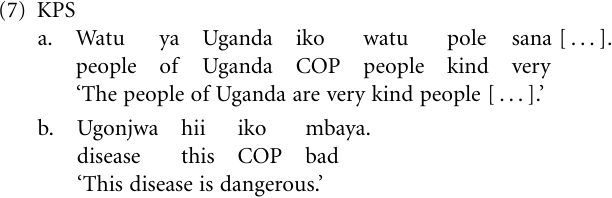
Copular structures Neither CS nor KPS require a copula in equational propositions; still, CS has a copula ni (or ndiyo) used for both classificational (John is a teacher) and identificational (The teacher is John) predications. This copula has largely disappeared in KPS, which developed a new copular use pattern by grammaticalizing the locative copula iko1 ‘be somewhere, exist’ to a general copula: Not only has iko retained the locative and existential functions of CS; as a result of its desemanticization (or generalization) it has become an all-purpose copula. The following examples illustrate its uses.
This copula has also given rise to a marker of predicative possession (‘to have’), where it frequently takes the comitative preposition na ‘with’. Since the use of na is optional, the equational and the possessive use patterns are frequently ambiguous, as in the following example:
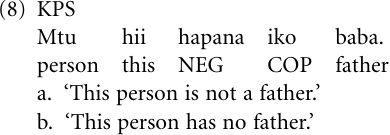
To conclude, via grammaticalization of the locative-existential copula-ko of CS, KPS has developed new copular and possessive constructions that have no homolog in the source language.
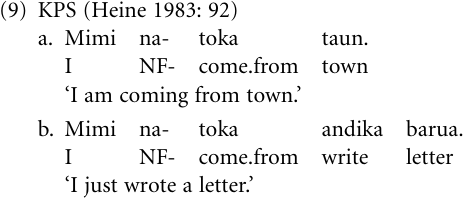
Tense–aspect Among the universal strategies used to create new categories for immediate perfects or past tenses there is one whereby verbs meaning ‘to come from’ are grammaticalized to tense–aspect markers; cf. French Il vient d’aller à Paris (he comes from to.go to Paris) ‘He has just gone to Paris.’ This strategy has also been employed by KPS speakers by developing their verb toka ‘come from’ into an immediate-past auxiliary (Heine 1991: 42): (9a) illustrates the lexical and (9b) the functional use of toka.
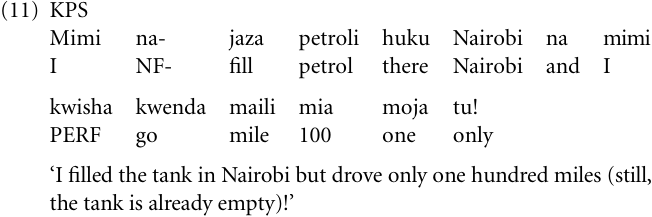
Another tense–aspect use pattern characterizing KPS concerns the grammaticalization of the verb kwisha ‘be finished’ to a perfect auxiliary. This process occurred in CS, where it has given rise to an already-perfect (denoting an event that occurred earlier than expected) in combination with the perfect prefix-me-, for example:
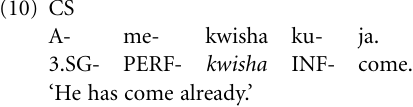
What is new in KPS is that, first, kwisha is not supported by the perfect prefix, which has disappeared in the pidgin, and second, that the use of kwisha has been extended to serve as a general perfect marker. Thus, in examples such as the following, the meaning ‘already’ no longer makes sense.
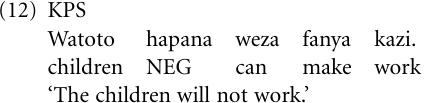
The future prefix-ta- belongs to the few inflections that have survived the transition from coastal L1-Swahili (CS) to pidgin. However, -ta- is restricted to the positive future, while the negative future is a new creation within the pidgin. An evolution from markers of ability (‘be able, can’) to future tenses is crosslinguistically not very common but is attested.2 KPS speakers appear to have used this strategy to form a negative future, using the phrase hapana weza (NEG can) or hawezi, derived from CS ha-wez-i (NEG.3.SG-can-NEG), for this purpose. Thus, the following sentence may have its literal meaning ‘The children cannot work’, but more likely is understood to express negative future meaning.
For further examples of new tense–aspect categories in KPS, see below.
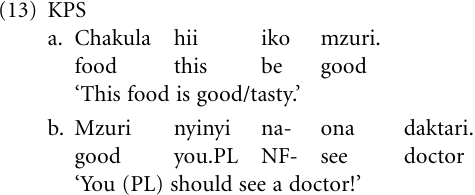
Modality One way of creating new expressions for deontic modality is to draw on a universal strategy whereby predicates of the kind ‘It is enough/ fitting/suitable/good (that)’ are grammaticalized to markers for necessity or obligation (Heine and Kuteva 2002a). KPS speakers have done so by developing the expression mzuri ‘(it is) good (that)’ into a marker of deontic modality, cf. (13).
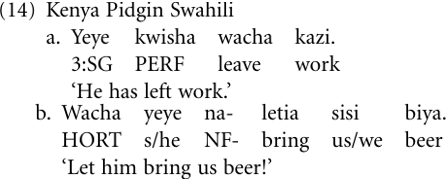
Another universal conceptual process concerns verbs meaning ‘leave’, ‘abandon’, or ‘let’ that are grammaticalized to hortative markers or related concepts of deontic modality (Heine and Kuteva 2002a). This process has given rise in KPS to a hortative use pattern: Example (14a) illustrates the lexical use of wacha ‘leave’ (< CS-(w)acha ‘leave, abandon’), that we had already in (6), and (14b) that of a hortative marker:
Negation One crosslinguistically common pathway leading to the rise of verbal negation markers has been described by Croft (1991); we gave a sketchy rendering of it in “The second layer: verbs” (Verb > negation). In accordance with this pathway, negative existential verbs (‘not to exist’) develop into general markers of verbal negation. In CS, verbal negation is expressed by a discontinuous structure consisting of the inflectional prefix hV- (si-in the first-person singular) and the negative suffix-i, cf. (15a). This negation structure has been eliminated in KPS except for a few, mostly lexicalized relics. Instead, early KPS speakers have drawn on the existential pathway by grammaticalizing the existential construction of CS, consisting of a negation prefix hV-, one of the three locative noun class markers pa (C16), ku- (C17), or mu- (C18), plus the existential copula-na ‘exist, be with’, illustrated in (15b).
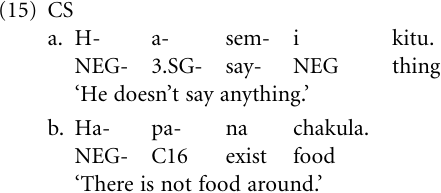
In accordance with this pathway, the CS negative existential phrase ha-pa na illustrated in (15b), using the noun class marker of the locative class 16, has been grammaticalized to an invariable verbal negation marker hapana in KPS, occurring immediately before the verb. Accordingly, the meaning of the CS sentence in (15a) would be expressed in KPS typically as in (16).
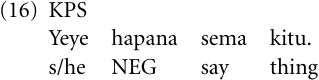
The results of grammaticalization in this process were the following: Via extension, the negative existential verb acquired a new context, namely serving as a pre-verbal particle. Desemanticization had the effect that the existential verb lost its existential and its predicate functions, thereby being reduced to the function of negation, and decategorialization meant that the erstwhile verb lost the ability to be inflected and became restricted to the pre-verbal position.
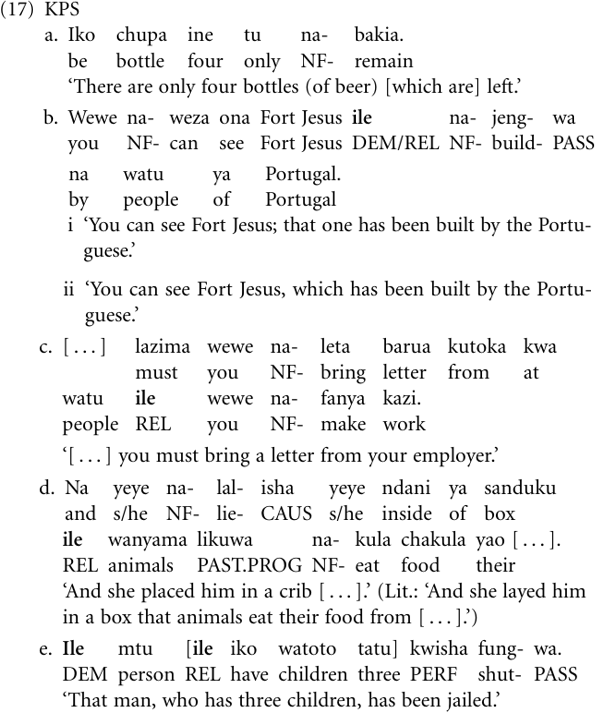
Relative clauses With the collapse and disappearance of the CS relative clause construction, based on the relativizer-o-, KPS speakers were left with no relative clause construction; what in other languages would be expressed by relative clauses was encoded in the emerging pidgin simply by juxtaposing clauses, as in (17a).3 But these speakers gradually created a new structure, drawing on universal principles of grammaticalization. Crosslinguistically the most common way in which relative clause markers arise is via the grammaticalization of demonstrative pronouns, English that being a case in point (see “The fourth layer: demonstratives, adpositions, aspects, and negation”). Like earlier speakers of English, KPS speakers drew on their distal demonstrative ile ‘that’ to mark both restrictive and non-restrictive relative clauses (see Heine 1991: 47–51 for more details). At the initial stage, ile appears to have been used only in contexts where it could also be interpreted as a demonstrative, that is, where it was ambiguous, as in (17b). Eventually, the use of ile was extended to contexts where it functions unambiguously as a relative clause marker, as in (17c). As (17d) shows, the relative marker is no longer restricted to definite referents. That the grammaticalization process from demonstrative to relative clause marker has been completed is suggested by examples such as (17e) where the relative pronoun can co-occur with the demonstrative. Note that (17e) is an instance of a center embedded construction, in that the relative clause is placed within the main clause; we will return to this example in "On the rise of recursion Conclusion”
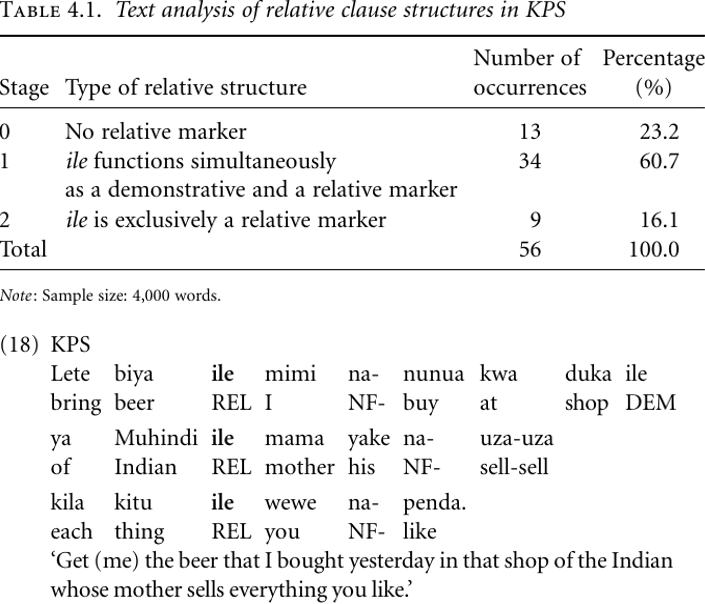
All these stages co-occur in KPS (at least when we studied it in the late 1960s). As Table 4.1 shows (see also Heine 1991: 50), the largest number of uses concern situations where ile is in some way or other ambiguous between a relative and a demonstrative reading. The use of the relative marker is in most contexts optional; however, there is a strong tendency to omit it with indefinite head nouns but use it with definite head nouns.
The following example shows that the relativizer ile has been grammaticalized to the extent that its use is fully recursive:
But ile has not only been grammaticalized to a relative clause marker; in combinations with specific nouns it also turned into a more general clause subordinator, thereby taking over many of the functions characterizing the inflectional prefix -o- of CS (or of Standard Swahili).
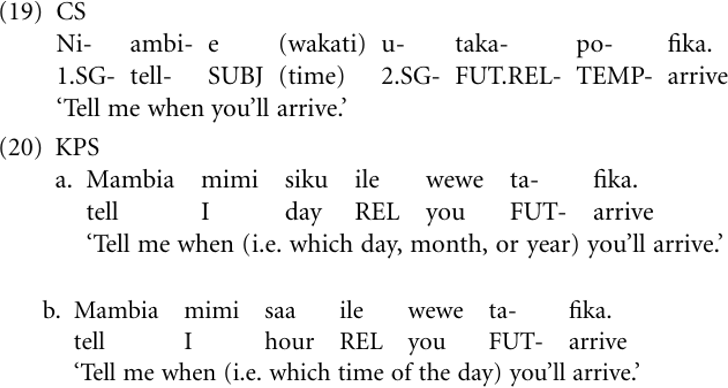
Adverbial clauses Virtually all of the developments characterizing KPS can appropriately be portrayed as being drastic reductions vis-à-vis CS. But, as the examples presented above suggest, the pidgin has somehow acquired a new typological profile that is characterized by new functional distinctions for which there is no exact equivalent in CS. In some cases this means that KPS developed grammatical distinctions that are absent in CS. For example, CS has an inflectional verbal prefix-po- introducing temporal adverbial clauses (built on the relativizer-o-), as in (19). KPS has lost this inflection and has created a new use pattern based on a lexical structure which is siku ile (‘day which’) when referring to events more distant in time, cf. (20a), and saa ile (‘hour which’) for events that happened recently, cf. (20b). Thus, KPS speakers dispose of a more differentiated grammatical distinction than CS speakers, in that for the latter there is no grammaticalized way of distinguishing between (20a) and (20b).
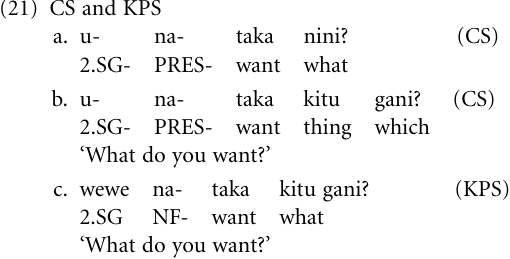
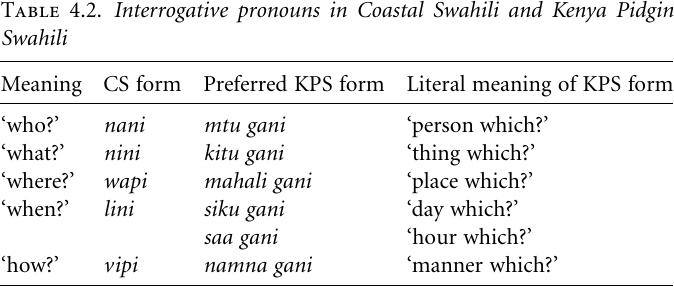
Question words In many cases the new grammatical structures that evolved in the pidgin were already present as minor use patterns for specific purposes in CS. What grammaticalization achieved is that these patterns were activated by the pidgin speakers, used more frequently, extended to novel contexts, and developed into new functional categories. The rise of new question words illustrates this process (see Heine 1991: 38–9): CS has a paradigm of unanalyzable disyllabic interrogative pronouns, which are listed in Table 4.2. With the exception of wapi ‘where?’, these pronouns are rarely used in the pidgin, where the analytic phrases listed in Table 4.2 tend to be used instead, consisting of a noun plus the attributive gani ‘which?’, see also (21c). This strategy, recruiting generic nouns that refer to some specific ontological domain plus an attributive interrogative to create new question words, is crosslinguistically widespread, and it is also typical of creoles (Peter Bakker, p.c.); as Baker (2006) demonstrates, interrogatives formed in this way became productive in the history of many, if not all creoles; with their semantic transparency and vocabulary-building capacity such interrogatives provided a valuable attribute in the evolution of creoles. At the same time, analytic (bimorphemic) interrogatives were already available as a use pattern in CS; thus, (21a) and (21b) are equivalent questions in many contexts. What happened in KPS is that these use patterns were generalized, being used more frequently in a wider range of contexts.
As we observed in our discussion of adverbial clause marking, in the present case as well the pidgin speakers dispose of a grammatical dis tinction that is absent in CS (even if it can be expressed lexically): Where CS has only one temporal interrogative (lini ‘when?’), the pidgin distinguishes between specific (saa gani) and more general time periods (siku gani).
1 iko is an invariable marker that is derived from the CS locative copula-ko taking noun class agreement prefixes. The frozen form iko contains the prefix i- of noun class.
2 See Bybee, Perkins, and Pagliuca (1994: 266), who hypothesize that this evolution involves the following stages: ABILITY > ROOT POSSIBILITY> INTENTION>FUTURE.
3 One might argue that na-bakia in (17a) is ‘‘underlyingly’’ a relative clause but one that is not formally marked. We did not find compelling evidence in support of such an analysis.








