On pidgins and other restricted linguistic systems
Discussion
As we pointed out above, pidgins tend to be portrayed as fairly ‘‘structureless’’ forms of communication that are formed ad hoc and do not exhibit any marked degree of consistency. While this may be true for ‘‘jargons’’, that is, pidgins in their earliest stage of development, it does not apply to any of the pidgins that we are familiar with, including KPS. The KPS structures that we presented in “The rise of new functional categories” are new grammatical use patterns in this pidgin that must have evolved within roughly half a century; there are essentially no equivalents in CS. Their development is fully in accordance with parameters of grammaticalization, as they can also be observed in other languages.8
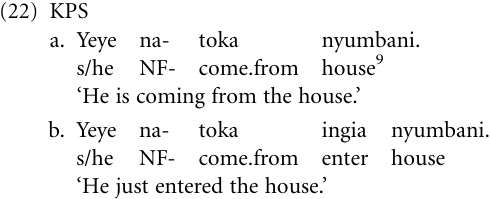
In many of their uses these patterns are ambiguous, as they can still be interpreted with reference to their lexical meaning. For example, the immediate-past marker toka can still be understood in its lexical sense. Some of these use patterns, however, have acquired new contexts where the lexical meaning no longer makes sense—hence, where they can be interpreted meaningfully only with reference to the new grammatical function. Thus, the erstwhile verb toka has also been extended to contexts where its lexical meaning ‘come from’, cf. (22a), is ruled out, that is, where its immediate-past tense function provides the only reasonable interpretation, as in (22b), where the meaning of the verb ingia ‘enter’ is incompatible with that of toka (which also means ‘come out’):
Furthermore, the process leading to the rise of these structures was not necessarily one where speakers intended to introduce a new functional category; rather, speakers used existing constructions in new contexts for specific communicative purposes that made sense in these contexts, and in some of these contexts, a new grammatical function emerged. In many cases, this context extension did not affect the structure of grammatical categorization but rather remained a contextually restricted option. In some cases, however, it had the effect that new grammatical use patterns emerged serving specific functional purposes and acquiring a new status as distinct functional categories. The result is that KPS acquired a profile that contrasts with that of CS on the one hand, and with that of a maximally restricted linguistic system on the other.
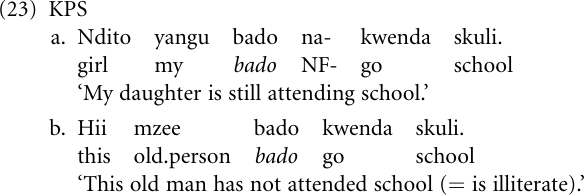
That it is the manipulation of existing forms in new contexts that determines the emergence of new use patterns and functional categories is suggested by the following example. The CS adverb bado has two different, though related, meanings, which are ‘still’ in affirmative and ‘not yet’ in negative constructions, and both meanings are retained in KPS. But in KPS this adverb has served as a basis for new contrasting functional use patterns: When preceded by the non-future (NF) marker na- it denotes an event that continues longer than expected (= ‘still’), cf. (23a). When used without the NF marker it denotes an event that was supposed to have started but has not started as yet (¼ ‘not yet’). However, in the latter use pattern, bado has undergone further desemanticization, in that it tends to be generalized as a negative perfect marker, as in (23b), where the meaning ‘not yet’ does not appear to make much sense.
There are also other conclusions to be drawn from the findings presented in this section. The first concerns the question of how much time is minimally required for new functional categories to evolve or, more generally, for a language to acquire a new typological profile. As we noted above, KPS is a product of British colonialization in Kenya, its genesis can be dated back to around the beginning of the twentieth century; we are not aware of any pre-colonial pidgin varieties in up country Kenya. Since the mid 1930 s there are records to the effect, first, that what was once a ‘‘natural’’ language (CS), had turned into an un questionable pidgin (KPS).10 That the pidgin acquired a set of new grammatical use patterns within less than five decades suggests that grammaticalization proceeded much faster in this pidgin than in what we know from ‘‘natural’’ languages.
Another issue concerns the agents of language change. That the creators of KPS were L1 speakers of the languages spoken in up-country Kenya is fairly uncontroversial, such languages being Kikuyu, Kamba, Luo, Luhya, Maasai, and Kalenjin, as well as roughly a dozen other languages. The contribution of native speakers of CS was at all times modest: There never was any substantial community of native Swahili speakers in the rural areas of up-country Kenya. The contribution made by the colonizers in this process, that is, British farmers, government officials, teachers, etc., is unknown. The agents must have been primarily male adults working on the plantations of European settlers and traders in commercial centers such as Nairobi, Thika, Nakuru, Eldoret, Kitale, Nanyuki, etc., and women working as household servants may also have played some role. There is no indication that children played a role in this process.
10 We have no information on any possible ‘‘jargon’’ stage that may have pre-dated the pidgin variety described here.
8 In our entire corpus of grammatical developments we came across only one example of a possible ‘‘degrammaticalization’’ (see “Problems"): The CS adverb katikati ‘between’ is occasionally used by KPS speakers as a noun meaning ‘center, inside’.
9 The CS noun nyumba ‘house’ is frequently used in its locative form nyumbani ‘in the house’ in KPS to denote both ‘house’ and ‘in the house’.








