Relationships between constructions
Having set out what kinds of factors govern the relationships between constructions and individual verbs, Goldberg’s next task is to explain what governs the relationships between constructions themselves. As we saw earlier in the chapter, Goldberg, like Langacker, assumes that constructions interact within a structured network of relations rather than comprising an unordered set. In Goldberg’s model, relationships between constructions are captured in terms of motivation and inheritance. Consider the following principle:
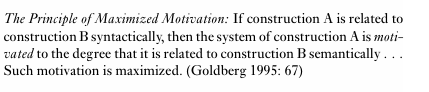
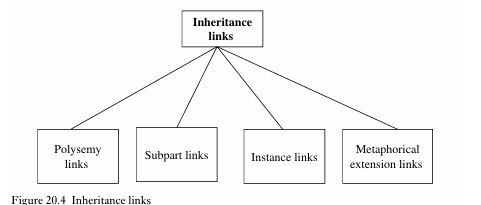
The term ‘motivation’ reflects the degree to which the properties of a given construction are predictable. In other words, given the premise that grammatical constructions are meaningful, it follows that constructions that share grammatical properties will to some extent also share semantic properties. The Principle of Maximised Motivation is a psychological principle. In order to explain how language observes this principle, Goldberg posits inheritance links within the network of constructions that comprise knowledge of language: ‘construction A motivates construction B iff B inherits from A’ (Goldberg 1995: 72). There are four different kinds of inheritance links, which are shown in Figure 20.4. We will examine each of these in turn.
Polysemy links Goldberg observes that a given sentence-level construction (a syntactic pattern conventionally associated with a meaning, and thus a symbolic unit) can be associated with a range of related senses. For example, the ditransitive construction is associated with a range of senses that all share the semantics of TRANSFER, but which also differ in systematic ways. Consider the following examples (based on Goldberg 1995: 75).
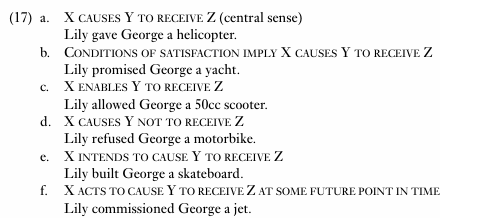
As we saw earlier in the chapter, although examples like these share in common the salient feature of the central sense, they differ in terms of whether the TRANSFER is actual or intended, permitted or prohibited, and so on. Just like lexical polysemy, constructional polysemy can be modelled in terms of a semantic network (recall Chapter 10).
Subpart links
If one construction is a proper subpart of another construction but exists independently, the two constructions are related by a subpart link. Consider the following example.

Example (18a) is an instance of the caused motion construction. Example (18b) is an instance of the intransitive motion construction. While (18a) lexically profiles the argument roles CAUSE (Lily), THEME (George) and GOAL (the conference), (18b) lexically profiles only the THEME (George). In this sense, the construction illustrated in (18b) is a proper subpart of the construction in (18a). Thus the relationship between the two constructions is captured by a subpart inheritance link.
Instance links
An instance link exists where one construction is a special case of a related construction. This type of link explains substantive idioms of the kind that we saw in Chapter 19. Recall that substantive idioms are lexically filled, which means that the idiomatic interpretation is only available if one of a restricted set of expressions is present within the construction. Compare the following examples (based on Goldberg 1995: 79).
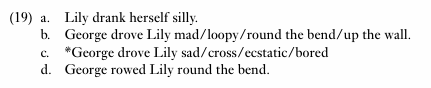
The example in (19a) is an instance of the resultative construction. When the verb drive occurs in this construction, one of a particular set of expressions must fill the result ‘slot’, as in (19b), and the construction takes on an idiomatic reading that can be paraphrased as ‘make somebody crazy’. If the ‘wrong’ expressions are chosen to fill the construction, the result is ungrammatical (19c) or fails to be recognised as the resultative construction (19d) and therefore loses its idiomatic interpretation. The idiomatic construction in (19b), then, is a special case or instance of the ‘ordinary’ resultative construction illustrated by example (19a).
Metaphorical extension
links Goldberg argues that some constructions are metaphorical extensions of other constructions, and that metaphorical extension therefore gives rise to a further type of inheritance link. For example, she argues that the resultative construction in (20a) is a metaphorical extension of the caused motion construction in (20b).

The similarity between these two construction types revolves around the interpretation of the result phrase (the adjective phrase (AP) senseless in example (20a)) as a type of metaphorical GOAL, parallel to the actual GOAL expressed by the PP in the caused motion construction (onto the sofa, in example (20b)). In other words, the resultative construction encodes a metaphorical movement towards a GOAL or a metaphorical change of location. As Goldberg observes, this parallel is further supported by the fact that resultatives do not permit GOAL PP phrases. This can be accounted for by the fact that the result phrase already expresses the (metaphorical) GOAL, so the expression of an additional GOAL is redundant. This is illustrated by the unacceptability of example (21).

Despite this metaphorical inheritance link, Goldberg argues that it is important to recognise the caused motion construction and the resultative construction as distinct, albeit linked, constructions. This is because each construction places different restrictions on what verbs can occur in the construction. For example, while the resultative construction licenses make (22a), the caused motion construction does not (22b).

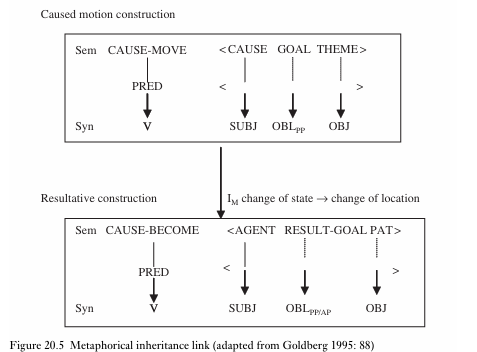
The metaphorical inheritance link (IM ) between the two constructions is shown in Figure 20.5.
In sum, constructions can be related in a number of ways within a complex network of inheritance links, and any given construction might be linked to a number of other constructions or families of constructions via a number of different types of links. Although the set of links must be learnt for each ‘family’ of constructions, any frequently occurring links will license novel instances of the construction. This is reminiscent of Langacker’s notion of entrenchment and emphasises the usage-based nature of Goldberg’s model.








