Simple vs. productive recursion
Recursion is a crosslinguistically ubiquitous phenomenon: In most languages it is—or can be—used productively both in attributive possession and in clause subordination. With the term productive recursion we refer to the unlimited design of the rule—there are unlimited levels of embed ding, that is the rule applies in principle indefinitely many times. But perhaps equally common are cases where a recursive rule applies only once to its own output or is non-productive, we will call such cases simple recursion. This distinction is not a trivial one: Simple recursion conforms to the definition of recursion proposed in (1a), but at the same time it has more in common with other, non-recursive, syntactic or semantic properties of human language than with productive recursion.
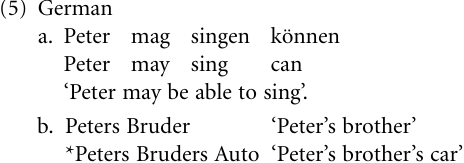
There are considerable typological differences with respect to this distinction. First, a given language may allow recursion in some specific domain of grammar where another language does not. In German there is simple recursion with modals, cf. (5a), where English has no recursion. On the other hand, German speakers have only simple recursion with inflected genitives, cf. (5b), where English speakers do not have such a constraint, as the English translation of (5b) shows.
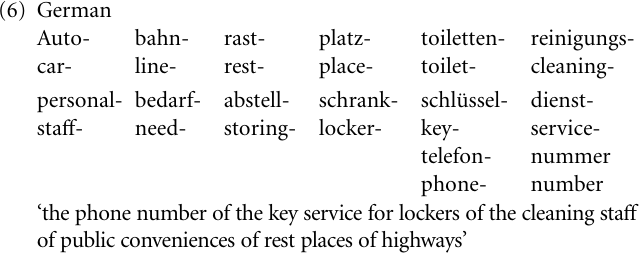
Quite a number of languages, such as Romance languages, have no productive recursion in compounding while others, such as Germanic languages, allow productive noun–noun compounding. Thus, French speakers can use at best simple recursion in compounding, for example homme grenouille (man frog) ‘frog man’; root compounding is unproductive, limited to frozen and self-conscious coinages (Bauer 1978). For English speakers on the other hand, undersea divers can appear in constructions of productive recursion, cf. (3a). The magnitude that productivity may have can be illustrated with example (6). We have never heard a German speaker uttering this compound, and it probably never will be uttered; however, it is a grammatically correct instance of productive recursive compounding.
Recursion as it presents itself in, for example, noun combining appears to be rooted in a fairly basic cognitive activity, namely in taxonomy whereby elementary conceptual relations are established among different taxa of the same domain. Simple recursion is a natural product of this activity: Once there is a linguistic expression for relations such as between less inclusive and more inclusive, part and whole, one social role and another, or possessee and possessor, the way is cleared for recursion to enter. And the situation is not dramatically different in the case of productive recursion: What is required is simply that an existing ‘‘rule’’ or convention is re-applied to the same taxonomic entity. Accordingly, the difference between simple and productive recursion appears to be one of degree rather than of kind.
While productive recursion is essentially unlimited, there are generally limits to its use: it is constrained in particular by pragmatic factors, for example by the capacity of a speaker’s memory, by what the speaker thinks the hearer can digest, etc. But it is also constrained by syntactic factors; for example, recursive productivity tends to be more limited in center-em bedded than in either left- or right-embedded subordination. Some students of connectionist models account for this fact by adding a component of analysis or description that deals specifically with productivity constraints (see Christiansen and Chater 1999), and since Miller and Chomsky (1963) it has been argued that there exists a separate working memory capacity that constrains recursion.1
1 We are grateful to Fritz Newmeyer (p.c.) for having drawn our attention to this fact.








