Embedding, iteration, and succession
As we noted above, embedding recursion ((7a) = (1b)) is not the only recursive mechanism responsible for discrete infinity in language use; there are two additional mechanisms corresponding to our definition of recursion in (1a), namely iteration (7b) and succession (7c).
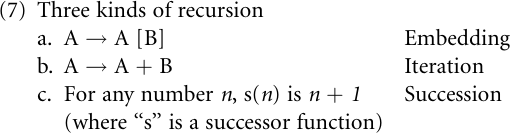
Iteration may take various forms; most commonly it is additive (‘A and B’) or alternative (‘A or B’). Its status vis-à-vis embedding recursion is unclear. The main positions surfacing from the literature are that iteration (a) is an instance of recursion on the same level as embedding recursion; (b) is a special instance of embedding recursion; or else (c) that the two are mutually exclusive mechanisms. The fourth possibility, namely that embedding recursion is included in iteration, does not seem to have found any noticeable support (but see Davidson 2004). In much of the literature on this subject it does not become clear which of these alternatives is implied, and quite a number of authors use the term recursion indiscriminately for both mechanisms.1 There are reasons for doing so: Both are generative in nature and, hence, both may lead to discrete infinity, and many manifestations of embedding recursion can also be framed in terms of models based on iteration.
At the same time there are also reasons to keep the two apart. First, their effect on language structure is different: Embedding recursion results in conceptual and linguistic subordination or hierarchy, while iteration leads to coordination (or conjunction). Second, there are recursive structures (e.g. center-embedding) that cannot be handled appropriately by iteration models. And third, the two also differ in the range of linguistic phenomena they are associated with. For example, iteration is not restricted to the noun phrase or the clause; it is also a productive mechanism of the verb phrase (e.g. He came in, sat down, took the newspaper, and...), and it is a grammaticalized characteristic of serial verb constructions.
Succession is the kind of recursion that underlies numerosity; thus, (7c) generates units such as the following: s(4) = 5, s(5) = 6,forexample1 + 4 = 5, 1 + 5 = 6, etc. The ontological status of succession and, more generally, of numerical cognition is far from clear (see below).
The only reason for reducing the term recursion to embedding recursion is that this is the use that is commonly implied in discussions on language evolution.
1 For Dougherty (2004), for example, recursion includes coordination, subordination, and embedding, and Goldin-Meadow (1982: 54) defines recursion in a way that is not uncommon in linguistics: ‘‘Recursion provides a language user with the means for expressing more than one proposition in a single sentence.’’








