Are there languages without recursion?
A number of languages have been claimed to lack recursion, such as pidgins, or the Omotic language Gorze of Ethiopia (for a paradigm example, see Everett 2005). This raises the question of whether embedding recursion is really an indispensable characteristic of human languages. We will not attempt a definite answer to this question (but see Parker 2005), for the following reasons: First, as pointed out above, recursion is a theory-dependent notion; accordingly, no general answer seems possible. And second, the situation is not all that clear in a number of languages because there is not enough information available. Nevertheless, it would seem that all languages on which there is appropriate information do exhibit some kind of recursive structures. This applies, for example, to all pidgins that we are familiar with: All African-based pidgins show recursion, at least at the noun phrase level, and the same applies to English-based pidgins such as Tok Pisin, Solomons Pijin, or Nigerian Pidgin English.
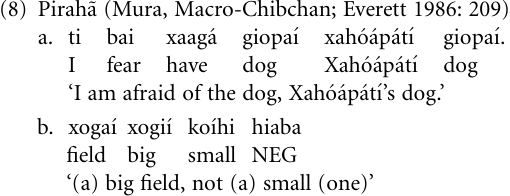
But there remains the case of the Amazonian language Pirahã: Based on his extensive knowledge of this language, Everett (1986, 2005; Bower 2005) concludes that it does not make use of recursion. A look at the description provided by Everett (1986) suggests, however, that there is an alternative view on this matter. As we noted above, recursion manifests itself in particular in noun modification and clause subordination or, to put it more strongly, if either of these is present, there is recursion. It would seem that both are in fact present in Pirahã. Thus, (8a) seems to be an instance of possessor–possessee modification and (8b) of noun–adjective modification. While Everett notes that noun modification involves paratactic augmentation, the evidence provided suggests that these are cases that in certain schools of linguistics could be described in terms of a recursive rule such as (1b).
And there are also examples to suggest that there is some kind of clause subordination in Pirahã; suffice it to quote Everett (1986: 262–3): ‘‘Certain types of subordinate clause (nominalized, temporal and conditional) are marked morphologically on the subordinate verb’’, or ‘‘Temporal and conditional ... clauses precede the matrix clause, whereas other types of subordinate (adverbial) clauses usually follow the matrix clause.’’
To conclude, we have so far found no clear evidence for languages that demonstrably lack recursion of any kind; we will return to this issue in “Grammaticalization—a human faculty?”.








