0
EN
1
المرجع الالكتروني للمعلوماتية

Grammar

Tenses

Present

Present Simple

Present Continuous

Present Perfect

Present Perfect Continuous

Past

Past Simple

Past Continuous

Past Perfect

Past Perfect Continuous

Future

Future Simple

Future Continuous

Future Perfect

Future Perfect Continuous

Parts Of Speech

Nouns

Countable and uncountable nouns

Verbal nouns

Singular and Plural nouns

Proper nouns

Nouns gender

Nouns definition

Concrete nouns

Abstract nouns

Common nouns

Collective nouns

Definition Of Nouns

Animate and Inanimate nouns

Nouns

Verbs

Stative and dynamic verbs

Finite and nonfinite verbs

To be verbs

Transitive and intransitive verbs

Auxiliary verbs

Modal verbs

Regular and irregular verbs

Action verbs

Verbs

Adverbs

Relative adverbs

Interrogative adverbs

Adverbs of time

Adverbs of place

Adverbs of reason

Adverbs of quantity

Adverbs of manner

Adverbs of frequency

Adverbs of affirmation

Adverbs

Adjectives

Quantitative adjective

Proper adjective

Possessive adjective

Numeral adjective

Interrogative adjective

Distributive adjective

Descriptive adjective

Demonstrative adjective

Pronouns

Subject pronoun

Relative pronoun

Reflexive pronoun

Reciprocal pronoun

Possessive pronoun

Personal pronoun

Interrogative pronoun

Indefinite pronoun

Emphatic pronoun

Distributive pronoun

Demonstrative pronoun

Pronouns

Pre Position

Preposition by function

Time preposition

Reason preposition

Possession preposition

Place preposition

Phrases preposition

Origin preposition

Measure preposition

Direction preposition

Contrast preposition

Agent preposition

Preposition by construction

Simple preposition

Phrase preposition

Double preposition

Compound preposition

prepositions

Conjunctions

Subordinating conjunction

Correlative conjunction

Coordinating conjunction

Conjunctive adverbs

conjunctions

Interjections

Express calling interjection

Phrases

Sentences

Clauses

Part of Speech

Grammar Rules

Passive and Active

Preference

Requests and offers

wishes

Be used to

Some and any

Could have done

Describing people

Giving advices

Possession

Comparative and superlative

Giving Reason

Making Suggestions

Apologizing

Forming questions

Since and for

Directions

Obligation

Adverbials

invitation

Articles

Imaginary condition

Zero conditional

First conditional

Second conditional

Third conditional

Reported speech

Demonstratives

Determiners

Direct and Indirect speech

Linguistics

Phonetics

Phonology

Linguistics fields

Syntax

Morphology

Semantics

pragmatics

History

Writing

Grammar

Phonetics and Phonology

Semiotics

Reading Comprehension

Elementary

Intermediate

Advanced

Teaching Methods

Teaching Strategies

Assessment

قم بتسجيل الدخول اولاً لكي يتسنى لك الاعجاب والتعليق.

Adjectival modification

المؤلف:  Bernd Heine and Tania Kuteva

المصدر:  The Genesis of Grammar

الجزء والصفحة:  P286-C6

2026-03-21

344

+

-

20

Adjectival modification

Adjective–noun constructions exhibit a number of restrictions. First, a number of languages do not have a distinct category of adjectives—hence there is no construction of this kind. And second, such constructions also show constraints on recursion in some languages, allowing simple but no productive recursion.


One way in which adjectival notions may be expressed is via the relativization of verbs; thus, in the Ik language of northeastern Uganda, qualities such as ‘big’, ‘red’, or ‘good’ need to be encoded by means of relativizing verbs of state, for example dε-Ika nı̒ ze-ı̒ka (foot-PL REL.PL be.big-PL) ‘big feet’. Since relative clauses are already recursive, we will ignore this kind of structure.


Instead, of central interest here is a process to be observed in quite a number of languages where two nouns are juxtaposed—with the effect that one of them is grammaticalized to an adjectival modifier while the other is the head of the construction—accordingly, a structure such as (13a) is grammaticalized to a recursive structure (13b) (see “The first layer: nouns”).
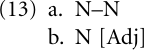


In this way, nouns for ‘man’ and ‘woman’ tend to acquire characteristics of adjectives in many languages, taking the position of adjectives and denoting ‘male’ and ‘female’, respectively. Semantic domains that are cross-linguistically most likely to undergo grammaticalization from noun to adjective are those of plants, animals, and metals, cf. English a pink dress, a silver pot. Grammaticalization involves (a) extension, in that a given noun is moved from the canonical position it occupies as a referential noun to a position next to another noun, (b) desemanticization, in that the nominal meaning is reduced to some semantic property of color, sex, size, etc., and there is also (c) decategorialization since that noun loses salient morphosyntactic properties of nouns, such as taking its own modifiers, determiners, and inflections.


That the directionality is generally one from noun-to-noun modification is also in accordance with evidence from child language development: Children learn nouns before they proceed to acquire noun modification. Conversely, we are not aware of any convincing evidence to suggest that young children start out producing modified nouns before they learn nouns in isolation. English-speaking children acquire simple nouns typically before age 2, while modifier–noun structures, such as possessive noun (your hand) and adjective–noun phrases (a brown car) are produced only between age 2 and 2;6 (Valian 1986; Tomasello 2003a: 208). The fact that these children consistently place adjectives before, rather than after, nouns might suggest that they do have some knowledge of the taxonomic relationship between the two entities—that is, that already at this age they use this as a hierarchical structure ([A] B) rather than as a shallow, juxtapositional ‘‘island’’ structure (A–B).


اخر الاخبار

اشترك بقناتنا على التلجرام ليصلك كل ما هو جديد

