On the rise of recursion Conclusions
Hauser et al. (2002) argue that the language faculty in the narrow sense (LFN) consists essentially only of recursion. We did not mean to challenge this view; rather, its main purpose was to show how recursive constructions may arise. We argued that there is a regular process leading from non-recursive to recursive noun phrase and sentence constructions, and that this process is a by-product of grammaticalization and, hence, can be accounted for by means of grammaticalization theory. Our concern was not with structure in general but rather with specific constructions. For example, we observed in “Attributive possession” that English speakers created the recursive of-construction, but there was already a recursive construction of attributive possession, marked by genitive-s. Thus, what we showed was simply how a non-recursive construction turned into a recursive one. In most cases this process involved integration, whereby constituents that were juxtaposed—be that in the form of asyndetic, paratactic or any other kind of combining—gradually turned into hierarchical structures of modification or subordination.
In “On the rise of recursion A definition” we distinguished between two basic types of recursion: tail recursion and nested (or center-embedded) recursion. Our main concern was with the former, and the question arises whether grammaticalization theory also accounts for nested recursion, which for some constitutes the ‘‘true’’ form of recursion: It entails not only that category X is nested in another category Y, where some parts of Y precede while others follow X, but also that these parts of Y, although forming one syntactic unit, are separated by X. Grammaticalization theory in fact accounts in much the same way for both kinds of recursion.
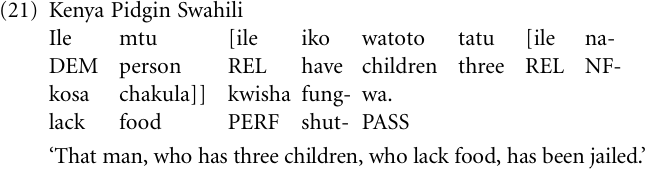
An example of nested recursion was provided from Kenya Pidgin Swahili in “The rise of new functional categories” (example (17e)). We described how this pidgin arose in the early twentieth century without any relative clause construction, and how it acquired such a construction by grammaticalizing the distal demonstrative ile ‘that’ to a relative clause marker—in much the same way as had happened earlier in the history of English. Now, whenever the newly acquired relative construction determines the subject noun phrase, it immediately follows the latter, with the effect that the subject is detached from the verb phrase. In this context, the predictable outcome of grammaticalization is therefore center-embedding and nested recursion. Note that nested recursion is productive, as example (21) shows, even if such double nestings are rarely found in normal discourse.
Our main concern was with simple recursion, and this raises the question of how simple recursion may lead to productive recursion, that is, to a characteristic of human languages that tends to be described as discrete infinity. The development from simple recursion to productive recursion is a fairly basic one: It simply means that an existing rule is applied more than once. However, as we noted in “Simple vs. productive recursion”, there are considerable differences with regard to which structures of a language allow productive recursion. In clause subordination it tends to be fully productive—that is, there are in principle no limits to its application. And much the same applies to attributive possession: In many languages there are essentially no constraints on its productivity. But other noun phrase structures frequently exhibit constraints of one kind or another, and in the case of modifying compounding, there exists crosslinguistically a broad range of variation: While some languages, such as German or Ewe, have virtually no limits in productivity, other languages, such as French or Swahili, allow only simple recursion, if at all. Overall, one may say that recursion tends to be more productive with structures that are syntactically relatively free, such as clauses or possessive constructions, and less productive with bound structures such as com pounds; but, to our knowledge, there are no general typological studies on the degree to which recursion is productive, or on why there are such differences.
Our discussion may have shown the following: First, on the basis of the grammaticalization evidence that we found, recursion does not appear to be created for its own sake but rather arises as a by-product of other cognitive or communicative intentions, such as modifying some argument or proposition—hence, it is a predictable outcome of certain grammaticalization processes. However, while grammaticalization is a necessary requirement for a recursive structure to arise, it is not a sufficient one; as we saw in “Animal cognition”, what is required in addition is an understanding of taxonomic hierarchy, as it manifests itself in particular in the conceptual relationship between inclusive and included taxa.
Second, what recursion achieves grammatically can essentially be achieved as well by other grammatical means, such as concatenation of phrases or sentences, or by pragmatically determined strategies, such as appositional or afterthought specification. Accordingly, there are languages that have been argued to do well with little use of recursion. And second, there are in fact forms of linguistic communication that lack recursion; as we saw in “Other restricted systems”, no form of recursive structures has been found in restricted linguistic systems such as those of homesigners, twins’ language speakers, and isolated children—however, these speakers are able to interact linguistically fairly well, both among themselves and with others.
Third, the manifestation of recursion that is perhaps most frequently mentioned in the relevant literature, namely its ability to introduce discrete infinity into language structure, is one that turns out to be fairly peripheral if one looks at how languages are actually used, as can be determined, for example, by studying larger samples of texts: Most in stances of recursion in language concern simple embedding, while instances of three or more embeddings are rare. And finally, we wish to reiterate that recursion is a theory-dependent notion—it is a property of the system of rules proposed rather than of the phenomenon to be studied. As such, the notion can be applied to many kinds of different phenomena, including phenomena that are unrelated to human cognition; for example, biological reproduction can be described efficiently in terms of this notion. We do not see any intrinsic reason why a linguistic theory that ignores this notion should be less appropriate than one that does not.








