Allomorphs
The term ‘allomorph’ was introduced in Thinking about Morphology and Morphological Analysis, in two con texts. In Kujamaat Jóola, we noted that the stem /baj-/ has two possible shapes, [baj-] and [bəj-], with [bəj-] occurring in the presence of a morpheme with an underlyingly tense vowel, and [baj-] elsewhere. In English, the plural marker comes in several shapes, among them [s] as in lips, [z] as in balls, [əz] as in roses, [n̩] as in oxen, and null as in sheep. We are most interested in alternations based purely on phonological context, as with the Kujamaat Jóola facts. In the English data, only the first three allomorphs of the plural suffix depend on phonological context. The last two, as in oxen and sheep, are lexical, and we will not be concerned with them here.
Like the English plural suffix -s, the English past tense suffix has three forms: [d], [t], and [əd]:
(1) [d]: blamed [blejmd], triggered [trɪɡərd], realized [rijəlajzd], sighed [sajd], rubbed [r∧bd]
[t]: jumped [ʤ∧mpt], licked [lɪkt], hushed [h∧ʃt], laughed [læft], itched [ɪtʃt]
[əd]:aided [ejɾəd], knighted [n∧jɾəd]
The distribution of the three allomorphs is predictable and parallel to the distribution of the three allomorphs of the English plural suffix. [d] is found on verbs ending in a vowel or a voiced consonant, with the exception of alveolar stop /d/. [t] is found on verbs that end with a voiceless consonant, with the exception of alveolar stop /t/. In verbs that end with /t/ or /d/ (generally realized in speech as [ɾ]), we find [əd].
We can formulate the distribution of the allomorphs in even simpler terms: the English past tense suffix is /d/. Where we find [t], the /d/ has assimilated to the preceding segment in voicing. Where we find [əd], the [ə] has been added by an automatic phonological rule of epenthesis (i.e., insertion of a phonological segment or segments) that is triggered by the fact that the final segment in the verb and the suffix itself agree in both place and continuancy. We can call /d/ the basic form or the basic allomorph of the English past tense suffix.
It is not always easy, or even possible, to determine the basic form of a morpheme. To do so, we must decide which form of a morpheme best accounts for the full range of data. Consider the two words from Classical Greek given below. The forms on the left are in the nominative case, used for subjects, and those on the right are in the genitive case.

On the basis of these two forms, we can hypothesize that the nominative in Greek is formed by the addition of -s and that the genitive is formed by the addition of -os. What then are the basic forms of the stems meaning ‘Ethiopian’ and ‘vein’? With respect to the first, the answer seems simple: comparing the nominative and genitive forms, we isolate aithiop-. Finding the basic stem meaning ‘vein’ is more difficult. It might be phlep-, the stem of the nominative, or phleb-, the stem of the genitive (cf. phlebotomist). Theoretically, it could also be neither. However, we want the basic form of the allomorph to be one that speakers would be able to posit on their own given the available evidence, and when given a problem set we have to assume that we, too, have all the relevant data.
If the basic form of the stem were phlep-, we would have no explanation for why speakers of Classical Greek did not simply add -os, as with aithiopos, yielding *phlepos. Positing an underlying stem of phleb- instead makes the genitive form phlebos understandable, and with an additional step of assimilation in voicing, it also allows us to explain the nominative form, phleps.

Allomorphs are often the product of assimilations like the one that takes /d/ to [t] in words like jumped, baked, or kissed, or that takes *phleb s to phleps. In the case of the English past tense suffix, the voicelessness of the final consonant in the verb spreads forward to the suffix in what we call progressive assimilation. In the Classical Greek example, the voicelessness of the nominative suffix moves in the opposite direction. We call this regressive assimilation.
Another example of regressive assimilation is found in Spanish. Word-final nasal consonants assimilate in place of articulation to a following consonant in many different contexts. For example, the preposition con ‘with’ has at least three phonetic realizations: [kom], [kon], and [koŋ]. (In fact, there are five phonetic realizations of con, but we are simplifying for clarity.) Their distribution is predictable, just like that of the English past tense suffixes. We find [kom] before labial consonants, [kon] before alveolars and vowels, and [koŋ] before velars. Again, we can identify a basic form, in this case /kon/. We know it is basic because it occurs in two unlike environments: before certain consonants and before all vowels.
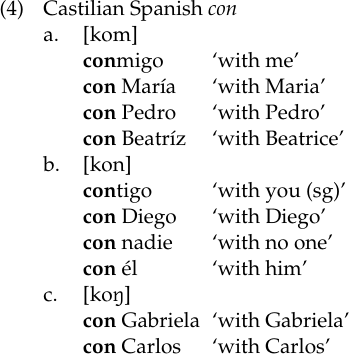
Assimilation like that seen with Spanish con is rampant in the world’s languages and thus a frequent source of allomorphy.
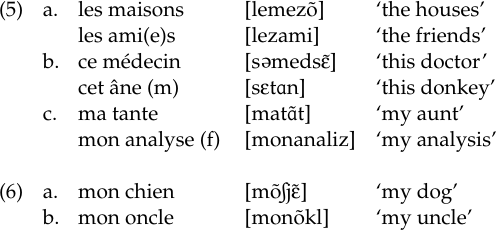
Epenthesis is another common source of allomorphy. Frequently languages epenthesize consonants in contexts where a final vowel in one word would otherwise come up against an initial vowel in the following word, particularly when the two have a strong syntactic bond. We call this unwanted vowel–vowel contact hiatus. French is a language that doesn’t tolerate hiatus well, and it has various ways of eliminating it in certain syntactic contexts. The plural article les [le] ‘the’ is pronounced [lez] when it is followed by a vowel-initial word (5a); the masculine demonstrative ce [sə] becomes cet [sεt], which happens to be homophonous with the feminine demonstrative cette (5b); and the feminine genitive adjectives ma [ma], ta [ta], and sa [sa] are replaced by mon [mon], ton [ton], and son [son] (5c). The last three forms are identical in spelling to the masculine genitive adjectives mon, ton, son. Before a consonant, the vowel of the masculine genitive singular pronouns is nasalized and the final /n/ is not pronounced. It is only pronounced before vowel-initial words – another hiatus context (6).
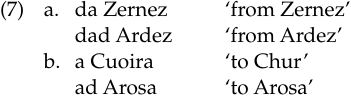
In the Vallader dialect of Rumantsch, the prepositions da ‘from’ and a ‘to’ become dad and ad respectively before words beginning with a vowel:
An instructive case is that of Spanish, as shown by the following set of data. We have put stressed syllables in boldface type:
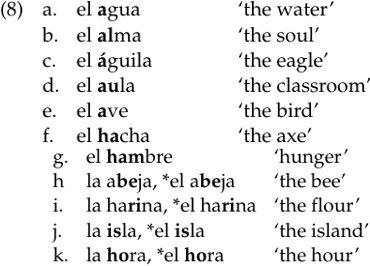
All of the Spanish nouns above are feminine, which may surprise you if you know already that el is the masculine definite article, and la is the feminine. In Spanish, la must be replaced by el before a feminine noun that begins with a stressed [a] (8a–g). This does not occur before any other vowel sound, as shown by the last two examples (8j, k). We include (8h) and (8i) because both abeja and harina begin with [a] but are stressed on the penultimate (second-to-last) syllable. This exempts them from the la → el rule.
We see that the Spanish anti-hiatus rule has a limited application. It applies only at the juncture between the feminine definite article and a stressed [a]. What’s more, it has at least two lexical exceptions: it does not apply in the case of la a ‘the a’ or la hache ‘the h’ (letters of the alpha bet).1 As morphologists, we are used to dealing with cases like this. Unlike syntax, which tends to be very regular, morphology is full of irregularities and exceptions.
1 A reader has pointed out that the exceptions of la a ‘the a’ and la hache ‘the h’ are reduced from la letra a ‘the letter a’ and la letra hache ‘the letter h’. Additionally, names of letters are often linguistically exceptional. In Ancient Greek, for example, although letter names are nouns, they do not take any inflectional endings.








