Primary and Secondary Affixes
Over the years, our knowledge of morphological structure has been enhanced by work in phonology. We learn a lot by observing the phonological processes that take place or do not take place within particular sets of morphologically complex words.
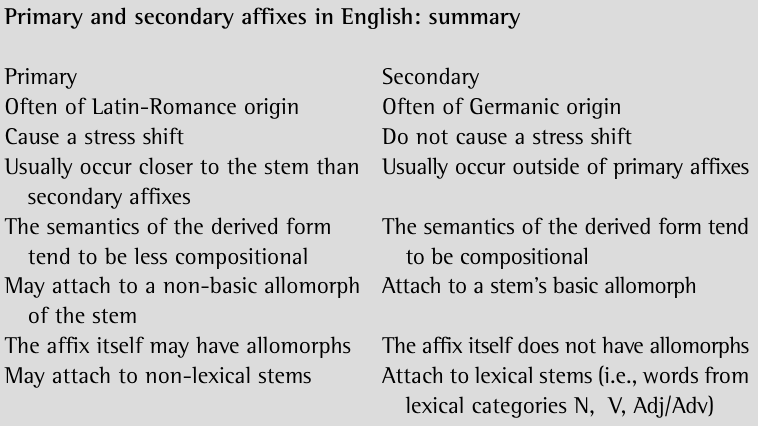
One distinction that has come out of work that pairs morphology and phonology is between primary and secondary affixes, also known as level 1 and level 2 affixes or class 1 and class 2 affixes. In English, this distinction is intimately connected with language history. Primary affixes in English are often of Latin-Romance origin, while secondary affixes are often of native Germanic origin. (English is a Germanic language.) However, we de-emphasize this fact in the following discussion because etymology can only take us so far in morphological analysis. The primary–secondary distinction is a living process, regardless of its history, and in English, as in other languages of the world, it cannot be explained away as etymological residue.
Below are some examples from Kiparsky (1983) of words bearing -(i) an, a primary affix (11), and ones bearing -ism, a secondary affix (12):
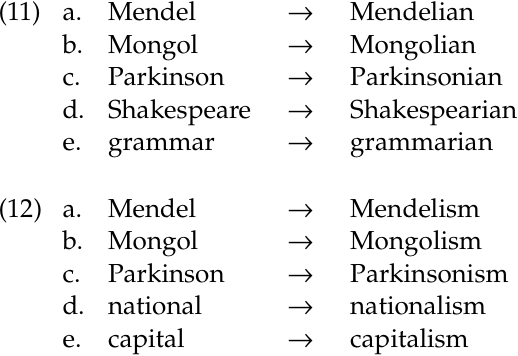
If you read the words in (11) and (12) to yourself, you hear an important difference. Words with -(i)an have a stress shift. The stress in Mendel is on the first syllable, while in Mendelian, it is on the second. Likewise, Parkinson is stressed on the first syllable, but Parkinsonian is stressed on the third. We can generalize by saying that in all words with -(i)an, stress is on the syllable that immediately precedes the suffix. Stems suffixed with -ism, on the other hand, are stressed on the same syllable as their unaffixed counterparts. Nationalism is stressed on the first syllable, just like national. This is the first and most famous difference between primary and secondary affixes in English. Primary affixes cause a stress shift, while secondary affixes do not.
If primary and secondary affixes both occur in the same word, we can make a second prediction. The primary affix will occur closer to the stem than the secondary affix. Therefore, Parkinsonianism is a possible word, but *Parkinsonismian is not.
Now consider the words reparable and repairable. Both have repair as their stem, but it is slightly disguised in the first. Semantically, both mean ‘capable of being repaired’, but only the second would be used to describe a broken appliance. Reparable has the additional sense of ‘liable to be paid back or recovered’ as with reparable damages. These words show that the suffix -able in English is actually two suffixes. One is primary, as in reparable, and the other is secondary, as in repairable. Traditional usage among morphologists is to use the symbol ‘+’ to mark the juncture between a stem and a primary affix and to use ‘#’ to mark the juncture between a stem and a secondary affix. We use these symbols to differentiate between the two types of -able here.
Other word pairs that show the opposition between +able and #able are prefer+able [prε̒f(ə)rəbl̩] vs. prefer#able [prəfə̒rəbl̩] and compar+able [kɑ̒mp(ə)rəbl̩] vs. compar#able [kɑmpæ̒rəbl̩]. Phonologically, the stem in the first is stressed differently in combination with +able than it is in isolation: compare the pronunciation of prefer+able and prefer. This is typical of primary affixes. In addition, the semantics of the forms containing the primary affix +able are less direct, or less compositional, than the semantics of the forms containing the secondary affix #able. If two models are not cómparable (contains the primary affix +able), they are unlike. If they are not compárable (contains the secondary affix #able), it is not possible, in a literal sense, to compare them. The semantics of forms containing the secondary affix #able are so predictable that they are often not even listed in dictionaries.
Looking at other +able vs. #able pairs, we discover other phonological characteristics of primary affixation. Consider the following words:
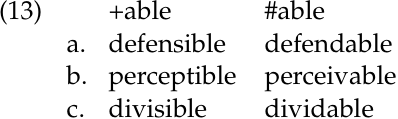
Forms with +able in (13) exhibit allomorphy in the stem. They use a form that is recognizable from nouns, namely defense, perception, and division, instead of the citation form of the lexeme: defend, perceive, and divide. The fact that +able can be spelled +ible is unimportant here. Further examples of stem allomorphs occurring with the primary affix +able are given in the leftmost column of (14):
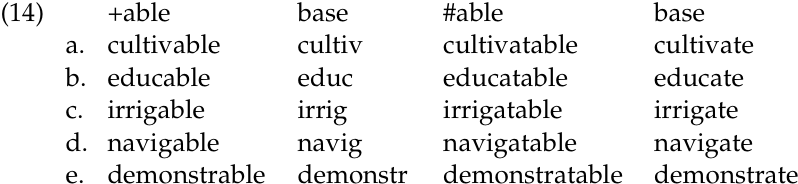
The second pair of columns in (14) show that the secondary affix #able differs from +able in attaching to the citation form of the lexeme: CULTIVATE, EDUCATE, IRRIGATE, NAVIGATE, and DEMONSTRATE.
Another difference between primary +able and secondary #able is that in words of the form X#able, X must be a transitive verb. In (14), cultivate, educate, irrigate, navigate, and demonstrate are all transitive. +able, on the other hand, is sometimes found on stems that are not transitive verbs, such as poss- (from Latin posse ‘to be able’), as in possible, or ris- (from Latin ridēre ‘to laugh’), as in risible.
We have said that we would de-emphasize etymology in our discussion of primary and secondary affixes, but here it becomes important. Many words with primary affixes – including possible and risible – were borrowed directly into English from French or Latin. They are fossilized; speakers have learned to use them, not created them on their own. However, even such fossilized examples as possible and risible are significant, because they illustrate another point: speakers are able to iso late both primary and secondary affixes when presented with words that contain them. Possible may be stored in the lexicon as a whole, but it is nevertheless analyzable. A person, such as a child or a second language learner, encountering possible for the first time will recognize it as an adjective because it ends in -ible.
In talking about the distinction between primary and secondary affixes, we have focused on suffixes. Prefixes can be primary or secondary as well. An example of a primary prefix is in+, and an example of a secondary one is un#. Both mean ‘not’. Phonologically, in+ has allomorphs. It surfaces as ir-, im-, in-, and il- in words like irreplacable, immortal, inoperable, and illegal. Un# does not have any allomorphs. Un- is of Germanic origin, with cognates in earlier stages of English, in contrast to in-, which came to English from Latin, through French.
In+, like +able, attaches to allomorphic stems:
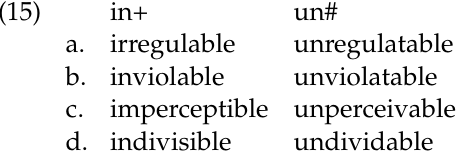
The stems it attaches to are stressed differently than the lexical stem of the corresponding lexeme:

In+ may attach to non-lexical stems, while un# does not. (In+ attaches to lexical stems as well, for example, impalpable, impossible.)

Compare well-formed words prefixed with un# such as ungodly, unhinge, unlike, unsteady. Godly, hinge, like, and steady are all lexical stems. An exception to this general observation is unkempt. There is no lexical stem kempt. But as usual, this morphological fact about English finds an explanation when we look to the history of the word. Kempt is the past participle of Old English cemban ‘to comb’.
Un# is also more productive than in+. You can test this claim yourself by thinking of some adjectives that do not usually have an in+ or un# prefixed form. Which sounds better, inferocious or unferocious? inwet or unwet? indead or undead?
If you are observant, you have noticed a final and very important difference between in+ and un#. The former has a special relationship with +able, and the latter with #able. Words with +able are prefixed with in+ and not un#, while words with #able are prefixed with un#.
We have included our discussion of primary and secondary affixes that deals with the interaction between phonology and morphology because that is the context in which this distinction has most often been treated and because it led to important work in phonology. Our objective was not to give a comprehensive account of the topic, but rather an overview, and thus we have left many issues untouched. Under the heading “lexical phonology,” phonologists have used the distinction between the two types of affixes to explore the possibility that different phonological rules apply at different levels of a morphological derivation (for a detailed overview, see Kenstowicz 1994). But as we have seen, primary and secondary affixes have semantic consequences as well. In particular, the semantics of primary affixes is less likely to be fully compositional.