Morphophonology and Secret Languages
We now turn to two secret languages that are permutations of existing languages. Secret languages are found around the world and have been attested in English, French, Spanish, Dutch, Thai, Cuna (Sherzer 1970), and Haitian Creole, to name only a few. They can be seen as examples of creative language use, and thus they should be considered external to the mental grammar. What, then, is the place of these languages in a book on morphology? In the examples that we present, speakers go from the existing language to the secret language through the regular application of phonological rules in what might be considered a morphological derivation. Secret languages also exploit notions that are independently motivated in phonology and morphology, notably the syllable and onset.
One secret language you may already be familiar with is Pig Latin. In one variation, words that start with vowels are suffixed with way [wej]. Words that begin with a consonant or consonant cluster shift the entire onset sequence to the end and are suffixed with ay [ej]:
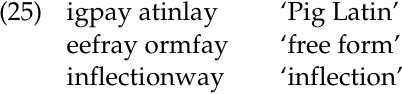
When speakers manipulate words in this fashion, they make use of their subconscious knowledge of linguistic entities such as onset and nucleus. Language games are therefore an instructive union of phonology and morphology.
Another secret language is verlan [vεʁlɑ̃], which is based on French. The word verlan is derived by reversing the syllables of l’envers [lɑ̃vεʁ] ‘the other way around’. Verlan works best with words of two syllables, because in these the two syllables can simply be reversed:
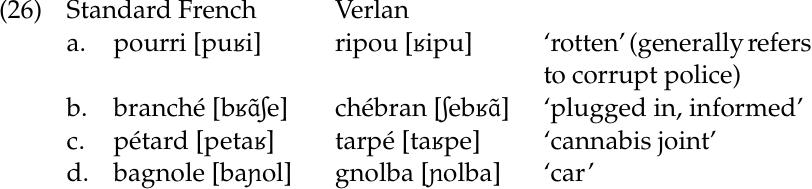
Monosyllables are verlanized differently depending on whether they are open or closed. In open monosyllables, such as pue [py] ‘stinks’, the order of consonant and vowel is reversed, yielding forms like [yp]. Closed monosyllables, such as femme [fam] ‘woman’, are treated as if they end in a schwa (Bullock 1996: 185) and therefore as if they are underlyingly bisyllabic. The syllables are reversed, and the final vowel is dropped: [famə] → [fa.mə] → [mə.fa] → [mœf]. Note that the schwa is realized as [œ]; this is because schwa cannot be in stressed position in French. Trisyllabic words are put into verlan by changing the order of the syllables, but there are no fixed rules on how. For simplicity’s sake, we do not deal with trisyllabic words here.
For Bullock (1996), the interesting question is how the phonology of secret languages like verlan compares to the phonology of the language they are based on. We see that verlan respects the basic syllable structure of French. French speakers who use verlan are aware on some level of prosodic entities such as onset, nucleus, coda, and syllable. (The same can be said of English speakers who use Pig Latin.) Nonetheless, Bullock and other researchers who have looked at French secret languages note that the phonology of verlan is not the same as that of the standard language. We see in (26d) that [ɲ] is a licit onset in verlan. It is not in standard French. Furthermore, in verlan, only the liquids [l] and [ʁ] are permitted in the codas of polysyllabic words. Bullock presents the example of bifton ‘cash, banknotes’, syllabified in standard French as bif.ton. In verlan, it would become fton. bi [ftõ.bi], because [f] cannot form the coda of a polysyllabic word. This example deviates from standard French phonology in another way: [ft] is not a possible onset in French. Finally, it is significant that we formulated the constraint on codas by referring to “polysyllabic words.” In verlan monosyllables, consonants other than [l] and [ʁ] are welcome in word codas:

In natural languages we would not expect to find a coda constraint that holds in polysyllabic words but not monosyllables. It is intimately related to the fact that no verlan speaker is monolingual, and there are no native speakers of verlan. All of verlan is based on standard French, and speakers of verlan invariably speak French, if not natively, then under more natural conditions. According to Bullock, the ‘rules’ of verlan are artificial compared to those of the standard – and natural – language.
Returning to Pig Latin, in the version presented here, words that start with a consonant cluster postpose the entire cluster, then add the suffix -ay. But another version of the secret language postposes only the first letter (e.g., losetcay for closet). Any rule that operates on letters rather than on phonological entities such as onsets is unnatural. Languages are first and foremost oral, and orthographies are systems imposed on them by people. Because of characteristics like these, secret languages must be looked upon as somewhat artificial and should not on their own be used to draw conclusions about the workings of natural languages.








