Affixation
The next type of derivational process we consider here is affixation. We have already looked at a number of affixes, so we focus on a few particular affixes, the types of stems they attach to, and the words they produce. We also build on the discussion of primary and secondary affixes by exploring other restrictions on combinations of affixes.
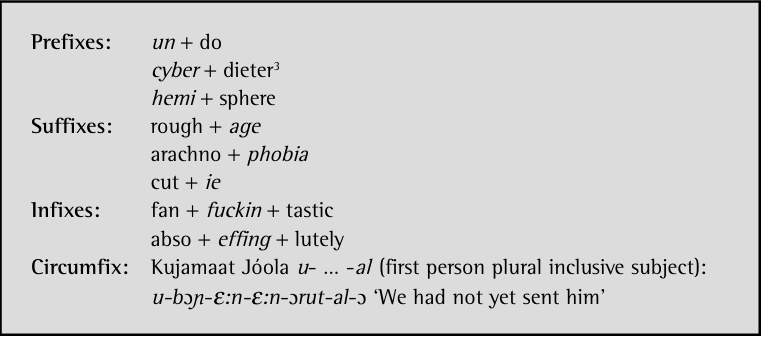
Recall from Morphemes that affixation may involve prefixes, suffixes, infixes, and perhaps circumfixes. Since our primary focus is on English, we deal only with the first two types, although as you can see in the following box, English does have a productive infixing process that incorporates swearwords.
We can characterize the stem an affix attaches to as bound or free and as belonging to a particular lexical category. Take the following words formed via prefixation with re-:

Re- attaches to stems belonging to the lexical category Verb. It produces words that are also verbs. All of the stems to which it attaches in the preceding examples are free. Ignite, boot, read, analyze, certify, and build may all stand alone; they do not need to bear a prefix or suffix. The same cannot be said for all stems that seem to bear the prefix re-, based on their meaning. The following words are all formed with re-, which imparts a sense of repetition or doing again. Yet the stems are unable to stand on their own. They are bound.
(12) a. repeat
b. resuscitate
c. recognize
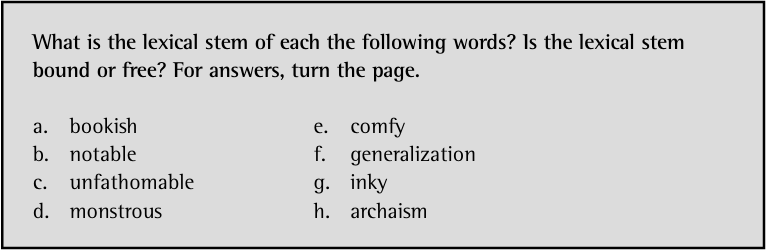
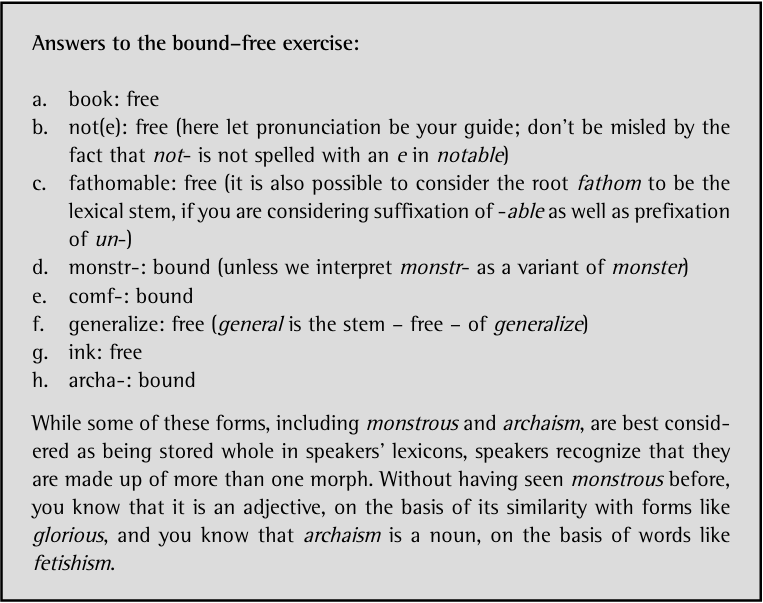
Sometimes an affix may attach to stems of more than one category. One such affix is -ish. It may attach to nouns, as in prudish, bookish, girlish, or childish, adjectives, as in oldish or smallish, or verbs, as in ticklish. In each case, the resulting form is an adjective.
So far we have mentioned stem type (bound vs. free) and lexical category as two factors that can constrain affixation. Another type of restriction we find is on the combination of affixes. Aronoff and Fuhrhop (2002) observe that many English speakers cannot say *dressingless, though both -ing and -less are secondary suffixes, and the word has a logical meaning: *a dressingless salad. The perceived ungrammaticality of dressingless by those speakers can be related to the fact that the combination *-ingless in English is vanishingly rare (a notable exception is meaningless).
In German, Aronoff and Fuhrhop observe another type of restriction on affixation. The following examples show how affixation can be recursive. In (13a) we have a verbal stem ‘teach’, which can be made into a noun with the addition of -er. This noun, in turn, can be made into an adjective, which can then be turned into a complex noun, Lehrerhaftigkeit ‘teacherlikeness’.
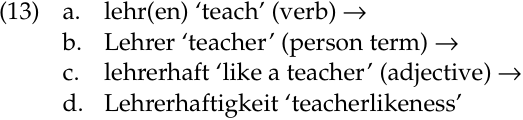
Significantly, Lehrerhaftigkeit cannot undergo further derivational affixation. In fact, no noun in -igkeit can. Aronoff and Fuhrhop call it a closing suffix. The existence of closing suffixes in German means that affixation in that language can never be as recursive as German compounding, which can go on and on, just like in English. (Recall the word high voltage electricity grid systems supervisor from earlier.)4
3 We came across the word cyberdieter in the December 19, 2002, edition of The Economist. It was used to refer to the customers of an online dieting firm.
4 Most speakers of English believe that German has more complex compounds than English does, but this is an illusion, rooted in the typographical fact that the component words of German compounds are generally written together, while English compounds are usually separated by spaces. Structurally, compounds in the two languages are almost identical.








