The Polysemy Problem
The most fundamental aspect of a word’s meaning is that it refers to some entity or relation (real or imaginary) in the world. We can refer to this entity or relation as the word’s semantic type. The word reptile refers to all individuals in the world that are reptiles. Verbs like respect or love refer to relationships between individuals. Formal approaches to grammar have provided us with terminology that allows us to make even more fine-tuned distinctions between words. We can differentiate bear from teddy bear by saying that the first is animate but the second is not, or foliage from leaf and literature from book on the basis of the mass/count distinction. Verbs are given labels such as ergative, unaccusative, transitive, or intransitive. (For a more detailed discussion, see Pustejovsky 1995: 8 ff.)
The main problem of lexical semantics is that the meanings of individual lexemes are highly diverse. We call this the problem of polysemy. As an example, take the verb lose. Lose has different meanings in the following sentences: They lost their passports; Jake lost his job; Sarah lost her husband to cancer; I lost my temper; We both lost ten pounds. But all of the meanings of lose reflected here are related – they are all instances of the same lexeme. Because lose has more than one related meaning, we say that it is polysemous.
There are many types of polysemy. In the next several examples, we present some general types of polysemy, focusing on nouns. While some nouns are inherently mass or count nouns, others can be either, as with watermelon:
(1) a. I love watermelon. (mass)
b. I sold three watermelons. (count)
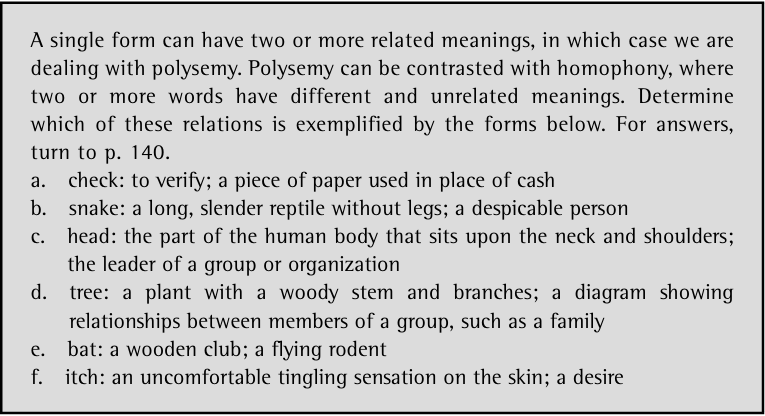
Besides the mass/count alternation, there are several other well-known alternations we find in noun meaning. A few are illustrated below:
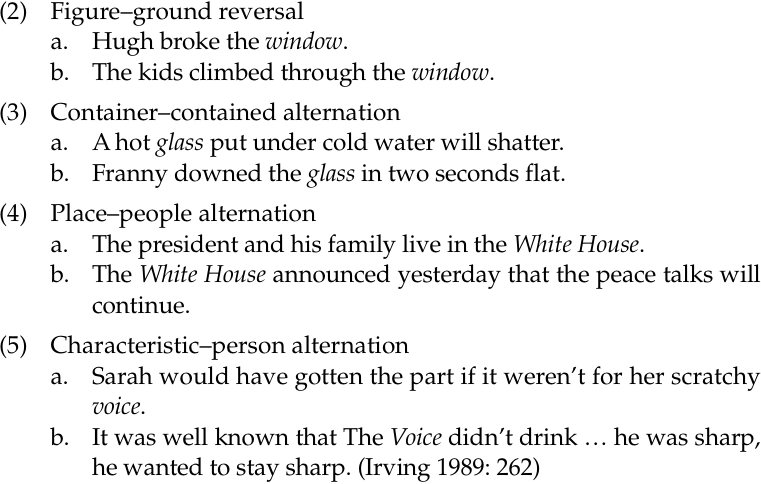
The sentences in (2–5) contain pairs of words with very different – even contradictory – interpretations. Yet they represent single lexemes. In (2a) window refers to a solid barrier, but in (2b) an aperture; glass (3a–b) can refer to the container or to the liquid inside. Examples like these show that the same phonetic string can convey different, but related meanings depending on the linguistic and pragmatic context. (As seen in Lexemes a given phonetic string may also convey unrelated meanings, in which case we are dealing with homophones.)








