The semantics of affixation
Let’s take the English suffix -ism. This affix has some very highly lexicalized meanings, one of which is ‘doctrinal system of principles’. We find this meaning in words like the following, and many others having to do with religion, philosophy, science, politics, or the arts:

The suffix -ism has an even more specific and lexicalized meaning: ‘a peculiarity of speech’. We talk about colloquialisms, spoonerisms, and Obamaisms (Obamaism can either be a system of beliefs or a peculiarity of speech). So -ism is an example of a suffix with two very highly lexicalized meanings, both of which might be considered to be more characteristic of words than of affixes.
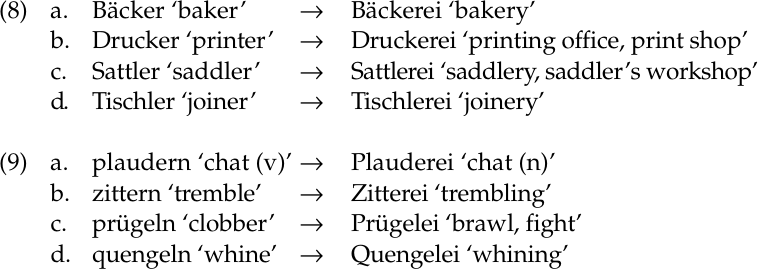
The German suffix -ei is like -ism in having at least two very highly lexicalized meanings. The first, illustrated by the words in (8), attaches to a noun and makes another noun meaning ‘the place in which X works’. The second, seen in (9), attaches to a verb stem and creates a noun referring to the ‘act of doing X’:
English has a cognate suffix of French origin, -(e)ry, as in bakery, tannery, winery; bribery, flattery, foolery.








