Derivation and Verbs in Kujamaat Jóola
Kujamaat Jóola, like many languages, exploits derivation and inflection to express a wide range of syntactic and semantic categories. What we would express in English as a sentence is often encompassed by a single Kujamaat Jóola verb, as in (1):

The core of (1) is a lexical root – bɔɲ ‘send’ – which provides the basic meaning of the verb. The rest of the meaning is conveyed by affixes on either side of the root. The first person plural inclusive subject is expressed by the circumfix u- … -al; the emphatic dubitive- incompletive by repetition of the dubitive-incompletive suffix - ε:n; the meaning ‘not yet’ by ɔrut; and the third person singular object by - ɔ. With the exception of the circumfixal subject marker, the relationship between meaning and form is one to one: the meaning of the word as a whole is the sum of its parts. Linguists refer to this type of morphology as agglutinative.
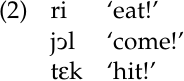
One characteristic of agglutinative morphology, identified by Horne (1966), is that affixation is not obligatory. We see this in Kujamaat Jóola in that a bare root is used for the positive imperative:
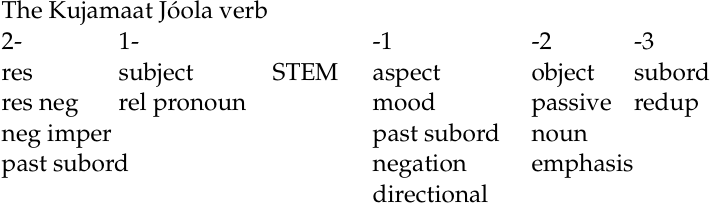
The order of morphemes in any language is typically fairly rigid, and Kujamaat Jóola is no exception. The following diagram schematizes the basic structure of the verb. At its core is the lexical stem, which may be simple or derived. The stem is followed by what Sapir refers to as position 1 suffixes, including aspectual, modal, and negative markers, as well as a derivational directional suffix and the second members of the past subordinate and first person plural inclusive circumfixes. Position 1 suffixes are followed by the position 2 suffixes: the passive marker, object pronominals (direct, indirect, or both), and noun emphasis marker. Finally, the third position is filled by verb reduplication and the simple subordinate marker. Immediately preceding the verb stem are the subject markers and relative pronouns (position 1 prefixes); the left-most position (position 2) is filled by the resultative, the resultative negative, the negative imperative, and the past subordinate markers. Many of these terms are probably new to you.