0
EN
1
المرجع الالكتروني للمعلوماتية

Grammar

Tenses

Present

Present Simple

Present Continuous

Present Perfect

Present Perfect Continuous

Past

Past Simple

Past Continuous

Past Perfect

Past Perfect Continuous

Future

Future Simple

Future Continuous

Future Perfect

Future Perfect Continuous

Parts Of Speech

Nouns

Countable and uncountable nouns

Verbal nouns

Singular and Plural nouns

Proper nouns

Nouns gender

Nouns definition

Concrete nouns

Abstract nouns

Common nouns

Collective nouns

Definition Of Nouns

Animate and Inanimate nouns

Nouns

Verbs

Stative and dynamic verbs

Finite and nonfinite verbs

To be verbs

Transitive and intransitive verbs

Auxiliary verbs

Modal verbs

Regular and irregular verbs

Action verbs

Verbs

Adverbs

Relative adverbs

Interrogative adverbs

Adverbs of time

Adverbs of place

Adverbs of reason

Adverbs of quantity

Adverbs of manner

Adverbs of frequency

Adverbs of affirmation

Adverbs

Adjectives

Quantitative adjective

Proper adjective

Possessive adjective

Numeral adjective

Interrogative adjective

Distributive adjective

Descriptive adjective

Demonstrative adjective

Pronouns

Subject pronoun

Relative pronoun

Reflexive pronoun

Reciprocal pronoun

Possessive pronoun

Personal pronoun

Interrogative pronoun

Indefinite pronoun

Emphatic pronoun

Distributive pronoun

Demonstrative pronoun

Pronouns

Pre Position

Preposition by function

Time preposition

Reason preposition

Possession preposition

Place preposition

Phrases preposition

Origin preposition

Measure preposition

Direction preposition

Contrast preposition

Agent preposition

Preposition by construction

Simple preposition

Phrase preposition

Double preposition

Compound preposition

prepositions

Conjunctions

Subordinating conjunction

Correlative conjunction

Coordinating conjunction

Conjunctive adverbs

conjunctions

Interjections

Express calling interjection

Phrases

Sentences

Clauses

Part of Speech

Grammar Rules

Passive and Active

Preference

Requests and offers

wishes

Be used to

Some and any

Could have done

Describing people

Giving advices

Possession

Comparative and superlative

Giving Reason

Making Suggestions

Apologizing

Forming questions

Since and for

Directions

Obligation

Adverbials

invitation

Articles

Imaginary condition

Zero conditional

First conditional

Second conditional

Third conditional

Reported speech

Demonstratives

Determiners

Direct and Indirect speech

Linguistics

Phonetics

Phonology

Linguistics fields

Syntax

Morphology

Semantics

pragmatics

History

Writing

Grammar

Phonetics and Phonology

Semiotics

Reading Comprehension

Elementary

Intermediate

Advanced

Teaching Methods

Teaching Strategies

Assessment

قم بتسجيل الدخول اولاً لكي يتسنى لك الاعجاب والتعليق.

The stem

المؤلف:  Mark Aronoff and Kirsten Fudeman

المصدر:  What is Morphology

الجزء والصفحة:  P149-C5

2026-04-11

269

+

-

20

The stem

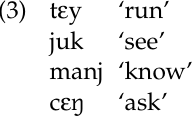
Some examples of Kujamaat Jóola roots are given below:
 

Inflectional affixes may attach to a root, or the root can be extended by the addition of derivational affixes. The root plus derivational affixes is called a stem. You have already encountered one verbal derivation suffix, -u ‘from’. Five more are listed below, with examples:
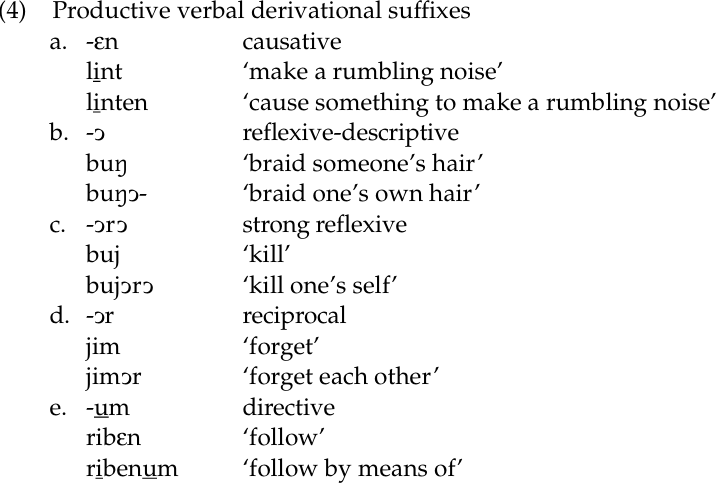
 

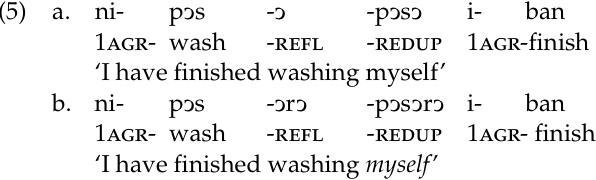
We see in (4c) that the root buj ‘kill’ can be suffixed with the strong reflexive to form bujɔrɔ ‘kill one’s self’. If a speaker were to add the reflexive-descriptive suffix (4b) instead, the result is a verb with more idiosyncratic semantics, bujɔ ‘be wounded’. The difference between affixation of the reflexive and strong reflexive is not always so striking, however, as we see in (5):
 

The sometimes idiosyncratic meaning of verbs bearing the reflexive suffix reflects a major point, that the meanings of morphologically complex words are not always fully predictable from those of their parts. Through use in context, morphologically complex words may acquire lexicalized meanings and need to be listed in the lexicon. This must be true of bujɔ ‘be wounded’.


Evidence that both roots and the roots plus derivational affixes count as stems in Kujamaat Jóola verb morphology comes from the following observations:
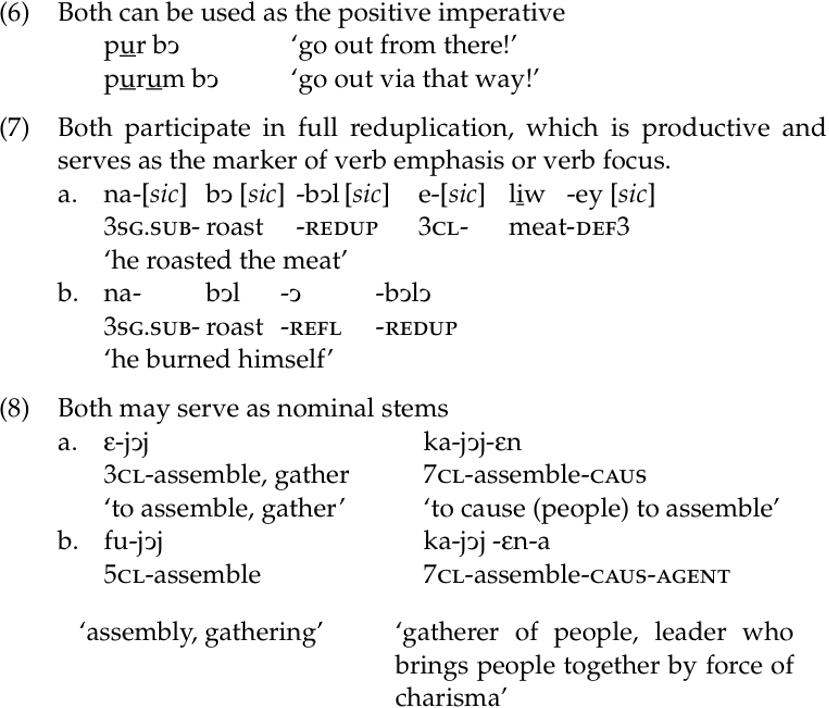
 

The stem in Bantu languages (also in the Niger-Congo family) may also consist of a root plus derivational suffixes (Hyman 1993; Mchombo 1993). For example, Mchombo shows that the Chichewa verb stem plus derivational affixes functions as a unit in that it may be nominalized (but units larger than the verb stem may not), undergo reduplication, and be used as the bare imperative. Chichewa is similar to Kujamaat Jóola in these respects. In addition, the Chichewa verb stem serves as the domain for a phonological process, tense–lax vowel harmony.


اخر الاخبار

اشترك بقناتنا على التلجرام ليصلك كل ما هو جديد

