0
EN
1
المرجع الالكتروني للمعلوماتية

Grammar

Tenses

Present

Present Simple

Present Continuous

Present Perfect

Present Perfect Continuous

Past

Past Simple

Past Continuous

Past Perfect

Past Perfect Continuous

Future

Future Simple

Future Continuous

Future Perfect

Future Perfect Continuous

Parts Of Speech

Nouns

Countable and uncountable nouns

Verbal nouns

Singular and Plural nouns

Proper nouns

Nouns gender

Nouns definition

Concrete nouns

Abstract nouns

Common nouns

Collective nouns

Definition Of Nouns

Animate and Inanimate nouns

Nouns

Verbs

Stative and dynamic verbs

Finite and nonfinite verbs

To be verbs

Transitive and intransitive verbs

Auxiliary verbs

Modal verbs

Regular and irregular verbs

Action verbs

Verbs

Adverbs

Relative adverbs

Interrogative adverbs

Adverbs of time

Adverbs of place

Adverbs of reason

Adverbs of quantity

Adverbs of manner

Adverbs of frequency

Adverbs of affirmation

Adverbs

Adjectives

Quantitative adjective

Proper adjective

Possessive adjective

Numeral adjective

Interrogative adjective

Distributive adjective

Descriptive adjective

Demonstrative adjective

Pronouns

Subject pronoun

Relative pronoun

Reflexive pronoun

Reciprocal pronoun

Possessive pronoun

Personal pronoun

Interrogative pronoun

Indefinite pronoun

Emphatic pronoun

Distributive pronoun

Demonstrative pronoun

Pronouns

Pre Position

Preposition by function

Time preposition

Reason preposition

Possession preposition

Place preposition

Phrases preposition

Origin preposition

Measure preposition

Direction preposition

Contrast preposition

Agent preposition

Preposition by construction

Simple preposition

Phrase preposition

Double preposition

Compound preposition

prepositions

Conjunctions

Subordinating conjunction

Correlative conjunction

Coordinating conjunction

Conjunctive adverbs

conjunctions

Interjections

Express calling interjection

Phrases

Sentences

Clauses

Part of Speech

Grammar Rules

Passive and Active

Preference

Requests and offers

wishes

Be used to

Some and any

Could have done

Describing people

Giving advices

Possession

Comparative and superlative

Giving Reason

Making Suggestions

Apologizing

Forming questions

Since and for

Directions

Obligation

Adverbials

invitation

Articles

Imaginary condition

Zero conditional

First conditional

Second conditional

Third conditional

Reported speech

Demonstratives

Determiners

Direct and Indirect speech

Linguistics

Phonetics

Phonology

Linguistics fields

Syntax

Morphology

Semantics

pragmatics

History

Writing

Grammar

Phonetics and Phonology

Semiotics

Reading Comprehension

Elementary

Intermediate

Advanced

Teaching Methods

Teaching Strategies

Assessment

قم بتسجيل الدخول اولاً لكي يتسنى لك الاعجاب والتعليق.

What is Inflection?

المؤلف:  Mark Aronoff and Kirsten Fudeman

المصدر:  What is Morphology

الجزء والصفحة:  P159-C6

2026-04-11

341

+

-

20

What is Inflection?

We encountered inflection in Inflection vs. Derivation, but here we explore it in more detail. The word itself comes from traditional Latin grammar. Its root flect-, which we see in the English word flex, means ‘bend’. (The British and German spelling, inflexion, is even closer to flex.) We give this etymology to evoke the image of a speaker “bending,” or, perhaps more clearly, altering the shape of a word so it will fit in a particular position within a sentence. Every sentence is a syntactic frame with positions for a series of words. In order to fill one of those positions, you take a lexeme from the lexicon and bend it to fit. In this way, inflectional morphology is determined by syntax.


What kinds of things do lexemes express through inflection? In general, we speak of inflection expressing morphosyntactic information, syntactic information that is expressed morphologically. This includes the abstract syntactic categories of tense, aspect, number, and case. Specific values for these categories, such as past, imperfective, plural, or genitive, are generally referred to as morphosyntactic features or morphosyntactic properties, the latter a term from Matthews (1991).
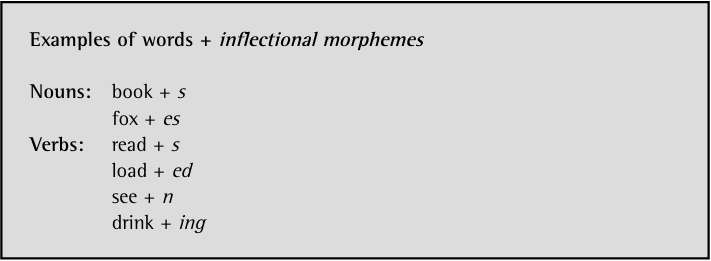


Inflection is the realization of morphosyntactic features through morphological means.


In order to fully understand inflection, we must situate it in the grammar. Since we are claiming that the syntax provides the morphology with morphosyntactic features, the job of the morphology must be to get from there to the actual phonological realization:

 

This diagram portrays the relationship between the syntax, morphology, and phonology as derivational, but it is equally possible to model a non-derivational, parallel relationship. Either way, a diagram like (1) is bound to be deceptively simple. We are still left asking precisely how words become inflected. We now turn to an exploration of the answers to that question.


اخر الاخبار

اشترك بقناتنا على التلجرام ليصلك كل ما هو جديد

