Government vs. concord
Once we talk about the difference between inherent and assigned, we can address the question of how inflection may be assigned, which is generally in one of two ways: government or concord. Another word for concord is agreement.
Concord or agreement occurs when one element in a sentence takes on the morphosyntactic features of another element. One familiar example of concord is noun–adjective agreement in the Romance languages or German. Adjectives take on the number and gender of the noun they modify.
Kujamaat Jóola nouns also trigger concord. The adjectives that modify them must be like them in gender or noun class. Similarly, verbs in Kujamaat Jóola reflect the noun class of their subject.
The other way in which a word can acquire a category is government. Government is more or less what it sounds like: one word dictates the form of another.1 Case assignment by verbs is usually thought of in this way. When a noun is required to appear in objective case, for example, it cannot be said that it agrees with (reflects the case of) the verb. This is because verbs don’t have case. The same holds for prepositions. Prepositions do not have case-marked forms, either, but in many languages they require that their object surface with a particular case, such as dative or accusative. This is attributed to government of the prepositional object by the preposition itself.
We cannot talk about morphosyntactic features themselves as being “government features” or “concord features.” It might seem, for instance, that case should be described as a “government feature” because nouns receive case under government by a verb or preposition. In (9), the noun object of the verb is in the accusative case because the verb sehen demands that its direct object be accusative:
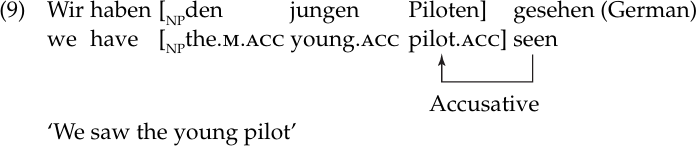
The problem is that the definite article den and the adjective jungen are usually thought to acquire this same case via concord with the noun. If this is true, then the mechanism of inflection is independent of inflectional features.2
1 The traditional notion of government gave rise to the Chomskian notion of government, used in certain theories of syntax, but the two are somewhat distinct.
2 An alternative is to say that the entire phrase receives accusative case under government and that the accusative case feature is distributed over all of its members.








