Differences between inflection and derivation
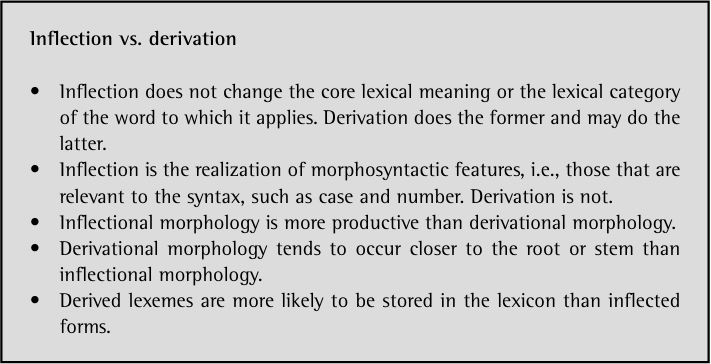
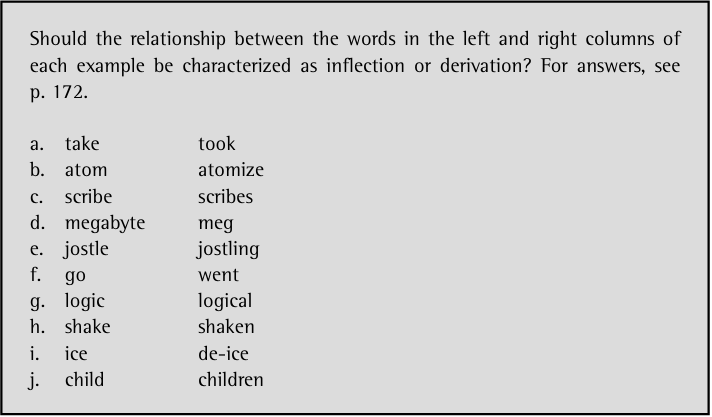
The first question we can ask about the distinction between inflection and derivation is whether there is any formal basis for distinguishing the two types of morphology. Can we tell them apart because they do different things to words?
One generalization is that inflectional morphology does not change the core lexical meaning or the lexical category of the word to which it applies. A noun with a plural suffix attached to it is still a noun; slurp means ‘eat or drink noisily’ whether it is past or present; and so on. Derivational morphology may or may not affect the lexical category of a word it applies to, and it typically changes its meaning. Glory is a noun, and glorious is an adjective. While their meanings are related, they cannot be said to mean the same thing in the way that slurp and slurps do.
A second generalization is that inflection, but not derivation, is determined by syntax. We discussed this at the beginning of What is Inflection?. Which form of a lexeme surfaces in a given position depends on its relationship with the words around it. Perhaps when you were younger, you tried mad libs like the following:

The person eliciting the words for the blanks in the Gettysburg address above automatically knows to put the first noun provided by his or her partner in the plural because “four score and seven” implies more than one (a score is a group of twenty, so “four score and seven” is eighty-seven). There is no need for the mad lib instructions to specify “plural noun.” Similarly, if a person eliciting words for a mad lib says, “Verb,” the reply will probably come in the citation form of the lexeme: READ, SLURP, LOVE, or KISS. But he or she will know whether it is necessary to add an -s, -ed, or -ing when inserting it into the blank, because it will be determined by context. The instructions do not need to specify “third person singular” or “present participle.”
A third generalization we can make is that inflectional morphology tends to be more productive than derivational morphology. Inflectional morphology can apply to words of a given category with relative freedom. Virtually any noun in English can be made plural with the addition of [z] or one of its two phonologically conditioned allomorphs. The only exceptions are nouns with irregular plurals, such as children or phenomena, and those that logically do not allow a plural form: mass nouns like rice and abstract nouns like intelligence generally fall into this category. On the other hand, not every adjective can take the derivational affix -ly that forms adverbs. We can say quickly, but not ?friendlily.
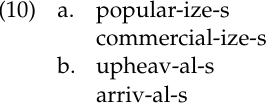
Another generalization that has been made is that derivational affixes tend to occur closer to the root or stem than inflectional affixes. For example, (10) shows that the English third person singular present inflectional suffix -s occurs outside of derivational suffixes like the deadjectival -ize, and the plural ending -s follows derivational affixes, including the deverbal -al:
Similarly, Japanese derivational suffixes like passive -rare or causative -sase precede inflectional suffixes marking tense and aspect:
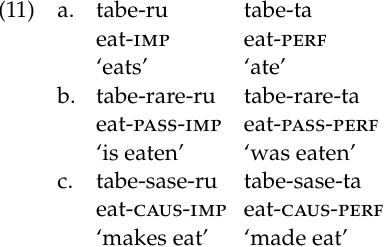
This generalization is largely true, but there are many exceptions in the world’s languages, so it is not a reliable diagnostic for distinguishing between inflection and derivation. (In Morphology and Phonology, we saw that the Kujamaat Jóola derivational suffix -u ‘from’ may follow inflectional suffixes.)
Finally, note that some linguists consider derived lexemes, but not inflected forms, to be present in the lexicon. This generalization is not absolute, since psycholinguistic studies have shown that speakers store at least some inflected words in their lexicons. Likewise, many derived forms are created on the fly, without ever being recorded in the lexicon.