Nominal modifiers
While Kujamaat Jóola has a variety of nominal modifiers, including demonstratives, numbers, and particularizers (Sapir 1965: 27–8), there is no well-defined category that corresponds to Indo-European adjectives. This is not unusual among the world’s languages. Throughout Africa, what might be considered canonical adjectives by speakers of Indo-European languages are rare (Welmers 1973). Instead, adjectival concepts like ‘small’, ‘beautiful’, or ‘angry’ are generally expressed by a verbal element. In Kujamaat Jóola, what at first glance appear to be adjectives are often formed with a verbal stem prefixed with a relativizer that agrees in noun class with the head noun:
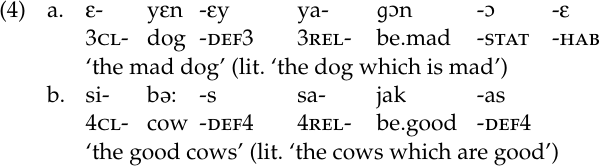
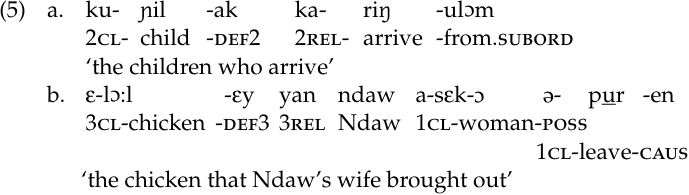
The relativizer takes the form Ca- when modifying a subject, and Can- when modifying an object. We see it again in the forms in (5), where the nature of the verb makes it more obvious that we are dealing with relative clauses. Note in (5b) that the object relativizer may stand on its own:
A second way to form what appear to be adjectives is to attach a prefix of the form (C)V- to what Sapir calls a “neutral theme” – that is, a stem that can be used as a noun, verb, adjective, or adverb depending on context. Again, the initial consonant of the prefix corresponds to the consonant of the noun class prefix. We see examples of neutral themes being used as adjectives in (6).
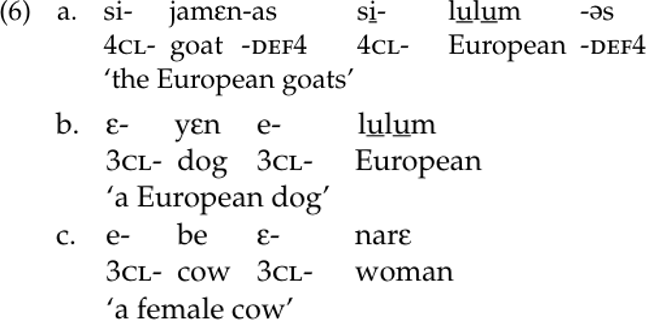
Prefixes of the form Ca- (7 ka-; 13 ba-; 14 fa-; 15 ma-) take the form Cu- in this construction, perhaps to avoid confusion with the relative pronoun presented immediately above.
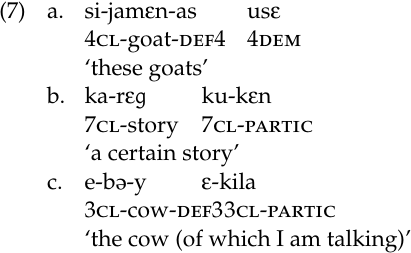
Demonstratives, which have the form uC(ε), and particularizers, which have the forms CV-kε(n) (indefinite) and CV-kila (definite), are illustrated in (7a–c). As we saw with neutral themes, prefixes of the form Ca- surface as Cu-:
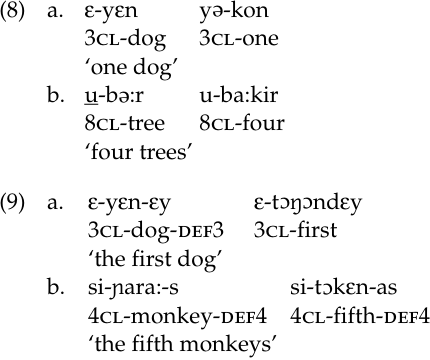
Cardinal numbers up to ‘four’ and ordinals up to ‘fifth’ also agree with a head noun (8–9):
Higher numbers do not agree with a head noun (examples from Sapir 1970):

In languages where numbers agree with a head noun, it is typical for agreement marking to be limited to the lower numbers. In many modern European languages, for example, only the word for ‘one’ agrees in gender with its head noun.









