Inflection and Universal Grammar
Universal Grammar is the theory developed by Noam Chomsky that states that all languages are identical at some level of analysis. It has had a tremendous influence on the field of linguistics, and most linguists agree with Chomsky that language has an innate component. A key phrase in the definition of Universal Grammar that we have provided is “at some level of analysis.” What is the level of analysis at which languages are identical? At which levels do languages differ? More specifically, are inflectional categories universal?
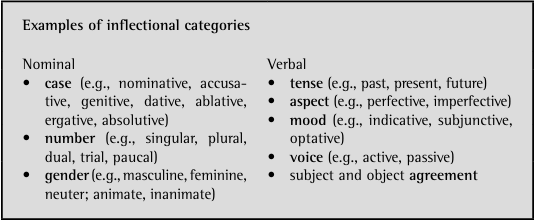
In one sense, inflectional categories are universal. We gave an overview of inflectional categories that crop up over and over again in the world’s languages. Yet it would be a mistake to say that the realizations of inflectional categories are stable cross-linguistically. To see what we mean, consider gender.
Gender is highly problematic from a universalist point of view. As we noted, the number of noun classes in the languages of the Atlantic family vary widely. Kujamaat Jóola has 19, but Gombe Fula has 25, Serer 16, Wolof 10, Manjaku 14, and Balanta seven. Some Atlantic languages have multiple dialects, and dialects do not necessarily share the same number of noun classes. When we look past Atlantic to other language families of the world, we find variation not only in the number of genders but also in the entire organization of the gender system. Despite differences between gender systems, however, some similarities do emerge.
German has three genders called masculine, feminine, and neuter. Examples of nouns belonging to each gender are given in (5):

Masculine, feminine, and neuter are obligatory inflectional categories of German. This means that every noun in the language, including borrowings like Parlament ‘parliament’, must belong to a gender. A noun cannot be genderless. Furthermore, gender is obligatory in that a noun cannot simply carry it around: its gender category must be expressed through agreement.
We can compare German to Ojibwa, an Algonquian language discussed by Corbett (1991: 20–2). Ojibwa has two genders, animate and inanimate (but note that some inanimate objects have grammatically animate forms):
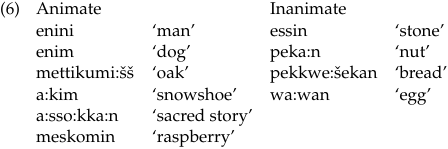
These function in the same way as the German genders in that they are obligatory and must be expressed.
How are the noun classification systems of German, Ojibwa, and Kujamaat Jóola related to one another? The obvious answer is that they are not related at all. For all of them gender is an obligatory inflectional category. Every noun must have a gender, and that gender must be expressed in the morphology. However, the gender categories themselves and the number of them are completely different.
If you look at many languages, you will discover that certain types of inflectional categories appear over and over again. For example, nouns are regularly inflected for case, number, and gender. Nouns in different languages do not necessarily inflect for the same cases – some languages will have two and others 20; nor do they inflect for the same genders. For verbs, the picture is similarly limited. Verbs might inflect for tense, aspect, mood, voice, or agreement, but you generally do not find languages where verbs inflect for other categories. Our brief overview of the German and Ojibwa gender systems, along with our more detailed treatment of the gender system of Kujamaat Jóola, should illustrate that although the inflectional categories themselves may not be universal, universal principles govern what is inflectionally possible and what is not.